
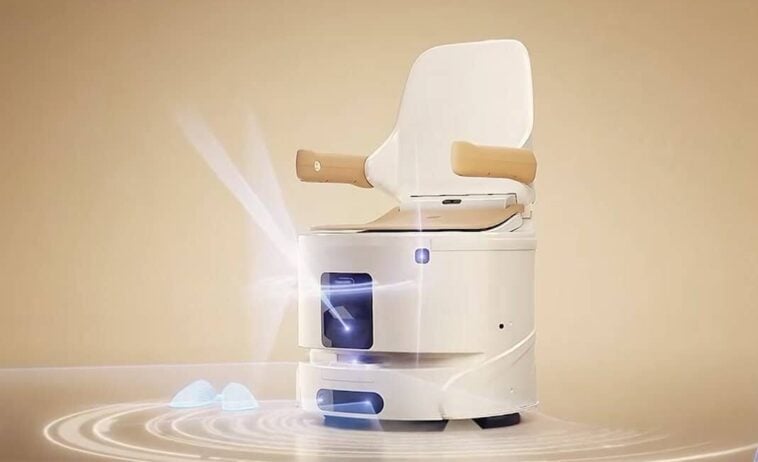
A Chinese company called Yueban recently unveiled a self-driving robotic toilet at the 2026 Shanghai International Aged Care Expo (held at the Shanghai New International Expo Centre) that travels wherever it’s needed.
Named the Xiaoban, the device is designed for people with mobility issues who find it difficult to reach a conventional washroom.
Xiaoban uses lidar and ultrasonic sensors to enable autonomous navigation in a home or care facility, the same sort of tech that powers higher-end robot vacuums. It can be summoned with a remote or voice command and is automatically able to avoid stairs and other obstacles in its way.
What happens after it arrives
Although users would still need assistance getting onto the toilet, the device handles most everything else.
A built-in bidet and warm-air dryer eliminate the need for paper while the bowl self-cleans after each use. Waste is sealed inside an enclosed receptacle where UV lights help control bacteria and odors.
After use, the robot heads back to its docking station to recharge and empty itself, draining directly into plumbing if it is available. Otherwise, the toilet rolls itself to a standard bathroom and uses an extending robotic arm to pump the waste into a conventional toilet for flushing.
In China, the Xiaoban is priced at around ¥28,999, which is roughly $4,300. Global availability, however, has not been announced.
The device is not intended to replace caregivers. It is designed to address some of the harder parts of the job, including getting someone to a bathroom and handling the cleanup. The Xiaoban is built to remove this from the equation. Essentially, the toilet does the walking so that the user doesn’t have to.
Elder care technology rarely gets attention, but a self-driving toilet might be the exception.
Sources: Baike Baidu, IT Home, Sohu, Xinhua News, The Verge