
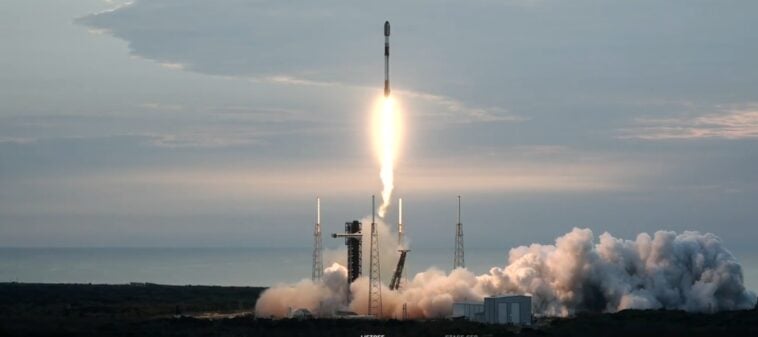
SpaceX launched a secretive new cargo-return system called Starfall earlier this week (June 23) and, true to form, has remained quiet about it. The vehicle’s purpose is to deliver cargo from orbit back to Earth.
A demonstration capsule lifted off from Cape Canaveral at around 6:53 a.m. local time on a Falcon 9 rocket. The booster landed on a droneship in the Atlantic while the capsule proceeded toward low Earth orbit.
Details of Starfall’s mission have been under wraps for months until FAA paperwork clarified the picture. A May assessment described the purpose plainly as the “transport and delivery of goods through space.”
SpaceX frames it more grandly as routine access to microgravity for research and in-space manufacturing of high-value materials like pharmaceutical compounds and semiconductor alloys, which can be produced with fewer defects when they’re free from the settling effects of Earth’s gravity (where heavy particles sink through liquids instead of mixing evenly).
The flying factory floor
Starfall is built purely for cargo. The squat, windowless black cylinder, often described as a flying saucer or hockey-puck-shaped disk, is short, wide, and measures roughly three meters across. It is less than a meter tall and has a payload capacity of up to a tonne.
After re-entry, it separates into two pieces: a top aluminum dish for the payload equipped with cold gas maneuvering thrusters and a carbon-fiber heat shield underneath. The heat shield, which houses the nitrogen gas for the thrusters, is jettisoned before the final parachute-assisted splashdown.
Beyond this, SpaceX has offered no further updates. Questions linger over how long the capsule would stay in orbit, and precisely when it would splash down into the Pacific roughly 1,300 kilometers off California.
A few smaller companies are pursuing the same goal. Varda Space Industries in the US seeks to manufacture pharmaceuticals in orbit and return them to Earth, while Space Forge, based in Wales, is focused on semiconductors and alloys. Both companies are counting on low gravity to yield cleaner materials.
What sets Starfall apart is scale. Varda has flown six containers, each roughly a meter wide, 300 kilograms in total, while Starfall is three times larger.
The military is in the picture, too. SpaceX already holds Pentagon contracts, and Starfall could support one of them. The Defense Department runs a program called Rocket Cargo that envisions using the larger Starship to deliver supplies anywhere on the planet within an hour, with Starfall potentially handling smaller missions. To spread its bets, the Pentagon has also contracted Blue Origin and Rocket Lab to study space-to-ground delivery systems.
Sources: FAA, SpaceX, Spaceflight Now, Varda, NewScientist, Space News