
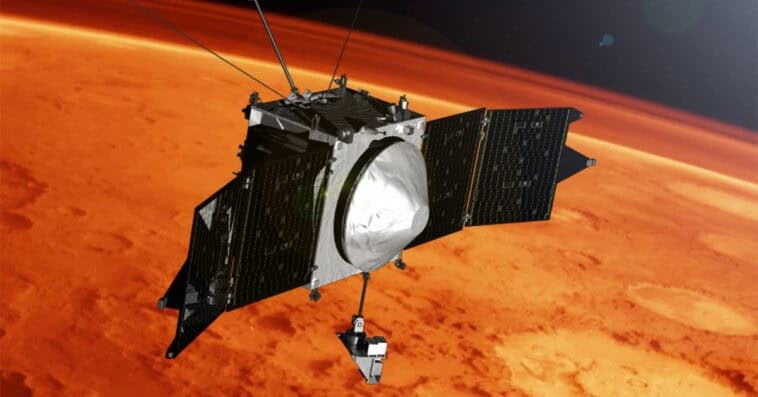
A routine pass behind Mars marked the end of an era for one of NASA’s most important space missions. After more than a decade orbiting the Red Planet and delivering groundbreaking insights into its atmosphere, the MAVEN spacecraft suddenly lost contact with Earth and never came back online. NASA has now officially declared the mission over, closing a remarkable chapter in Mars exploration. But what caused MAVEN’s sudden failure, and what lasting discoveries did it leave behind? Read on to learn how the orbiter’s final moments unfolded — and how the data it collected could help pave the way for the first humans to one day set foot on Mars.
What happened to MAVEN and why NASA can’t bring it back
After a nearly 12-year run — surviving a decade longer than its original one-year mission — NASA’s MAVEN (Mars Atmosphere and Volatile Evolution), spacecraft has officially gone dark. The probe, which was the first ever dedicated to studying the Martian atmosphere, fell silent on December 6 after slipping behind the far side of the Red Planet.
What went wrong?
Up until it passed behind Mars, all of MAVEN’s systems were running perfectly. But when it emerged on the other side, Earth received nothing but silence.
NASA engineers scrambled to catch a signal and managed to piece together a brief fragment of data. The grim diagnosis? The spacecraft had unexpectedly drifted off course and entered “safe mode,” sending it into an unusually fast, chaotic spin. Because it was tumbling out of control, MAVEN’s solar panels couldn’t catch the sun, completely draining its batteries and killing its communication systems.
A NASA review board has officially determined that MAVEN is unrecoverable.
The investigation isn’t over yet
While the rescue mission is over, the investigation isn’t. Scientists still don’t know what triggered the sudden, violent spin in the first place, and a final report is expected later this year. NASA has now begun the formal process of shutting down the mission and preserving MAVEN’s massive treasure trove of data so scientists can study it for decades to come.
How MAVEN rewrote Mars history
Originally built to last just a single Earth year after its November 2013 launch, MAVEN pushed through a full decade of extended operations. It became the first mission ever to dedicate itself entirely to investigating the Martian upper atmosphere and its complex relationship with the Sun.
By understanding how Mars loses its atmosphere to the vacuum of space, scientists finally gained an understanding of the planet’s climate history, its lost liquid water, and whether it could have once supported life.
The loss of the spacecraft hits hard for those who built and monitored it. Mike Moreau, the MAVEN project manager, praised the team and said they “really experienced the loss of a loved one with the end of the mission here.”
Principal investigator Shannon Curry agreed, but highlighted MAVEN’s many accomplishments. “The team was certainly broken up about this, but at the same time, we’re incredibly proud of the science we’ve accomplished over the last decade,” she said, calling MAVEN “the best observer of atmospheric escape anywhere in the solar system.” During NASA’s media call on Tuesday, Curry even went so far as to proudly crown the probe as the “Best. Mars. Mission. Ever.”
With more than 800 scientific publications generated during its lifetime, MAVEN completely transformed our view of the Red Planet. Here are its five most groundbreaking discoveries:
1. The Sun is stripping Mars naked
MAVEN proved that the solar wind — a relentless stream of charged particles shooting out from the Sun — acts like a cosmic sandblaster, continually stripping away Mars’ atmosphere. This erosion spikes dramatically during violent solar storms. Over billions of years, this devastating process transformed Mars from a warm, potentially water-rich world into the frozen, arid desert we see today.
2. Planet-wide ‘light shows’
On Earth, the glowing northern and southern lights (auroras) are mostly confined to our poles. MAVEN discovered that on Mars, things are wildly different. The probe detected entirely new kinds of auroras triggered by solar protons. Because of Mars’ unique magnetic environment, these breathtaking proton auroras can light up the night sky across the entire planet.
3. Cosmic cannonballs (atmospheric sputtering)
To figure out exactly how Mars lost its air, MAVEN tracked a rare noble gas called argon. Because argon rarely interacts with other elements, its presence at high altitudes gave scientists a front-row seat to a process called “atmospheric sputtering.”
Think of it like a cosmic game of billiards or doing a massive cannonball into a swimming pool: fast-moving solar particles crash into the Martian atmosphere at such extreme speeds that they literally splash gas molecules right out into space. MAVEN caught this happening in real time.
4. Dust storms choke out water
In 2018, a monstrous, planet-encircling dust storm completely enveloped Mars. MAVEN watched the catastrophe from above and discovered a terrifying planetary mechanism: the extreme heat from global dust storms lofted water molecules much higher into the atmosphere than normal. Once pushed into the upper atmosphere, that water is instantly destroyed and lost to space in a sudden, massive surge.
5. Interplanetary wi-fi and comet chasing
Beyond its atmosphere research, MAVEN was a versatile overachiever:
Comet Hunter: Just last year, the team quickly reprogrammed MAVEN to track Comet 3I/ATLAS. By snapping ultraviolet images through various wavelengths (like switching filters on a camera), it mapped the hydrogen shooting off the comet to help scientists decode its ancient history.
The Mars Data Relay: MAVEN served as a vital communication bridge between Earth and the rovers crawling on the Martian surface. In fact, it holds the solar system record for the most data relayed from another planet in a single day.
What comes next
Ultimately, MAVEN’s decade of data isn’t just about the past — it’s about our future.
“The science MAVEN has given us is key to informing what kind of radiation protection and safety measures we must take before sending humans to Mars,” said Louise Prockter, director of the Planetary Science Division at NASA Headquarters in Washington. “The data collected from MAVEN will continue to provide valuable insight into Mars for decades to come.”