
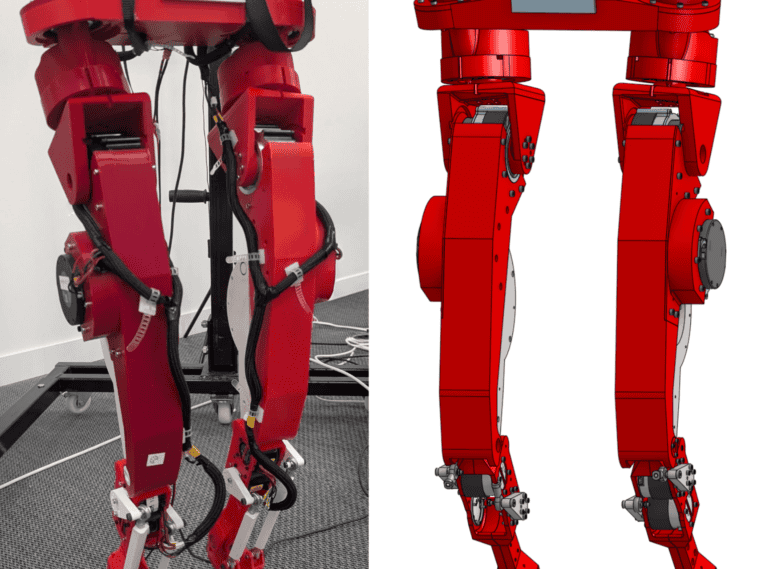
Building a humanoid robot used to be the kind of thing reserved for well-funded labs and companies with serious budgets. Now, if you have a 3D printer, some technical skills, and about $2,500 to spend, you can build one yourself. Well, part of one, at least.
A new open-source project called LeRobot Humanoid is bringing humanoid robotics closer to hobbyists, students, and researchers by making the hardware cheaper, repairable, and fully customizable.
Meet LeRobot Humanoid
The project was developed by Hugging Face, the AI company best known for its open-source machine learning tools. Instead of creating a polished consumer robot, the team built something closer to a robotics kit for serious experimentation. The current version focuses on a bipedal lower-body platform—essentially robotic legs that can stand, balance, and walk.
The biggest appeal here is not that you’ll suddenly have a sci-fi butler walking around your house; it’s that you can actually understand how the entire system works. The project includes hardware designs, assembly instructions, wiring diagrams, simulation tools, and machine learning training environments. Instead of buying a sealed product, you’re getting access to the entire robotics stack.
If something breaks, just print another one
One notable part of the design is its sheer repairability. Most of the robot is built from 3D-printed components paired with off-the-shelf electronics and affordable actuators. If a part cracks, you just print another one. If you want to modify a design, you edit the model and test a new version. This dramatically lowers the cost of experimentation compared to traditional robotics projects, where custom parts are notoriously expensive and difficult to replace.
The real goal isn’t the hardware
What Hugging Face is really trying to do is solve one of robotics’ biggest headaches: the “simulation-to-reality” gap. Researchers often train robots in virtual environments because it’s faster, cheaper, and safer. However, behaviors that work perfectly in a simulation often fall apart in the real world, where a flawless virtual walk turns into a real-world stumble. LeRobot Humanoid is designed to bridge that gap by connecting simulation tools, real-world testing, and data collection into one seamless workflow.
Robotics in the open-source era
The project is spread across multiple repositories covering everything from mechanical design to robot control systems. There’s even a dedicated “legged zoo” environment where users can train walking behaviors before deploying them to the physical hardware. This makes the platform feel less like a one-off project and more like a robotics operating system that anyone can build on.
Advanced robotics is slowly becoming accessible to students, hobbyists, and independent builders, rather than remaining locked behind the gates of giant tech companies. While a $2,500 DIY project isn’t exactly cheap pocket change, compared to where humanoid robotics sat just a few years ago, it’s a massive sign of progress—one 3D-printed part at a time.
Source: Hackster.io