
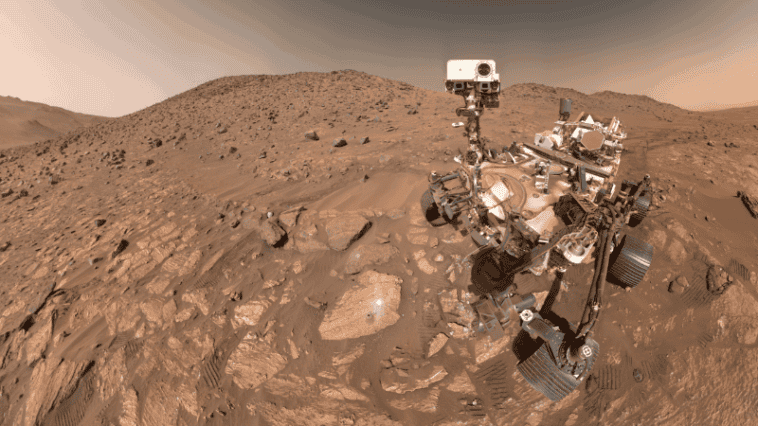
NASA’s Perseverance rover captured a new animated selfie on Mars in the ‘Wild West,’ the farthest west it has traveled since landing on the planet in 2021.
This is the rover’s sixth selfie on Mars, and in it you can see the explorer sitting beside a rocky outcrop called the “Arathusa,” with the rugged rim of the Jezero Crater seen stretching across the background.
Clues from the subsurface
The selfie itself was the result of NASA stitching together 61 separate images captured by the camera (mounted at the end of the explorer’s robotic arm) over the course of roughly an hour. It was taken during the rover’s latest (and fifth) science campaign near the western edge of Jezero Crater, an area NASA scientists describe as some of the oldest and most geologically interesting terrain the Mars 2020 mission has explored so far.
The rover had used its abrasion tool to grind a circular patch into the rock right before taking the selfie. As per the mission team, the revealed material appeared to contain igneous minerals that were formed when molten rock cooled underground billions of years ago, possibly even before Jezero Crater itself existed.
The finding makes the Arathusa area especially valuable to the team because, unlike the sediment-rich river delta Perseverance explored earlier in the mission, this region may offer a direct look at Mars’ ancient crust and volcanic history.
Impact sites and magma oceans
During the science campaign, the rover also used the camera located on its mast (the Mastcam-Z) to capture a large panoramic mosaic of a nearby region called the “Arbot,” whose landscape shows sharp ridges, scattered boulders, and rock formations that researchers believe were created or altered by a massive meteor impact about 3.9 billion years ago.
NASA scientists say some of the rocks in this area may contain clues about the red planet’s earliest geological conditions, including whether it once had a magma ocean during its formation.
Perseverance has, in the course of its mission (that has lasted more than five years now), traveled nearly 26 miles across Mars, just short of a marathon distance, collected 27 rock core samples, and abraded 62 sites while continuing its search for signs of ancient microbial life.
The rover’s next route will take it toward areas rich in olivine-bearing rocks, which could help scientists better understand how Mars cooled and evolved over time.
Sources: NASA, NASA’s Perseverance, NASA’s Mars Goals