
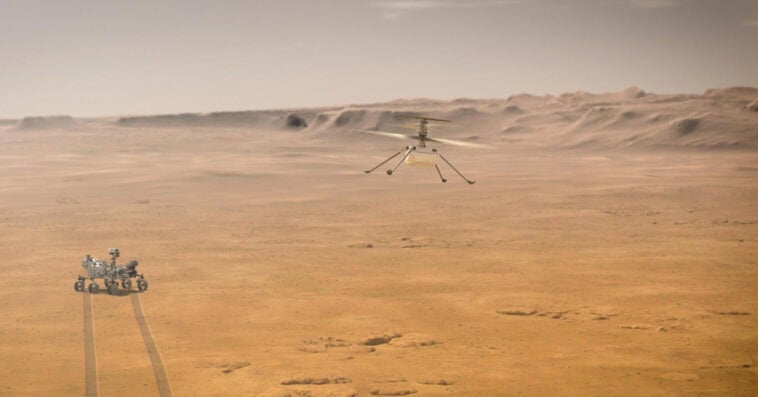
NASA is gearing up for one of its boldest Mars missions yet, and it’s not just about landing on the Red Planet. In 2028, the agency plans to send a nuclear-powered spacecraft carrying not one, but three helicopters designed to take exploration to new heights. But how will these flying scouts survive a high-risk descent? As NASA revives nuclear propulsion and rethinks how we explore Mars, this mission could reshape the future of space travel in ways few saw coming.
NASA unveils nuclear-powered mission to Mars for 2028
NASA is preparing for a historic return to atomic-powered spaceflight. Just last week, newly appointed Administrator Jared Isaacman announced that the agency plans to launch a nuclear-powered spacecraft toward Mars in December 2028. The mission’s primary goal is to deploy three specialized helicopters to scout the Martian landscape, a move Isaacman says will “unlock the capabilities necessary for sustained exploration beyond the Moon and missions to Mars and the outer Solar System.”
At the center of this plan is an advanced spacecraft known as Space Reactor-1 (SR-1) Freedom. If completed, it would mark the first real test of nuclear-powered space travel since the 1960s. Despite its futuristic concept, much of the technology is already in progress. The spacecraft will build on systems originally designed for Lunar Gateway, a small station intended to orbit the Moon. It will use a compact 20-kilowatt fission reactor (largely already developed) to generate heat, which will then be converted into electricity to power its propulsion system.
Describing the mission’s significance, Steven Sinacore, NASA’s program executive for fission surface power, said: “It is the first freight run on the transcontinental railroad of the Solar System.”
A surprising strategic shift
This mission represents a dramatic shift in direction for NASA. Just a year ago, a White House budget proposal suggested ending the agency’s nuclear propulsion research, and several related projects were shut down in December. Now, through a partnership with the U.S. Department of Energy, the SR-1 mission is bringing that work back to life.
The spacecraft will carry a fission reactor fueled by low-enriched uranium and uranium dioxide, mounted on a long boom to keep it safely distanced from the main vehicle, while titanium fins will help release excess heat.
Many details, however, remain unclear. NASA has not revealed the mission’s total cost, nor has it addressed the risks involved in launching radioactive materials into space — particularly what could happen in the event of a launch failure. Still, the agency has experience handling nuclear-powered missions, having previously sent spacecraft into space using energy from decaying plutonium.
NASA’s Mars helicopters aim for daring ‘skyfall’ landing
The cargo aboard the SR-1 Freedom is a direct evolution of a concept proposed by AeroVironment—the same innovators who partnered with NASA’s Jet Propulsion Laboratory to create the record-breaking Ingenuity helicopter. While Ingenuity proved flight was possible on Mars with 72 successful trips, these new scouts will use a daring “skyfall” maneuver. Instead of being dropped by a rover, the three helicopters will eject from their entry capsule while still plummeting through the atmosphere, performing their own controlled soft landings.
Once on the ground, these drones will serve as the eyes and ears of future missions. Equipped with high-resolution cameras and subsurface radar, they will hunt for underground water ice and identify safe landing zones for the first human explorers.
The scientific debate
Despite the technical excitement, the mission has sparked a conversation within the scientific community. Some planetary scientists argue that larger helicopters capable of carrying more advanced instruments would deliver greater scientific value.
Briony Horgan, a planetary scientist at Purdue University, expressed a cautious outlook on the current plan. “We will have to see how much new science will be enabled,” Horgan noted, pointing out that scientists already have a rigorous, long-term roadmap for Mars exploration with specific objectives. “It would be a major loss if that program was exclusively replaced with science slapped onto other efforts,” she added.
Source: Science