
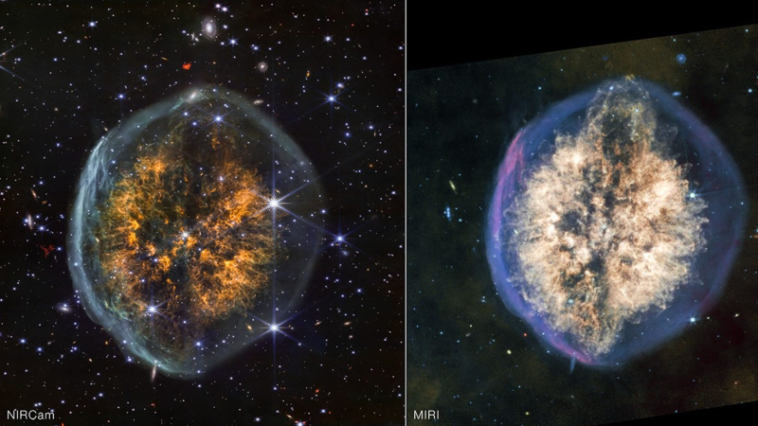
Something in the constellation Vela (a southern Milky Way region visible mainly from the Southern Hemisphere) looks a little like a brain floating in space.
Astronomers have been calling it the “Exposed Cranium.” The nickname stuck years ago, but new images from the James Webb Space Telescope are showing the object in far more detail than anyone had seen before.
The nebula, officially known as PMR 1, sits roughly 5,000 light-years from Earth. It formed when a dying star began shedding its outer layers, sending gas and dust outward into space. That expanding shell is what telescopes see today.
A Dissection in Deep Space
From a distance, the shape is strange enough to give the nebula its nickname. The glowing cloud looks like a brain inside a faint outer bubble—something like a skull with the top peeled back.
Webb captured the scene using two different instruments, and each one shows a slightly different version of the same object.
One image comes from the telescope’s Near-Infrared Camera (NIRCam). Under its gaze, the nebula’s outer shell forms a pale ring while the clouds inside glow orange. A dark stripe cuts down the middle, splitting the structure into two lobes that resemble the two halves of a brain.
The second image comes from MIRI, Webb’s Mid-Infrared Instrument. Through this longer-wavelength lens, the surrounding bubble shifts toward blue and purple tones, while the interior looks thicker and more tangled. The dark stripe visible in the first image fades here because dust in the nebula blocks part of the view.
Looking at the same object in multiple wavelengths is one of Webb’s strengths. Each band of infrared light reveals different pieces of the structure—gas expelled at different times, clouds of dust, and the faint outer shell drifting away from the star that created it.
The Mechanics of a Dying Sun
Planetary nebulae like PMR 1 mark the final stages of a star’s life. As the star runs out of nuclear fuel, it begins to push its outer layers into space, leaving behind a hot core that illuminates the expanding cloud.
The nebula itself was first spotted in 2013 by the now-retired Spitzer Space Telescope, but it hadn’t been studied in much detail since then. Webb’s images offer a much clearer look at the layers of gas surrounding the star.
What eventually happens to that star depends largely on its mass, which is yet to be determined. Some stars end their lives quietly, shrinking into dense remnants known as white dwarfs. Others collapse more violently and explode as supernovae.
Either way, the glowing shell around PMR 1 will continue expanding for thousands of years—slowly thinning out until it fades into the surrounding galaxy.
Sources: NASA, ESA, STScl, Live Science