
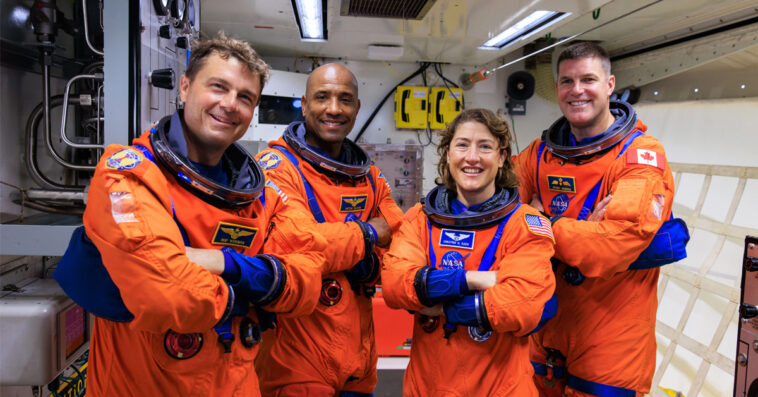
For the first time in more than half a century, humans are preparing to leave Earth’s orbit and head near the moon, with NASA’s Artemis 2 mission set to launch in 2026. Decades after the last Apollo astronauts gazed back at our celestial neighbor, a new crew of pioneers will orbit the moon, breaking records and making history along the way. From cutting-edge spacecraft to groundbreaking science experiments, and a first for a woman and a person of color in lunar space, this mission promises a glimpse of the next era in space exploration. Could this be the moment humanity finally begins its return to the lunar surface?
The astronauts who last walked and orbited the moon
It was in 1972, when NASA’s Apollo 17 astronauts — Eugene Cernan, Harrison “Jack” Schmitt, and Ron Evans — embarked on humanity’s last lunar journey. Cernan and Schmitt spent three days exploring the moon’s surface, while Evans orbited above in the command module. After completing their historic mission and circling the moon for two more days, the crew ignited their engines for the return to Earth, becoming the last humans to witness the moon up close, a view no one has experienced in over 50 years.
Artemis 2 to bring humans back near the moon
After decades of planning, delays, and evolving mission goals, NASA is finally ready to send astronauts beyond Earth’s orbit again. The Artemis 2 mission, scheduled for 2026, will be the first in the Artemis program to carry a crew aboard the Orion spacecraft. Over about ten days, the astronauts will travel around the moon and return to Earth, becoming the first humans in a generation to see our nearest celestial neighbor up close.
NASA has announced the Artemis 2 crew: Reid Wiseman as commander, Victor Glover as pilot, and Christina Koch, along with Canadian astronaut Jeremy Hansen as mission specialists. The team has spent the past three years training intensively for every part of the mission, with extra preparations over the past year involving NASA’s wider Artemis team.
If all goes according to plan, the crew could launch as early as February 5, 2026. Before then, the fully assembled Space Launch System (SLS) rocket will be moved from NASA’s Vehicle Assembly Building at Kennedy Space Center to Launch Complex 39B. NASA has also lined up backup launch windows through April in case of delays.
On launch day, the astronauts will board Orion and ride the SLS into Earth’s orbit. After confirming all systems are functioning properly, the rocket’s upper stage will send Orion on a “free-return” path around the moon. This trajectory will slingshot the spacecraft around the lunar surface and bring it safely back to Earth in a figure-eight path, ensuring the crew’s return even if something goes wrong along the way.
Artemis 2 comes after NASA’s November 2022 launch of the uncrewed Orion spacecraft on the Artemis 1 mission. Originally, NASA planned to fly Artemis 2 in 2023, but damage to Orion’s heatshield during reentry caused delays, first by a year, and then by another year.
What Artemis 2 hopes to learn
The main goal of Artemis 2 is to test the Orion spacecraft on its first mission with astronauts aboard. Along the way, the crew will take part in a series of science experiments, including studying their own bodies. For the first time since the Apollo missions, researchers will gather data on how space affects the human body, looking at things like radiation exposure and changes to the immune system.
History in the making
Along with marking humanity’s long-awaited return near the moon, Artemis 2 is making history in other ways. Depending on its launch, the Orion spacecraft could take the crew farther from Earth than any previous manned mission, potentially surpassing the distance record set by Apollo 13. Christina Koch and Victor Glover will also make history as the first woman and the first person of color, respectively. to fly near the moon.
Race to the moon: U.S. faces pressure from China
A lot of the discussion around U.S. space missions recently has centered on who will reach the moon first — NASA’s astronauts or China’s taikonauts — especially in the moon’s southern polar region. This area is believed to hold large amounts of water ice, a key resource for drinking water and even rocket fuel, making it a strategic prize.
Experts and U.S. officials emphasize that this is not just about space exploration — it’s also a matter of national security. As Senator Ted Cruz noted, if rival countries gain dominance in space, it could pose serious risks to the U.S.
Source: Space.com