
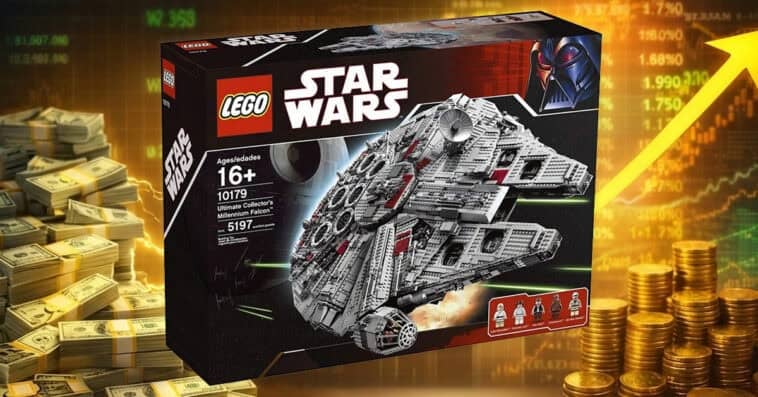
If you thought your old LEGO sets were just dusty relics from childhood, think again. Collectors and investors are paying huge sums of money for vintage LEGO sets, with some appreciating faster than gold, stocks, or even fine wine. From iconic Star Wars relics to architectural masterpieces, certain LEGO sets are now commanding jaw-dropping prices on the secondary market. But not every LEGO set is a hidden treasure—knowing which ones could turn your childhood stash into serious cash takes insider knowledge. Read on to discover why vintage LEGO is one of the most lucrative investments you never knew you had.
Serious returns on ‘unserious’ goods
There’s an unexpected heavyweight in the investment world you probably didn’t know, and it fits in the palm of your hand. A 2021 study revealed that high-end LEGO sets are proving to be a more profitable asset class than traditional staples like art or precious metals. According to the research, the secondary market for these iconic bricks appreciates by a remarkable 11% every year, outpacing the annual returns of gold, stocks, bonds, fine wine, and even rare stamps.
Researchers at Russia’s Higher School of Economics (HSE) suggest that investors are finding massive success in “more unusual goods whose purchase might seem less serious,” such as limited-edition Barbie dolls, superhero figurines, and model vehicles. While these might look like mere playthings, the financial data suggests otherwise.
“We are used to thinking that people buy such items as jewellery, antiques, or artworks as an investment,” explained Victoria Dobrynskaya, an associate professor at the Faculty of Economic Sciences at HSE. “However, there are other options, such as collectible toys. Tens of thousands of deals are made on the secondary Lego market. Even taking into account the small prices of most sets, this is a huge market that is not well known by traditional investors.”
A look at the ‘Holy Grails’ of LEGO investing
To understand why these plastic bricks rival gold, one only needs to look at the “holy grails” of the secondary market, where rarity and nostalgia drive prices into the thousands. The Ultimate Collector’s Series Millennium Falcon (2007) remains a legendary example; originally retailing for around $500, pristine, unopened units now frequently command between $3,000 and $5,000 on the resale market. Other heavyweights include the original Taj Mahal (2008) and the Death Star II (2005), both of which have seen their values skyrocket because their complex, high-piece-count designs appeal to a wealthy “AFOL” (Adult Fan of LEGO) demographic that views these sets as sophisticated display pieces rather than toys.
What drives LEGO’s secondary market prices through the roof
The secret to LEGO’s financial dominance lies in a precise formula of timing and exclusivity. By analyzing the valuation of 2,322 different sets released between 1987 and 2015, researchers identified that the most aggressive price surges are fueled by restricted production windows, specialized collector editions, and an ever-shrinking supply on the secondary market. Crucially, these high-stakes returns apply almost exclusively to “MISB” (Mint in Sealed Box) examples; the study focused solely on new, unopened sets, where the cardboard seal acts as a literal vault for the value inside.
While gold remains a finite but uniform asset, a LEGO set’s value is dictated by its retirement —the definitive moment production ceases. When legendary releases are pulled from shelves, the global supply is frozen forever. This creates a perfect storm for investors: as nostalgic demand grows, the available stock of pristine boxes only diminishes, allowing a well-preserved piece of plastic to outpace blue-chip stocks and precious metals.
However, the market is not a guaranteed goldmine for the uninitiated. Success requires more than just buying boxes; it requires a deep, cultural understanding of the brand.
“Sets produced 20-30 years ago make LEGO fans nostalgic, and prices for them go through the roof,” Dobrynskaya noted. “But despite the high profitability of Lego sets on the secondary market in general, not all sets are equally successful. One must be a real LEGO fan to sort out the market nuances and see the investment potential in a particular set.”
Source: The Guardian