
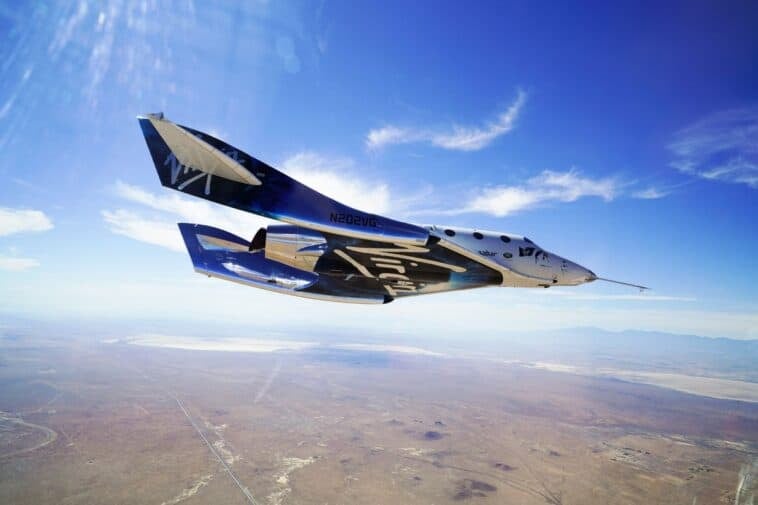
Space tourism is back on the menu. All it takes is $750,000 and a tolerance for rocket-powered physics.
In a very notable jump from its previous $600,000 price point, Virgin Galactic has reopened ticket sales for its suborbital flights after a long pause. A whopping $750,000. And people are already lining up.
As you wrap your head around the price tag, let’s break down the offering.
What is on the table (and what’s not)
To reset expectations real quick, passengers are not orbiting Earth. They are not docking anywhere and are absolutely not becoming astronauts in the NASA sense of it.
The simplified version is they go up, not around.
The flight starts with a carrier aircraft lifting the spaceplane to high altitude. Then it drops. The hybrid rocket motor ignites, propelling the VSS Unity (or the next-gen Delta Class) to nearly three times the speed of sound. Passengers cross the 50-mile altitude mark—the boundary recognized by the FAA—to earn their commercial astronaut wings.
The total time for the trip is about 90 minutes. So, it’s short. But for those few minutes, passengers are weightless, looking at Earth from a perspective very few humans have ever seen.
Why the price keeps climbing
Space sounds magical, but the tech to get there? Not so much. Reusable human-rated spacecraft come with long years of testing, and extreme safety requirements.
And the magic for error is essentially zero.
Virgin Galactic learned that the hard way especially with the 2014 accident involving Scaled Composites that forced a major reset in how cautiously this program has progressed since.
On top of that, the economics are brutal. There’s limited flights, limited seats, and extremely high costs to deal with.
The company reported a $279 million net loss in 2025 and negative free cash flow of $438 million.
Virgin Galactic basically has the market
Timing is doing Virgin Galactic a favor right now, as Blue Origin has paused tourist flights. On its end, SpaceX is focused on bigger missions: satellites, cargo, deep space.
So for a private individual trying to book a space experience today, Virgin Galactic is pretty much the only option.
It’s a niche market. But for now, it’s the company’s.
The real story is the next-generation spacecraft
This latest ticket release is tied to a new phase of hardware. Virgin Galactic’s next-generation SpaceShip is expected to begin ground testing in April 2026, with flight testing in Q3.
There is also a second vehicle already in development.
The company wants to go from a handful of flights per month to potentially multiple flights per week per spacecraft.
If they pull that off, everything changes. More seats, better utilization, and eventually, maybe, lower prices. That’s the long game.
Can space travel ever become widely affordable?
There is a pattern where new tech starts out expensive and early adopters fund the development until systems improve and prices drop. Is that the case here? There is no easy answer for that.
But if it is, we are certainly not there yet.
Right now, space tourism is still in its early-adopter phase. If flight frequency increases and operations stabilize, prices could come down. For now though, it is one very expensive view.
Source: Fox News