
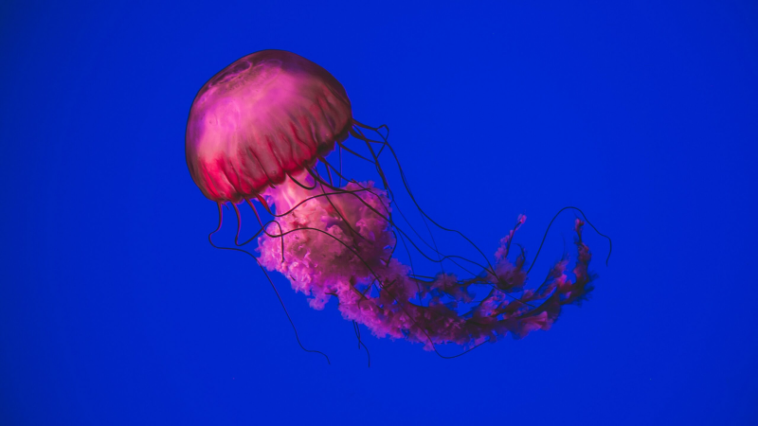
In the early 1990s, NASA launched thousands of baby jellyfish into space.
Not just a few specimens in a lab container, but about 2,500 tiny jellyfish polyps, sealed in bags of artificial seawater and sent aboard the space shuttle Columbia. By the time the mission ended nine days later, the number had exploded, with tens of thousands of jellyfish having developed in orbit.
The experiment had nothing to do with marine biology, though. Researchers were trying to answer a much stranger question. What would happen if humans were born in space? More specifically, they wanted to understand how living organisms develop a sense of gravity when gravity is almost absent.
Jellyfish, oddly enough, offered a useful model.
Engineering an Upside-Down World
When a jellyfish matures into the familiar umbrella-shaped form—the stage scientists call the medusa—it grows tiny calcium sulfate crystals inside its bell, the pulsing dome that makes up its main body. These crystals sit inside small pockets lined with microscopic hairs. When gravity pulls the crystals downward, the hairs detect the shift and send signals to the jellyfish’s nervous system.
That mechanism helps the animal figure out which way is up.
Humans use something strikingly similar. Within the inner ear are small mineral structures that move in response to gravity and stimulate sensitive hair cells. Those signals tell the brain how the body is oriented.
So the NASA team wondered: if jellyfish grew up in microgravity, would that system still develop properly?
During the shuttle flight, astronauts accelerated the jellyfish life cycle so the polyps would mature quickly in orbit. By the time Columbia returned to Earth, the experiment had produced roughly 60,000 jellyfish. Back on the ground, scientists began comparing them with jellyfish that had grown normally on Earth.
That’s when things got strange.
The space-grown jellyfish could still swim, but not well. Their movements looked irregular and clumsy, with strange pulsing patterns that researchers hadn’t seen in the control group. Some scientists described the behavior as the jellyfish equivalent of vertigo.
The crystals responsible for detecting gravity had formed normally in space. But the animals appeared to struggle in handling Earth’s gravity once they returned. For researchers studying long-term space habitation, the result was unsettling.
If simple organisms raised in microgravity struggle to adapt once they return to normal gravity, it raises an obvious question: What might happen to humans born far from Earth if they ever tried to come back?
The jellyfish experiment didn’t answer that question. But it suggests that the human body may depend on gravity more than scientists once assumed.
Sources: NASA, NTRS – NASA, Discover Wildlife