
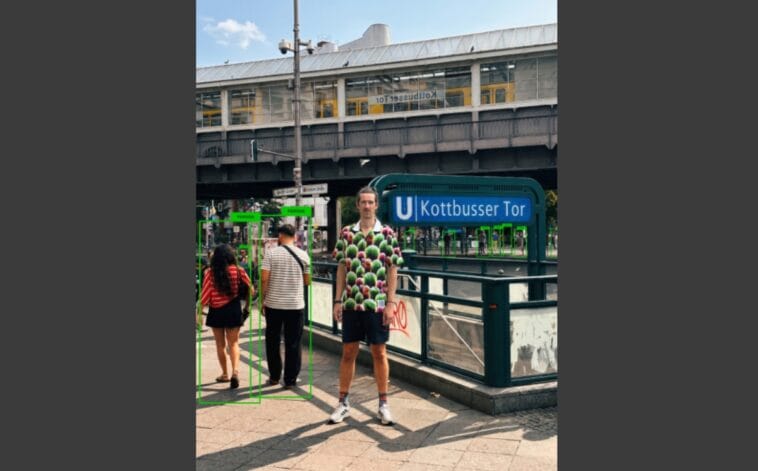
As concerns grow over the pervasiveness that is AI-driven surveillance, a German game designer has built a shirt engineered to make AI cameras “blind” to the presence of a human.
Berlin-based artist and technologist Simon Weckert’s design features a chaotic mix of colors and shapes printed across the fabric. The goal is not to fool the human eye but to break the outline detection software that artificial intelligence relies on to identify a body.
“Digital Camouflage is a garment developed in response to the AI video surveillance planned for Berlin’s Kottbusser Tor,” Weckert notes on his website. “Its pattern is based on a so-called adversarial attack: it targets the features that object-recognition systems look for when searching for a human figure, so the wearer is no longer registered as a person by the machine,” he explains.
Kottbusser Tor is a high-traffic Berlin U-Bahn (underground railway) station. It is part of Berlin’s Kreuzberg district and is currently the focal point of urban surveillance debates.
Engineering visual confusion
The shirt’s combination of pink, orange, and green shapes is meant to prevent detection software from binding the parts of a body into a single, recognizable figure.
One could call the digital camouflage pattern a paradox of sorts, as Weckert used a specialized generative AI method known as TC-EGA (Toroidal-Cropping-based Expandable Generative Attack) to run an adversarial loop. Meaning he went through round after round of trial and error before the pattern stopped reading as a person at all.
A shirt built to defeat AI, designed with the help of AI, is the kind of detail that would fit right into a William Gibson novel. And what do you know, one already did. Gibson’s 2010 sci-fi and thriller novel, Zero History, imagined something quite similar, where a garment was so aggressively patterned that it broke facial recognition on sight.
This is not Weckert’s first foray into the limelight, however. The technologist has built a career on exposing the vulnerabilities of digital infrastructure. In 2020, for instance, he pulled a wagon loaded with 99 smartphones through Berlin and tricked Google Maps into showing a traffic jam on an empty street.
Sources: Simon Weckert, Dezeen, Futurism