
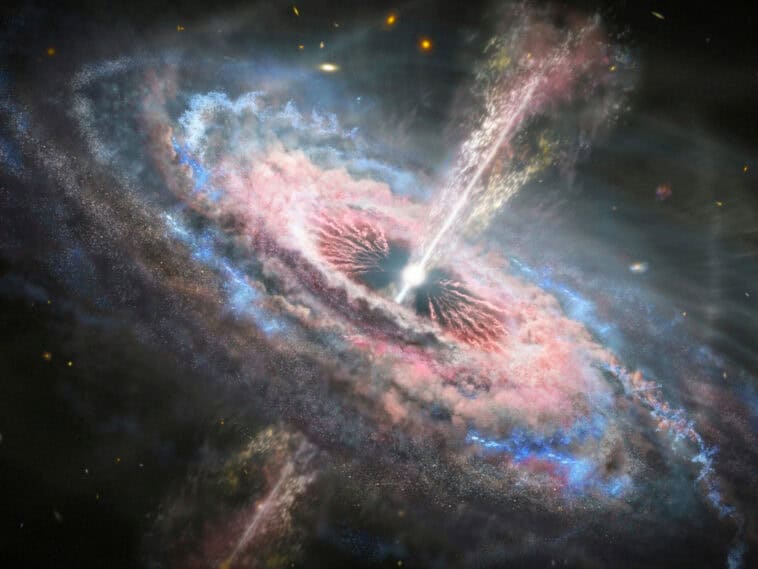
There is a literal fault in our stars. Astronomers may have stumbled onto a bizarre cosmic object that appears to be part black hole, part star, and is so ridiculously energetic that it outshines its entire galaxy.
The object, called MoM-BH*-1, was discovered accidentally by the James Webb Space Telescope while astronomers were hunting for some of the oldest and most distant galaxies in the universe. Instead, they found a cosmic chimera.
Meet the black hole star
MoM-BH*-1 comes from the early universe and appears as a bright red dot in JWST observations. Its star-like gas cloud is roughly the size of our solar system, while its black hole component is estimated to be 100,000 times the mass of the Sun.
But the truly absurd part is how bright it is. The object reportedly emits around 100 times more energy than any known stellar formation and is roughly 100 billion times brighter than an average star. It was so luminous that it completely outshone its host galaxy.
MoM-BH*-1 is one in a billion!” said study author Rohan Naidu, an astrophysicist at MIT.
JWST went looking for galaxies and found a cosmic plot twist
The discovery came during the Mirage or Miracle (MoM) survey, which uses the James Webb Space Telescope to search for some of the universe’s earliest galaxies. Instead of simply finding another distant galaxy, researchers spotted this extremely unusual red object.
An interesting note you should take is that MoM-BH*-1 could help explain one of JWST’s strangest discoveries: the mysterious “little red dots.” These tiny crimson objects appeared in large numbers when JWST began looking deep into the early universe, particularly during its first couple of billion years.
Scientists have been trying to figure out what they actually are. Supermassive stars? Galaxies? Supermassive black holes wrapped in enormous clouds of gas? Now there’s another possible answer in black hole stars.
The little red dots might be hiding something huge
The new discovery suggests that the reddish appearance of these objects could come from gas rather than dust. And astronomers are not treating MoM-BH*-1 as a one-and-done discovery.
Starting in December, Naidu and his team plan to use the James Webb Space Telescope to investigate the object in greater detail, including its actual size and the composition of its atmosphere. Naidu said the discovery made him wonder whether they could be looking at a completely new kind of “stellar atmosphere” on a spectacular scale. So, there might be more to come.
Source: New York Post