
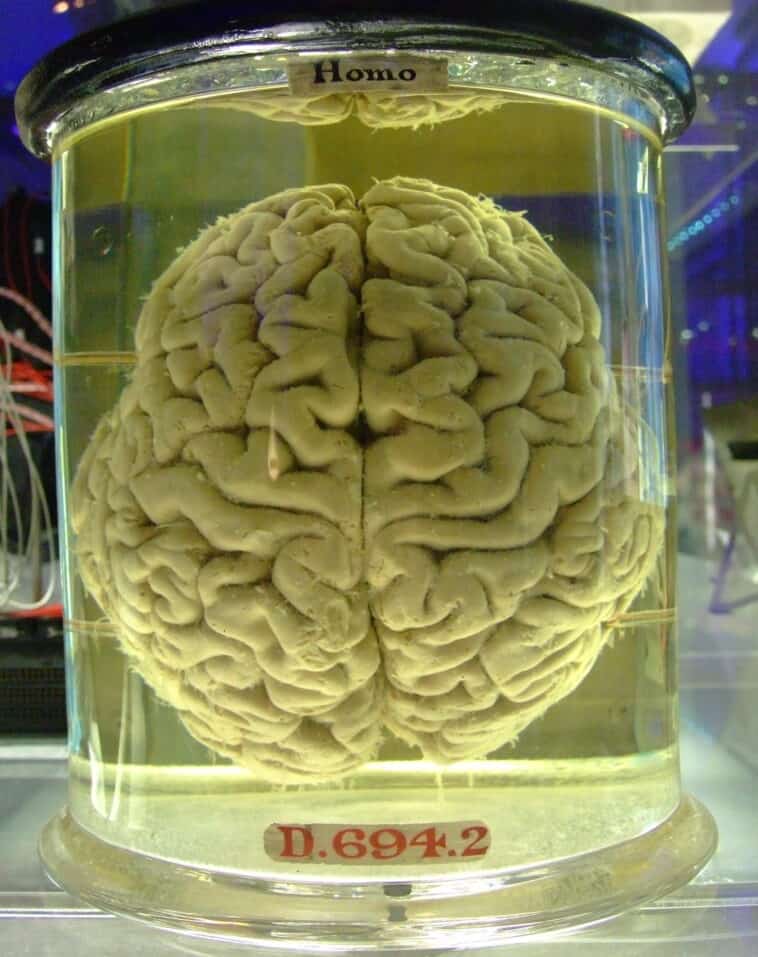
Have you ever stopped to think about what your brain is actually doing right now? For decades, standard science has told us a pretty straightforward story: your brain is a biological supercomputer, and your thoughts, feelings, and memories are basically electrical code produced by billions of neurons.
But what if that whole premise is wrong?
Renowned neuroscientist Christof Koch, a leading figure from the Allen Institute for Brain Science who has previously taught at MIT and Caltech, is asking a massive question: What if the brain doesn’t actually create consciousness? What if consciousness is woven right into the very fabric of reality itself?
The hard problem that won’t go away
Koch isn’t just throwing wild theories around for fun. He’s confronting what scientists call the “hard problem” of consciousness. The puzzling mystery of why physical processes in the brain give us subjective, lived experiences.
As Koch put it in an essay shared with ScienceAlert: “Nothing in science explains how three pounds of matter, a piece of furniture of the universe like any other, subjects to the same natural laws, can love, hate, dream, imagine, fear or hope for its future.”
Despite huge leaps in mapping out how neural circuits handle memories and decisions, traditional materialism still can’t bridge that gap.
Three huge challenges to standard science
At the Bial Foundation’s “Behind and Beyond the Brain” symposium in Porto, Portugal, Koch laid out three major areas where current scientific models fall short:
- The reduction trap: We simply can’t reduce subjective, conscious experience entirely down to physical brain mechanisms.
- The physics dilemma: Developments in modern physics keep forcing us to question what can truly be considered “real.”
- Outlier phenomena: Existing scientific frameworks struggle to explain unusual experiences like near-death experiences, mystical states, or terminal lucidity (sudden moments of clarity right before death).
The brain as a filter, not a generator
So, if the brain isn’t generating awareness, what is it doing?
To answer this, Koch points toward philosophical frameworks like analytic idealism, panpsychism (the belief that consciousness is a fundamental property built into all matter), and Integrated Information Theory (IIT). Under these views, consciousness isn’t a byproduct of the brain—it’s a fundamental feature of the cosmos.
Instead of being the organ that creates awareness, your brain might be acting more like a filter that shapes and restricts a vast, underlying field of consciousness.
A 25-year-old bet and a moment on the beach
This isn’t the first time Koch has publicly questioned traditional neuroscience. Back in 2023, he famously conceded a 25-year bet to philosopher David Chalmers, admitting that science was no closer to uncovering the neural mechanics of consciousness than it was when they made the wager in 1998.
This paradigm shift didn’t just come out of a textbook for Koch; it was also shaped by a deeply personal moment. Several years ago, while sitting alone on a beach, he experienced the boundary between himself and the outside world completely dissolving. He described it as a timeless, universal reality. An experience that he says changed his view of reality and led him to rethink his scientific assumptions.
What this means for AI and the future
If consciousness isn’t just complex computation, this changes the game for artificial intelligence, too. What this means is that making a computer hyper-intelligent or super-sophisticated might not automatically make it conscious. However, this does not mean future AI systems could never become conscious.
The next step
For now, Koch acknowledges that his theory has not been fully established scientifically. However, he insists that the next big leap is translating his mind-blowing insights into testable scientific hypotheses.
Sources: ScienceAlert, Nature Reviews Neuroscience