
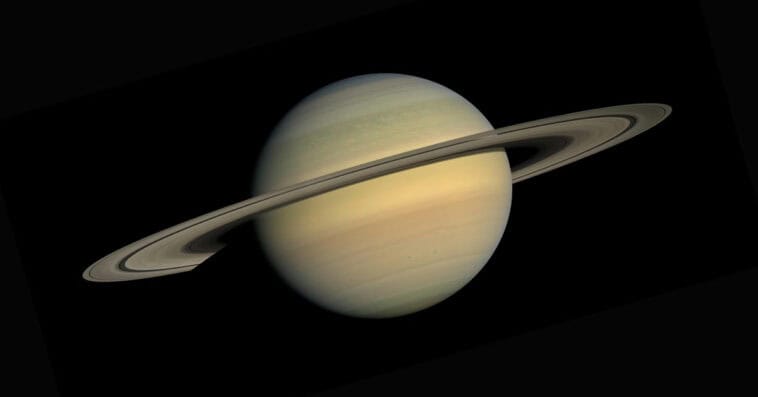
Tonight, Saturn is about to pull off a cosmic trick that even seasoned skywatchers rarely get to witness—its famous rings will seemingly vanish, leaving the gas giant looking strangely bare in the night sky. It’s not magic, and it’s not a glitch in your telescope, but the reason behind this startling disappearance is far more fascinating than you might expect. Keep reading to find out what’s really happening and why this illusion won’t return for years.
The illusion that makes Saturn’s rings disappear
On the night of November 23, anyone peering at Saturn through a telescope may think the planet’s famous rings have vanished—but it’s all part of a remarkable celestial illusion. During this brief window, Saturn’s vast disk of icy debris lines up perfectly edge-on with Earth, making the rings so slim from our viewpoint that they essentially disappear.
This strange shift in appearance happens because Saturn travels around the sun with a pronounced 26.7-degree tilt, causing our perspective of its rings to change slowly over time. As Earth and Saturn move along their orbits, the rings alternate between being fully displayed and nearly invisible. When they narrow into a razor-thin line, astronomers call it a ring-plane crossing—a rare moment when one of the solar system’s most iconic features slips temporarily out of sight.
How to catch the illusion
To catch the illusion tonight, turn your gaze to the southeastern sky and look about halfway up the horizon. There, Saturn will stand out as a bright “evening star” just beneath the small ring of stars marking the head of the Great Western Fish in the constellation Pisces.
Although the rings themselves will vanish from view, you might notice a faint shadow slicing across Saturn’s disk—an ultra-thin clue that the rings are still there, just perfectly aligned. Using a telescope with at least a 4-inch aperture will sharpen the experience, allowing you to pick out subtle atmospheric bands on the planet’s turbulent surface and spot several of its major moons, including Titan, Enceladus, and Rhea.
How often does a ring-plane crossing happen
As we’ve seen, Saturn’s rings can vanish from view due to a rare edge-on alignment—but how often does this cosmic trick actually occur? Typically, ring-plane crossings happen every 13 to 15 years. Yet 2025 is unusual, offering not just one, but two observable events: the first on March 23 and the second, tonight, on November 23.
This isn’t a break in the pattern; it’s a result of the specific geometry between Saturn’s 26.7-degree tilt and Earth’s orbit. Some crossings, like the March event, are less favorable for observation because Saturn is too close to the Sun or low in the sky. So while the “roughly every 14 years” rule applies, it’s possible to experience multiple visible disappearances—or subtle alignment moments—within a single cycle, depending on our vantage point. Tonight, observers get to witness one of these rare, fully visible crossings.
Source: Space.com