
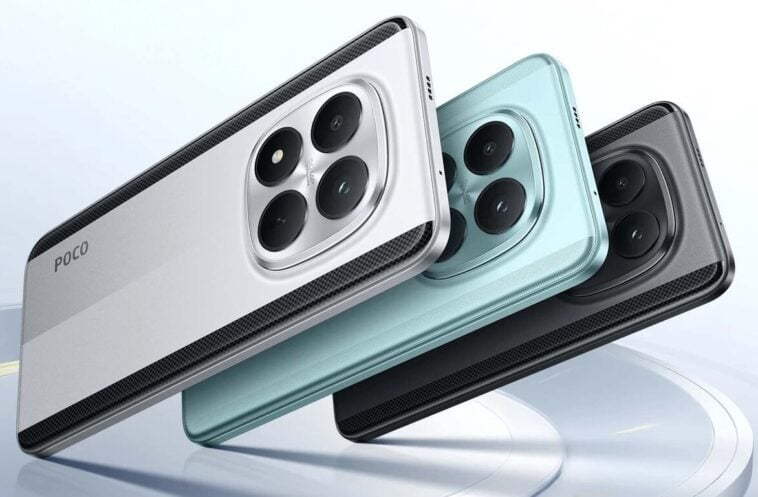
With smartphones becoming more utilitarian than exciting purchases, the enormous field of mid-range phones has been getting a lot more attention. After all, with flagships going for north of $1,000, getting almost as good for just $400 or $500 suddenly sounds a lot more attractive. That’s the price range the Xiaomi Poco M8 Pro has landed in, the latest in the Poco mid-range series.
Whether you go mid-range is a question of what you’re willing to give up by going cheaper, and in 2025, it wasn’t much — as long as you were fine with giving up either a top-end camera array or top-end performance, there were a lot of terrific values out there. In 2026, the Xiaomi Poco M8 Pro is setting an early baseline for mid-range Android smartphones by being pretty good across the board. As we’ll see in our Poco M8 Pro review, this phone doesn’t excel in any one area, but there aren’t any glaring problems with it, either, making it a solid value for the price.
Design and build
The Poco M8 Pro has a plastic back with an aluminum frame. Despite the plastic, the Poco M8 Pro doesn’t feel cheap or flimsy in hand. It’s got some heft to it, although it’s lighter than many other 6.83-inch phones at 207 grams.
In fact, the phone might prove to be a little more durable than expected for a phone at this price. The plastic back is reinforced by fiber and the glass display is protected by Corning Gorilla Glass Victus 2, which is one of the best options for avoiding both scratches and screen cracks. The aluminum frame also helps to give the phone a little more robustness. As expected with most phones these days, the Poco M8 Pro is rated IP68/9K for total protection from dust, water, and water pressure. It’s worth noting that the model launching in Europe will only be rated IP68 — that means it won’t be rated for protection from high water pressure, which most folks probably aren’t too worried about.
There’s a large camera module on the back that takes up most of the upper third of the phone, which is fine, but it’s a little grating to see this phone continue the trend of smartphone camera modules that look like they have more cameras than they do. There are four camera-sized circles here, but the Poco M8 Pro only has two rear cameras — of the other two modules, one houses the flash/flashlight, and the other seems to be a dummy.
The phone has a couple two-tone colorways, black and silver, that have black bars running down the sides to give the Poco M8 Pro something of a distinctive look. Not bad, but our favorite is the light mint green colorway (seems to be in this year!), which uses nearly the same color for both the main body and the border stripes on the side.
Performance
As befits a mid-range smartphone in 2026, the Poco M8 Pro isn’t a high-end performer, but it’s no slouch, either. The Qualcomm Snapdragon 7s Gen 4 chipset, the latest in Qualcomm’s mid-range line, is at the core of this phone, which can be purchased with either 8GB or 12GB of RAM (our review model had 12GB). From this line of chipsets, we usually expect to see the focus more on efficiency and battery life than on top-end performance, but the Poco M8 Pro is by no means a clunker.
Over an hour of playing Genshin Impact on the highest settings and 60fps with the display at full brightness, the Poco M8 Pro held up just fine. At no point did I actually hit stable 60fps gameplay, landing more in the mid-40s for the most part, but there were no significant frame rate dips during that hour. The phone only got mildly warm during gameplay, so the thermal management system seems to be working well.
There is a game settings tool that you can pull in from the left, like with many Android phones, but it’s not as robust as what you’ll find on many other devices, even at the mid-range level. There’s no performance boost option, but you can still tinker with touch control sensitivity and choose if you want HDR playback that emphasizes saturation or brightness.
Getting the mid-range Qualcomm chipset also means that some of the high-end connectivity features won’t be available here — specifically, Wi-Fi 7 and Bluetooth 6.0, with the Poco M8 Pro topping out at dual-band Wi-Fi 6 and Bluetooth 5.4. That probably won’t be an issue for most folks, but early adopters of either standard should take note.
Display and audio
The Poco M8 Pro has a 6.83-inch 2772×1280 AMOLED display with a 120Hz refresh rate, although as we saw in the performance section, you’ll need to push graphics settings down in order to get a stable frame rate high enough to take advantage of that refresh rate. The display has support for HDR10+ and Dolby Vision, and with an average brightness peak of 1800 nits and a localized peak of 3200 nits, it’s well equipped to make HDR content shine. And it does — gameplay shined during the performance test, and it’s a terrific device for watching movies and videos.
This mid-range phone even got a little love on the audio side. The stereo speakers have Dolby Atmos processing, which makes music much clearer than what you’d get on the average smartphone at this price, with individual instruments much more distinct. The phone gets very loud, too, without distortion on the high end. Dolby Atmos does a lot of the work to keep audio crisp, but it can’t work miracles — bass comes out really flat, which becomes more noticeable at high volumes (and makes me miss the little subwoofer on the Poco F8 Ultra). Otherwise, it’s one of the better smartphone audio setups I’ve heard on a mid-range phone.
With a little extra brightness and some processing tech that we often see reserved for more expensive phones, the Poco M8 Pro pushes phones twice its price in the entertainment category. As long as you’re OK with the hit to top-end performance that we discussed in the previous section, you’re not missing out on much by going mid-range here.
Worth a quick mention — Xiaomi’s wet display tech is present here, which makes the touchscreen operable even in a downpour. In rainy conditions, it’s still possible to use the phone and the fingerprint scanner, which was a nice feature to have.
Battery life
The Poco M8 Pro is powered by a 6,500mAh battery, which is about average for Android smartphones right now. Thanks to a chipset that’s designed more for efficiency, battery life is excellent — I regularly got well over a day, although I wouldn’t be confident enough to go two. Fortunately, the phone has 100W charging, so with a 100W charging brick, it can get back to fully charged in less than an hour.
While battery life is great, there are other mid-range phones out there like the Realme GT 7 that have larger batteries. An hour of playing Genshin Impact at full brightness, max settings, and a 60fps cap used up 19% of battery capacity, while an hour of video at full brightness used up 6% of battery capacity. That’s really good in a vacuum, but it’s not the best out there in the mid-range world.
Camera
The rear camera array has two sensors — a 50MP wide angle main camera with phase-detect autofocus and optical image stabilization and an 8MP ultrawide camera with a 120-degree field of vision, but no autofocus or optical image stabilization. On the front, the phone has a 32MP selfie camera. The main camera can take 4k video at 30fps, while the selfie camera can take 1080p video at up to 60fps.

Photos taken with the main camera aren’t bad — the sky is a little overexposed in the photo above and I would’ve liked the foreground to be a little brighter. Details definitely aren’t as sharp as you’d get on a more expensive device, but that’s to be expected. It’s not bad for quick sharing on social media, but you can probably find better, even at this price.

In 2x zoom shots taken with the main camera, you get the same issues as the 1x photo above, but I didn’t feel like I lost much in clarity when zooming in. Again, nothing too remarkable — the balance is probably the most noticeable issue — but decent for the price.

Balance was just OK in low-light shots, but the individual lights on the bridge didn’t get blown out too much. The night sky gets a little overexposed, and you might get the faux daylight effect in nighttime shots with some bright light sources.

Continuing with the theme, portrait shots were OK but not great. There’s a little blurring around the edges of subjects, but here you can make out little individual specs of flour, and the background doesn’t look artificially blurred.

There’s a noticeable drop in clarity in photos taken with the ultrawide camera, which you can notice in particular when you look at the grass on the left in this picture versus the one taken with the main camera. I think it’ll work well for sweeping landscape shots at the end of long hikes.
Software
Although Xiaomi is guaranteeing four years of operating system updates and security patches for the Poco M8 Pro, the phone ships running Android 15 and Xiaomi HyperOS 2.0. Both Android 16 and HyperOS 3.0 have been released and are on other Xiaomi devices, so while we’re sure Xiaomi will stick to the update guarantees for the Poco M8 Pro, it should be noted that as of publication, there hasn’t yet been an Android 16 update pushed out.
The bloatware situation is rough — there are folders of pre-installed apps including games, social media apps (like LinkedIn and TikTok), and utility apps like WPS Office, in addition to all of Xiaomi’s system apps. The system apps normally wouldn’t be a big deal, but they do occasionally push notifications about new themes or games you can download from the Game Center. You can turn those notifications off easily, of course, but it’d be nice if that wasn’t the default. The pre-installed apps can all be uninstalled, and the system apps can all be disabled.
Not much to mention here regarding AI. Aside from Google Gemini, the Poco M8 Pro has a handful of AI-based photo editing tools, including a photo beautifier that spruces up photos (something that was around before AI became a buzzword). The phone can also detect the background of a photo and generate and extension of it to increase the size of the photo. If you’re not a fan of device manufacturers cramming as much AI as they can into their phones, this might make you like the Poco M8 Pro more.
Sustainability
A four-year update guarantee for a solidly mid-range phone is about as good as we usually see. If that means you can hang onto this phone for at least five years or so, the low price of the phone becomes even more attractive. It helps that the phone is well equipped to survive drops, too — the aluminum frame should make the phone durable enough, and using Corning Gorilla Glass Victus 2 should prevent the display from shattering and prevent most scratches.
Pricing and availability
The Poco M8 Pro can be purchased in 8GB RAM / 256GB storage and 12GB / 512GB configurations, and comes in black, green, and silver colorways. The phone has been released globally, with the price starting at around the equivalent of $400 in most markets.
Bottom line
Usually when we review mid-range smartphones, recommendations boil down to this: this phone excels at x, but you have to give up a lot in y. Not so much with the Poco M8 Pro — this phone does everything pretty well, and pretty well becomes extremely well when you factor in the low price. The hit to performance is relatively small, and mostly negligible unless you play a lot of mobile games, while the camera fares well as a quick point-and-shoot device.
The lack of a dedicated zoom camera is the only sacrifice that might give even bargain hunters pause, but that’s a feature we rarely see at this price. That said, photos from the main and ultrawide cameras are beatable by other mid-range phones.
Battery life? Not the best, but most folks just need a phone they can confidently use for an entire day and maybe a little extra, and the Poco M8 Pro fits the bill.
With a display just about as good as what’s on many flagship phones, the Poco M8 Pro ends up performing just as well as a flagship device the majority of the time. If you’re not a gamer and aren’t too fussed over the finer points of camera quality, there’s little reason to buy a phone more expensive than this in 2026.