
It’s getting crowded at the top of the Android mountain — we’re seeing more and more almost-flagship phones get updates with full slates of premium features to directly take on the likes of the Samsung Galaxy S and the Google Pixel. Count the Poco F8 in, and in particular the Poco F8 Ultra.
The largest of the F8 phones at 6.9 inches, this phone is a powerhouse in every way, including one unexpected surprise — an impressive set of stereo speakers (including a subwoofer!) designed in partnership with Bose. Does booming bass help this phone shake up the smartphone world? We’ll take a look in our Poco F8 Ultra review!
Design and Build
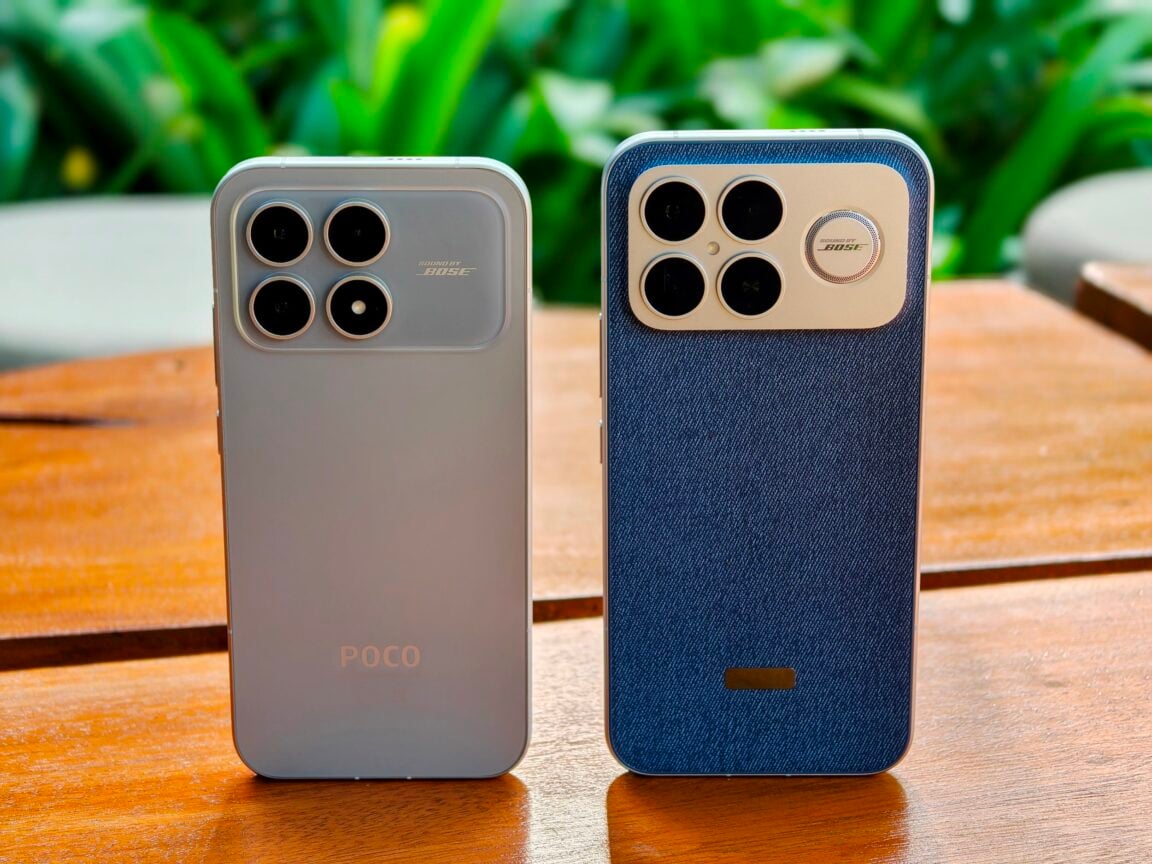
The feature set is fancy, but Poco went a little blue collar with the design of the F8 Ultra. While there are plain old black and white options, the exciting choice is denim. The back cover has a textured fabric that looks like it was cut from a new pair of jeans. I can’t say it actually feels like denim — in hand it feels more like faux leather than a pair of jeans — but either way the texture makes the phone comfortable to hold, especially in landscape orientation.
In portrait orientation, it’s a little awkward to hold, as is going to be the case for any 6.9-inch phone. They managed to keep the weight down to 220g, so despite its size, the phone doesn’t feel especially heavy. Like other flagship options, the Poco F8 Ultra has a metal frame (aluminum in this case) and a glass back on the non-denim colorways.
Rather than use Corning’s protective glass, Xiaomi uses their own reinforced glass to protect the display. I’m not sure I’d expect it to be more scratch-resistant than what Corning makes, but at the very least the display shouldn’t shatter easily. The F8 Ultra is rated IP68, making it water- and dust-proof. It doesn’t have the increasingly common IP69 rating for protection against water pressure, which isn’t that big of a deal for most folks.
Aside from denim (or glass) on the back, you’ll also see a big rectangular bar with three cameras (looks like four, but one of those circles houses a speaker or mic and possibly some IR sensors) and the phone’s most distinguishing feature — a subwoofer with Bose branding. We’ll get to how that sounds in our display and audio section.
Performance
The Poco F8 Ultra uses the Qualcomm Snapdragon 8 Elite Gen 5 chipset, which you’ll find on most flagship Android smartphones in the year to come, including the OnePlus 15. It can be configured with either 12GB or 16GB of RAM, with our review unit having 16GB. That Gen 5 chipset has been performing very well on other early flagship Android phones we’ve reviewed, and the implementation is just as good here.
The Poco F8 Ultra maintained smooth, 60fps gameplay over an hour of Genshin Impact at max settings, max brightness, and with the phone’s gaming performance mode turned on. There are also options for Super Resolution for finer details and Smart Frame Rate to make gameplay smoother. The former makes a small but positive difference, but the latter made the phone run hotter and often lowered fps, which I’ve noticed happen on other phones with similar modes to Smart Frame Rate. No need to mess with it either way — with just the phone’s gaming performance mode turned on, gameplay is smooth and the graphics look as sharp as they can be.
Everyday performance is stellar, with no unexpected hitches. Connectivity speed is fast, too, thanks to 5G and Wi-Fi 7 compatibility (just dual-band for Wi-Fi, not tri-band). It looks like the Poco F8 Ultra hasn’t implemented the newest Bluetooth 6.0 standard, but Bluetooth 5.4 should be fine enough unless you’ve bought a very expensive pair of headphones recently.
Display and audio
The Poco F8 Ultra has a 6.9-inch 2608×1200 AMOLED display with a peak local brightness of 3500 nits. That peak brightness is lower than what we saw in the Realme GT 8 Pro, but is still plenty bright enough to make HDR playback pop — good thing, because the phone also features HDR10+ and Dolby Vision. The max resolution might be a little lower than others at 1200p, but it’s hard to notice the difference in detail between 1200p and 1440p on a smartphone. That said, it’s worth noting that last year’s Poco F7 Ultra did have a 1440p display.
Long story short, no surprises on the display. Audio is where things get interesting. Most flagship smartphones have dual stereo speakers, and they usually sound fine enough, albeit with weak bass and some distortion at higher volumes. Parent company Xiaomi decided that was a weak point that the Poco F8 Ultra could take advantage of, because they’ve partnered with Bose to put a small subwoofer on the back of this phone.
The cynical part of me initially thought this was a bit of a gimmick — we’re mostly all using headphones or earbuds with smartphones anyway — but it must be said: the Poco F8 Ultra sounds really, really good. The subwoofer legitimately gives the phone great bass response, and I was impressed at how clear and distinct that bass sounded, too. Even the mids and highs come out clean and distinct, making for easily the best set of smartphone speakers I’ve listened to (no surprise they used Dolby Atmos audio processing).
Admittedly, I’m not sure a superior set of speakers in and of itself would convince me to buy this phone over another, but it sure is nice to have as a bonus feature. I wouldn’t be mad if we started seeing tiny subwoofers on more phones after reviewing the Poco F8 Ultra, that’s for sure.
Battery
We’ve learned over the years that a high-powered phone with a bright display needs a very big battery to match. The Poco F8 Ultra has a 6,500mAh battery, which is large, but by no means the largest among competing phones, which have anywhere from 7,000mAh to 7,300mAh batteries.
So, it’s not too surprising that battery life falls just a little short of other early 2026 flagship options like the OnePlus 15 and Realme GT 8 Pro, although the difference is marginal. An hour of playing Genshin Impact at max settings, full brightness, and with gaming performance mode turned on used 18% of battery capacity, while an hour of video at max brightness used 4% of battery capacity. Compared to those other two phones, the difference for video was negligible, and for gaming the Realme GT 8 Pro and Poco F8 Ultra were almost tied. The OnePlus 15 still ends up being the best of the bunch by a fair margin, with gaming under the same conditions using 14% of capacity.
In daily use, the Poco F8 Ultra is still very impressive. It uses almost no power while idle and lasts well into a second day, although I’m not sure I would fully trust it to last two days — it’s still a phone I would charge nightly. But, there’s virtually no reason to worry about a single day’s use, unless you plan on doing a lot of gaming or video editing on the go.
The Poco F8 Ultra works with up to 100W charging adapters, which will reliably get the phone to fully charged in about an hour. It also works with up to 50W wireless chargers, which is a feature we’re starting to finally see more of on formerly mid-range phones moving up into flagship territory.
Camera
The three-camera array on the Poco F8 Ultra includes a 50MP main camera with dual-pixel phase-detect autofocus (PDAF) and optical image stabilization (OIS), a 50MP periscope zoom camera with PDAF and OIS capable of up to 5x optical zoom, and a 50MP ultrawide camera with neither PDAF nor OIS. On the front, there’s a 32MP selfie camera that also lacks PDAF and OIS.

Pictures taken with the main camera came out crisp and clear, for the most part. The results are generally good, although compared to other flagship phones released this year, balance isn’t quite as good — in this photo, the foreground comes out a little dark, while parts of the sky are a little overexposed.

The periscope zoom camera compares well with the main camera. The photo taken at 2x zoom above retains an impressive amount of detail — Alcatraz island off in the background doesn’t come off as a big blob of rock. Like the photo from the main camera, balance isn’t perfect, but it’s not so far off that it detracts from the photo.

5x zoom photos were particularly impressive — thanks to OIS, you can shoot at 5x without any external stabilization and still get a picture that comes out clear. The balance wasn’t any worse here than in the 2x shot, and colors still pop.

The ultrawide camera is the weakest of the three — in the photo above, the foreground came out a little more blurry and washed out than those taken with the main and zoom cameras. The photos still come out looking great for social media, but if you take more than a quick glance the flaws become noticeable.

Photos taken in portrait mode came out solid. Object detection can be a little hit or miss — while the photo above came out well, I had other portrait shots where larger parts of the subject ended up blurry.

Night photos were a strength — I was impressed by the clarity and the color reproduction. I was pleased to see that even with a mix of darkness and strong light sources, no parts of the picture came out washed out or blurry.
Software
The Poco F8 Ultra runs Android 16 with the Xiaomi HyperOS 3.0 overlay, which I don’t find to be a huge departure from stock Android in day-to-day use. It still means there are a lot of extra utility apps that are redundant with Google’s suite of apps, but on the bright side, bloatware has been kept to a minimum, which is a must for any phone trying to compete in the flagship market. In this case, Netflix, TikTok, WPS Office, Amazon Music, LinkedIn, and AliExpress all come preinstalled, and can be uninstalled.
It looks like Xiaomi hasn’t leaned into AI all that much in HyperOS 3.0, instead leaning more on Google’s Gemini. There’s a section in settings that guides you through all the native AI features, but a lot of it is stuff that might not really be AI depending on how you define AI. One-touch image beautification probably qualifies, as the phone can analyze the contents of a photos and make details sharper accordingly, and you can have the phone recognize and remove unwanted objects or people from pictures. Like with other phones, that sometimes works, sometimes doesn’t, and it’s usually obvious where an object has been removed.
Other features like translation, interpretation, and transcription are pretty standard across all phones now, and again tend to be hit or miss, depending on the speed of the speaker and the languages in use. Otherwise, it seems like Xiaomi is content to let the software experts of the world handle AI features, which seems like a reasonable approach.
Sustainability
While I’m not particularly worried about physical damage to this phone, other competing flagships are better on paper. I don’t feel like not having an IP69 rating matters (unless you’re worried about dropping the phone in a hot tub), but if you’re prone to getting your phone’s display scratched, the Poco F8 Ultra might not be the most resistant to that. Still, with sustainability, we’re worried about how long we can use a phone before it needs to replaced, so we’re not terribly worried about the phone collecting a few scratches over the course of a few years.
The Poco F8 Ultra should get four years of Android version updates and security patches. With the Poco F8 Ultra’s physical durability, that gives us a phone that should last at least four to five years. That’s still short of Samsung’s seven-year guarantees, but Samsung’s flagship phones are also a lot more expensive, so the value calculation doesn’t necessarily swing in Samsung’s favor, even if it’s more likely that their phones will stay out of landfills for longer.
Pricing and availability
The Poco F8 Ultra is available now in the United States in 12GB RAM/256GB storage and 16GB RAM/512GB storage configurations, in black, white, and denim. At launch, those configurations will be discounted at $679 and $729, respectively, with regular retail prices increasing to $729 and $799, respectively.
Bottom line
On the spec sheet, the Poco F8 Ultra is a true flagship phone, up there with the Samsung Galaxy S25, OnePlus 15, Google Pixel 10, and Realme GT 8 Pro. Does it actually belong in that category? For the most part, yes — this phone has excellent performance, the display is beautiful, and the Bose sound system (with subwoofer!) elevates the phone more than I thought it would.
Compared with those other phones, the F8 Ultra only falls a tiny bit short in battery life, but it’s still so good that I don’t think it’ll be a problem for most folks. The only ding on this phone is that if you really, really want to take the best possible photos with your smartphone, there are many better options than the F8 Ultra.
But, the camera array on this phone is still very strong, and given that, the pricing makes a very strong argument for the Poco F8 Ultra. With the OnePlus 15 now sitting at very near $1,000 and the Samsung Galaxy S25 Pro/Ultra and Pixel 10 Pro/XL going for above $1,000 at full price, snagging the 16GB RAM/512GB configuration of the Poco F8 Ultra for $799 at full price (or better yet $730 at launch) seems like a really good deal, especially now that four years of Android updates are guaranteed.
Is the Poco F8 Ultra the strongest flagship smartphone across the board? No. But with prices of all things shooting up, it’s the best way to get a phone that looks, feels, and performs at a premium level for a price that isn’t completely discouraging.