
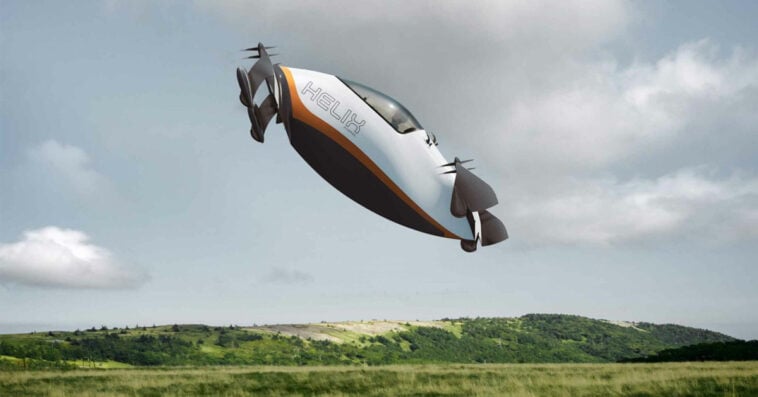
For decades, the promise of a flying car in every garage has felt like a distant Jetsons fantasy, but a breakthrough in aviation is finally bringing that dream down to earth and straight into your backyard. A revolutionary personal aircraft has officially hit the market for $190,000, and the most shocking part isn’t the price tag; it’s the fact that you can take to the skies without ever setting foot in a flight school or earning a pilot’s license. Curious how it works, who can fly it, and what the future holds for everyday aerial travel? Keep reading to get the full scoop.
Meet Pivotal’s flying car Helix
The idea of a personal flying car has long lived in science fiction, but Pivotal is making it real. The company’s story began in 2009 when founder Marcus Leng set out to build an electric aircraft that could rise vertically without gasoline. By 2011, he piloted the prototype, known as BlackFly, quietly refining it over the years. After moving to the Bay Area in 2014, Pivotal revealed BlackFly to the world in 2018. That second-generation design laid the groundwork for today’s Helix. In 2022, Ken Karklin became CEO and shifted the focus from experimental test flights to customer reservations and formalized flight training.
Helix is a single-seat electric vertical takeoff and landing (eVTOL) aircraft that blends the vertical lift of helicopters with the simplicity of fixed wings, eliminating the need for a runway. Fully electric and weighing just 355 pounds empty, it cruises at around 62 mph, flies up to 30 minutes on a single charge, and recharges in about 75 minutes using a 240-volt outlet. Because it qualifies as an FAA (Federal Aviation Administration) Part 103 ultralight — the same category as hang gliders — pilots don’t need a license to take off.
How much does it cost to own a Helix?
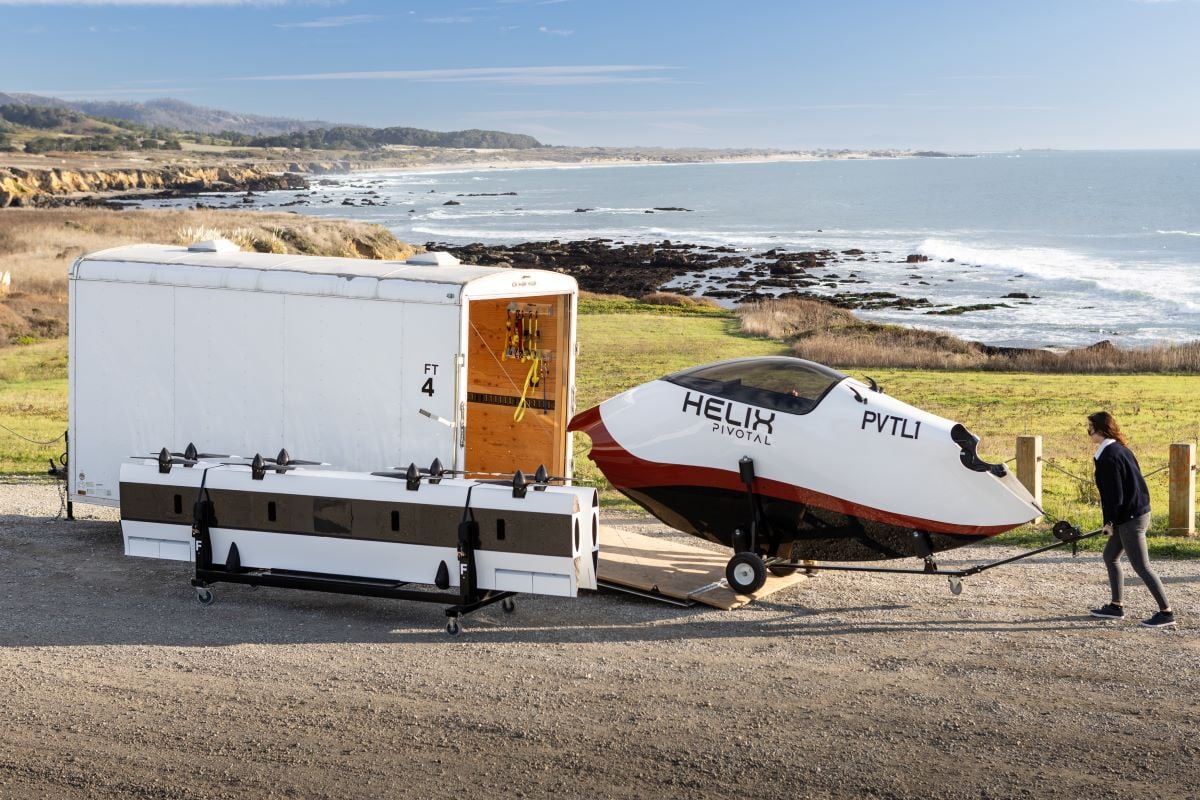
Owning a Helix flying car starts at $190,000, putting the dream of personal flight within reach for serious enthusiasts. Those looking to hit the skies with complete convenience can add a custom transport trailer for $21,000 and a dedicated charger for $1,100. To secure one, buyers place a $50,000 deposit, and CEO Ken Karklin notes that reservations now could see delivery in nine to twelve months. Pivotal has already filled over a year’s worth of slots, reflecting strong early interest. You can make your reservation at the Pivotal website.
Learning to fly a Helix
Helix training takes place at Pivotal’s headquarters in Palo Alto and at the Monterey Bay Academy Airport, giving new pilots hands-on experience in both classroom and practical settings. The program covers the FAA knowledge test, ground school, and instruction on controlling, maintaining, transporting, and assembling the aircraft. Most participants complete the full training in under two weeks, making it a surprisingly quick path to personal flight.
So far, more than 50 people have been trained on Pivotal aircraft, including a mix of customers eager to take their Helix airborne and employees helping to support the growing fleet.
How safe is flying a Helix
From the ground up, Pivotal designed the Helix with simplicity and reliability in mind. With just 18 moving parts and multiple layers of redundancy, the eVTOL minimizes the chance of system failures. Its safety has been verified independently by the Light Aircraft Manufacturers Association, and the company’s quality management system carries AS9100D certification. Noise, another common concern, is surprisingly manageable: during takeoff and landing, the aircraft sounds “roughly like a couple of leaf blowers,” but once it’s airborne, it can be nearly silent to those on the ground.
Years of operational data have been central to shaping Helix’s performance. “Across our fleet, and including privately owned BlackFly aircraft, Pivotal eVTOLs have completed over 9,000 flights to date — of those, 2,500+ have had a pilot onboard,” the company said via Fox News, proudly noting that this track record is incident-free. “We have a flawless flight record and a flawless safety record.”
Despite these, Pivotal acknowledges that public trust is as vital as engineering, so it relies on direct engagement with communities and independent testing to build confidence. “We engage directly with communities through events and demonstrations across the country, giving stakeholders the opportunity to experience the aircraft firsthand.”
Independent studies reinforce Pivotal’s claims that their aircraft are quiet by design. “Independent NASA testing shows the Pivotal BlackFly produces approximately 70 dBA of flyover noise at 100 feet, a level aligned with how sound is perceived by the human ear,” said the company.
FAA rules further ensure safe and responsible operation of Pivotal’s aircraft: “Under FAA Part 103 regulations, ultralight aircraft are allowed to operate in uncontrolled airspace, including public and private land – close to 90% of the country. However, ultralight aircraft are not permitted to fly over congested areas, further reducing any concerns around noise.”
What’s next for Pivotal
Pivotal is charting a path into three strategic areas: personal ownership, public safety, and defense applications. In 2023, the company collaborated with an innovation division of the U.S. Air Force and the defense technology firm MTSI, leasing eight aircraft for testing that directly shaped the latest Helix design. Karklin said that everyday recreational flying and short-range travel could be just as transformative as large urban air mobility projects. According to him, these practical, approachable use cases may spark adoption faster, bringing personal eVTOLs into the mainstream before major city-scale networks take flight.
Source: Fox News