
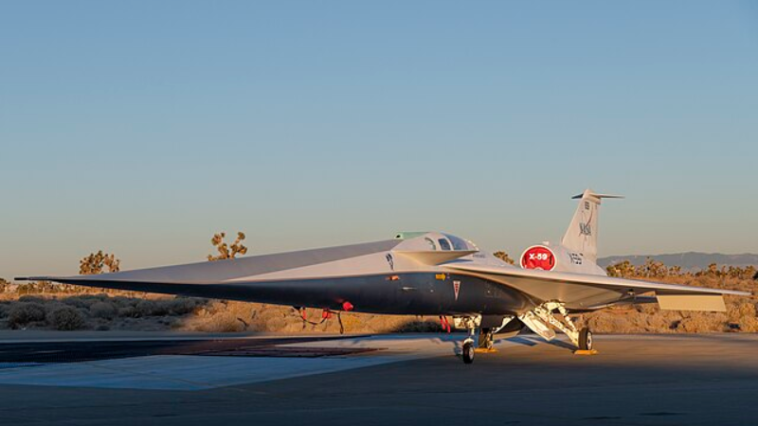
NASA’s latest experiment in quiet flight just made a little history and a very soft sound.
The space agency has spent years developing technology to solve one of aviation’s oldest problems: the deafening sonic boom that banned supersonic passenger jets from flying over land for more than 50 years.
For the first time, that solution—an experimental aircraft called the X-59, nicknamed the “flying swordfish”—took to the skies in late October this year. Developed by NASA and Lockheed Martin, it’s the first aircraft of its kind built to fly faster than sound without the thunderous booms that once made supersonic travel impossible over land.
The flight lasted about an hour, lifting off from Lockheed Martin’s Skunk Works facility in Palmdale, California, before landing safely at NASA’s Armstrong Flight Research Center in Edwards. It reached 12,000 feet and speeds of up to 290 mph, far below its top capability, as engineers focused on checking flight systems and controls.
The Aircraft Built to Beat a 50-Year Ban
The modest first flight was just the beginning of a much larger mission. Future tests are expected to push things much further. Designed to reach Mach 1.4 (925 mph) at 55,000 feet, the sleek jet could eventually cut cross-country travel times in half, paving the way for a return of commercial supersonic flight in the U.S. for the first time since it was banned in 1973.
At 99.7 feet long, with a 29.5 ft wingspan, and just 14 feet tall, the X-59 looks like something out of science fiction — all needle nose and narrow wings. This unusual shape isn’t for looks, though. The long, chisel-like nose was engineered to reshape the shockwaves that form when a plane breaks the sound barrier.
Instead of one explosive boom, those shockwaves scatter into a series of smaller ones, each producing a quiet thump. NASA says the noise will be about as loud as a car door closing — a far cry from the window-rattling blasts that grounded supersonic passenger jets decades ago.
Testing the Future of Supersonic Travel
The project, as part of NASA’s Quesst mission, aims to test public response to quiet supersonic flight. Future tests will have the X-59 fly over selected U.S. communities so researchers can measure how people react to the sound.
If successful, the data could help regulators lift the 50-year ban on supersonic commercial flights over land. That means one day, flying from New York to Los Angeles in just three hours might no longer be science fiction.
NASA’s engineers call the X-59 a “flying laboratory,” but its purpose is far more ambitious: to prove that speed and silence can coexist in the sky.
And after its first flight, a future, once shelved with the Concorde, just got a little bit closer.
Sources: NASA, Live Science, Lockheed Martin