
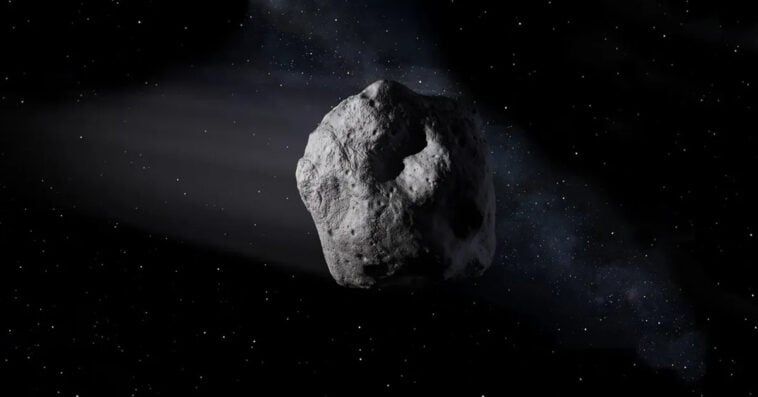
Imagine a rock the size of a football stadium hurtling through space at thousands of miles per hour, heading straight for a major city, and we have no way to stop it. NASA has just issued a sobering wake-up call, revealing that there are roughly 15,000 “city-killer” asteroids hiding in our cosmic neighborhood that we haven’t even found yet. While Hollywood movies make saving the world look easy, top experts are now admitting that Earth is currently wide open to a surprise attack, with no shield ready to protect us from these mid-sized monsters. It sounds like the plot of a disaster film, but the danger is very real. Keep reading to find out why these invisible threats are giving scientists nightmares and how close the next one might actually be to our front door.
Why humanity is defenseless against a surprise asteroid strike
The threat isn’t coming from the monsters we can see, but the ghosts we can’t.
A top NASA official has issued a sobering reality check: Earth remains dangerously exposed to a hidden fleet of roughly 15,000 undetected asteroids—each capable of wiping a major city off the map. Speaking to the American Association for the Advancement of Science (AAAS) in Phoenix, NASA planetary defense officer Kelly Fast admitted that while we have a firm grip on the massive “planet-killers,” the mid-sized rocks are slipping through the cracks.
“What keeps me up at night is the asteroids we don’t know about,” Fast warned.
According to reports from the Daily Star and The Times of London, the primary concern isn’t the giant objects or the tiny debris that “hitting us all the time.” Instead, the danger lies in the “interstellar in-betweeners”—rocks measuring roughly 500 feet across. These “city killers” are large enough to survive atmospheric entry and cause catastrophic “regional damage,” yet they are small enough to evade our current surveillance net.
The numbers are staggering. Of the estimated 25,000 city-killers lurking in our cosmic backyard, we have only identified about 40%. The remaining 60% are effectively invisible because they orbit the Sun alongside Earth, often staying tucked away in the Sun’s glare where they cannot reflect light. Fast noted that their awkward size makes them nearly impossible to track “even with the best telescopes.”
To bridge this defensive gap, NASA is preparing for a high-stakes scouting mission. Next year, the agency plans to launch the “Near-Earth Object Surveyor space telescope,” a specialized craft designed to hunt for thermal signatures rather than visible light. By “feeling” the heat of these dark asteroids against the cold backdrop of space, scientists hope to finally map the hazards hiding in the dark.
As Fast puts it, the goal is simple but urgent: the agency must “find asteroids before they find us” and perfect the technology for “getting asteroids before they get us.”
Why finding a city-killer is only half the battle
Detection is only half the battle; the second half is a fight we aren’t currently equipped to win. Even if we managed to unmask every incognito space rock in our vicinity, humanity’s defensive toolkit remains dangerously empty.
While NASA made history in 2022 by slamming its DART (Double Asteroid Redirection Test) spacecraft into the mini-moon Dimorphos at 14,000 mph (proving we can technically nudge an asteroid off its path) scaling that success for a real-world emergency is a different story. According to DART mission leader Nancy Chabot, a planetary scientist at Johns Hopkins University, we simply don’t have a “city-killer” interceptor “sitting around ready to go.”
The hard truth is that while the theory works, the hardware doesn’t exist yet. “We would not have any way to go and actively deflect one right now,” Chabot lamented.
The roadblock isn’t just scientific; it’s financial. Chabot noted that space agencies currently “lack the funding to keep planetary defenses on standby,” meaning there is no “rapid response” fleet waiting on a launchpad. Despite the grim current state of affairs, she insists that our vulnerability is a choice.
“We could be prepared for this threat,” she warned. “We could be in very good shape. We need to take those steps to do it.”
As the census of “city-killers” grows, the need for a standing defense plan is no longer a futuristic luxury—it’s a race against a clock we can’t yet see.
Our closest ‘city killer’ threat
The most immediate danger on NASA’s watch list isn’t headed for Earth—at least, not yet. Scientists are sounding the alarm over Asteroid 2024 YR4, a notorious “city-killer” that has been under intense surveillance for two years. New trajectory models reveal a startling 4% probability that this massive space rock will slam into the Moon in 2032.
While a lunar impact might seem like a distant problem, planetary defense experts aren’t taking any chances. To prevent a catastrophic crash landing on our celestial neighbor, researchers have proposed a solution straight out of a Hollywood blockbuster: a nuclear strike. Reminiscent of the sci-fi thriller Armageddon, the plan involves using atomic charges to intercept the asteroid and blow it to pieces—or nudge it off its collision course—before it can reach the lunar surface.
Source: The Daily Star, The Times of London, New York Post