
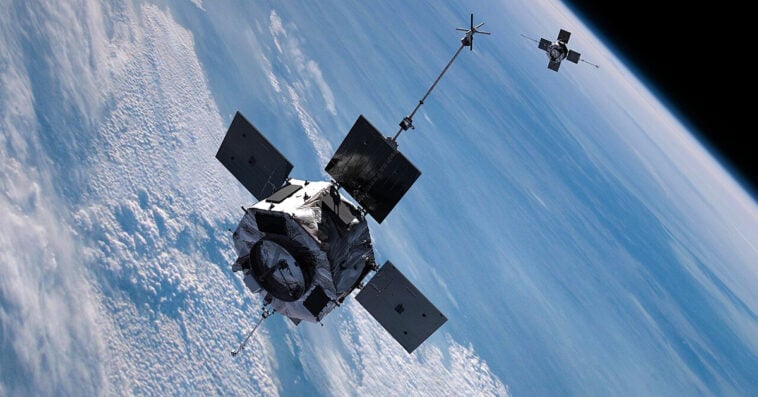
A defunct NASA spacecraft weighing about 1,300 pounds is expected to make a dramatic return to Earth today, bringing an end to a mission that began more than a decade ago. The satellite has spent nearly 14 years orbiting the planet and is now set to plunge back through the atmosphere. While most of it is expected to burn up during a fiery descent, one question remains: could any debris pose a danger on the ground? Keep reading to learn more about the retired spacecraft, why it is falling now, and what scientists say could happen when it finally reenters Earth’s atmosphere.
The final descent of NASA’s Van Allen Probe A
A veteran of deep-space exploration is coming home in a blaze of glory. Today, March 10, 2026, the 1,323-pound (600 kg) Van Allen Probe A is slated to pierce Earth’s atmosphere.
According to Space.com, the satellite was initially designed to operate for only two years. However, it continued functioning far longer than expected. Both the probe and its twin spacecraft, Van Allen Probe B, remained active until 2019, delivering valuable scientific data throughout their extended missions.
The two spacecraft were originally called the Radiation Belt Storm Probes and were launched together on August 30, 2012. A United Launch Alliance Atlas V rocket carried them into orbit from Space Launch Complex 41 at Cape Canaveral Air Force Station in Florida.
Their mission focused on studying Earth’s Van Allen radiation belts, which are two doughnut-shaped zones filled with high-energy charged particles trapped by the planet’s magnetic field. By observing these regions, scientists gained deeper insights into how solar storms can alter radiation levels in space, potentially affecting satellites, astronauts, and other spacecraft.
According to NASA, “By observing these dynamic regions, the Van Allen Probes contributed to improving forecasts of space weather events and their potential consequences.”
After years of successful operations, both spacecraft were eventually retired in 2019 once their fuel supplies were exhausted. Van Allen Probe B ended its mission first on July 19, 2019, while Van Allen Probe A followed on October 18, 2019.
Now, the final phase of the probe’s journey is approaching. The U.S. Space Force estimates that Van Allen Probe A will reenter Earth’s atmosphere at around 7:45 p.m. EDT on Tuesday, with a possible timing window of plus or minus 24 hours.
Why Van Allen Probe A is returning early
While both satellites were originally projected to remain in orbit until 2034, a volatile surge in solar activity has rewritten the timeline. Intense solar radiation caused Earth’s upper atmosphere to heat and expand, significantly increasing the atmospheric drag on the aging spacecraft. This orbital friction acted like an invisible brake, dragging Van Allen Probe A out of its stable path and pulling it toward a premature, fiery conclusion.
Interestingly, its twin is not sharing the same fate just yet. Despite their identical origins, Van Allen Probe B remains in a more resilient orbit and is not expected to make its own reentry until at least 2030.
Why you don’t need to worry about falling debris
While the idea of a 1,300-pound satellite plummeting toward the surface sounds like a scene from a disaster movie, the actual threat to life is remarkably low. As the spacecraft hits the atmosphere, the majority of its chassis will be consumed by the intense friction and heat of reentry.
However, NASA does acknowledge that a few reinforced parts might survive the inferno:
“NASA expects most of the spacecraft to burn up as it travels through the atmosphere, but some components are expected to survive re-entry,” a NASA official said in a statement.
Despite the possibility of small fragments reaching the ground, the statistical danger remains “extremely low.” According to NASA’s calculations, the probability of any single person being harmed is roughly 1 in 4,200.
The primary reason for this high safety margin? Our planet’s geography. With 70% of Earth covered by water and vast stretches of the remaining land being uninhabited, any debris that survives the descent will almost certainly splash into the ocean or land in a remote area rather than a populated city. Estimates suggest the overall risk of injury is around 1 in 5,000, making a serious incident highly unlikely.
Source: Space.com