
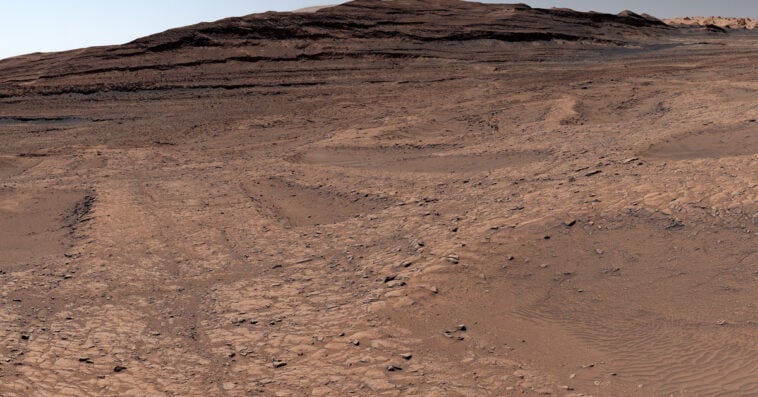
NASA’s Curiosity rover has just come face-to-face with a mystery that has haunted scientists from a distance for years. While orbital satellites first spotted strange, web-like patterns on the Martian surface many years ago, they remained blurry shapes viewed from miles above — until now. These “spiderwebs” are actually massive mineral ridges called boxwork, and Curiosity’s new, up-close photos are finally revealing their secrets. These towering structures hint that liquid water flowed through the Martian soil far more recently than anyone predicted, turning a long-standing curiosity into a groundbreaking discovery about the planet’s ability to host life.
New evidence suggests ancient Martian water lasted longer than expected
For the past six months, NASA’s Curiosity rover has been navigating this labyrinth of boxwork —stunning, wall-like ridges standing 1 to 2 meters tall that separate deep, sandy hollows. When viewed from satellites miles above, these interconnected patterns look like giant, dusty spiderwebs etched into the Martian surface.
The rover is currently climbing Mount Sharp, a 5-kilometer-tall peak where each rock layer represents a different era of Martian history. As Curiosity ascends, the landscape usually shows signs of a planet drying out, but these spiderwebs tell a different story.
“Seeing boxwork this far up the mountain suggests the groundwater table had to be pretty high,” says Tina Seeger of Rice University, a lead scientist on the investigation. “And that means the water needed for sustaining life could have lasted much longer than we thought looking from orbit.”
Until Curiosity arrived, researchers could only guess how these structures formed. A theory from 2014 suggested that central fractures (cracks in the bedrock) acted as ancient plumbing, allowing mineral-rich groundwater to seep through. These minerals hardened the surrounding rock, creating a sturdy “skeleton” that remained standing even after millions of years of wind eroded the softer stone away.
With up-close inspection, Curiosity identified the dark lines seen from space as the predicted central fractures. The rover also found nodules (bumpy mineral textures), which are clear fingerprints of past water. Surprisingly, these nodules weren’t found inside the fractures as expected. Instead, they were scattered along the ridge walls and the hollows between them.
“We can’t quite explain yet why the nodules appear where they do,” Seeger noted. “Maybe the ridges were cemented by minerals first, and later episodes of groundwater left nodules around them.”
This discovery proves that the Red Planet’s wet period wasn’t a brief flash in the pan, but a long-lasting era that may have provided a stable home for ancient microbial life.
Curiosity drills deep to decode Mars’ watery past
A cornerstone of NASA’s Curiosity mission is the detailed study of Martian rock, made possible by the rover’s drill mounted at the end of its robotic arm. The drill grinds rock into fine powder, which is then delivered to sophisticated instruments inside the rover for in-depth laboratory analysis.
Last year, the Curiosity team collected three drilled samples from the boxwork region: one taken from the crest of a ridge, another from exposed bedrock within a hollow, and a third gathered before the rover reached the ridged terrain. These samples were examined using X-ray techniques and a high-temperature oven. The results revealed clay minerals within the ridge material and carbonate minerals in the hollow — chemical fingerprints that offer valuable insight into the role water may have played in shaping these formations.
More recently, scientists obtained a fourth sample and subjected it to an advanced method reserved for especially compelling targets. After heating the powdered rock in the rover’s onboard oven, researchers introduced chemical reagents in a process known as wet chemistry. This approach enhances the detection of specific organic compounds — carbon-based molecules that are considered fundamental building blocks for life.
Curiosity is expected to move on from the boxwork terrain in March and will continue traversing Mount Sharp in order to help scientists piece together how the planet’s climate evolved and dried billions of years ago.
Source: Phys.org