
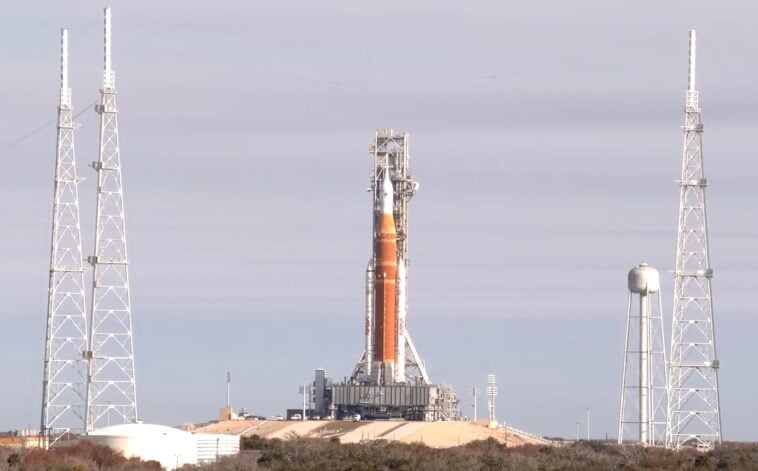
NASA has officially begun rolling the Artemis II rocket away from Launch Pad 39B and back toward the Vehicle Assembly Building (VAB)—a careful, multi-hour trip across roughly four miles of roadway. The crawler moves at little more than walking speed, turning the operation into a rare sight: a Moon rocket commuting back indoors before ever leaving Earth.
The delay effectively rules out a March launch and pushes the mission back to April, the next available launch window. While it may look like a setback, this is the NASA process doing exactly what it should—and what human-spaceflight safety demands.
The rollback follows engineers identifying an irregularity in the rocket’s upper-stage helium pressurization system during final preparations. No failure occurred, no emergency was declared, and no dramatic abort took place. What NASA saw was data that was not perfectly understood. When astronauts are involved, uncertainty is reason enough to pause.
What Engineers Found
During the Wet Dress Rehearsal—the full fueling and countdown simulation that takes the rocket to just seconds before ignition—engineers were not only validating procedures, they were studying behavior.
The test confirmed that the vehicle could be loaded with cryogenic propellants and run through the terminal countdown, but it also revealed something subtle inside the rocket’s upper stage: an irregularity in the helium pressurization system.
Helium in a launch vehicle is not a propellant; it is the control mechanism that allows propellants to behave predictably. It performs several essential functions:
- Maintains stable pressure inside liquid oxygen and liquid hydrogen tanks as fuel drains.
- Forces propellant toward the engines at precisely controlled rates.
- Clears feed lines prior to ignition to prevent unstable combustion.
- Stabilizes engine start conditions during the critical first milliseconds of firing.
Rocket engines operate in a narrow envelope. They must start cleanly and symmetrically. If tank pressure fluctuates or flow timing varies, ignition can still occur, but it won’t be identical every time. For an uncrewed payload, this may fall within acceptable margins. For a human-rated vehicle, it does not.
During the rehearsal, sensors indicated helium behavior that differed slightly from prediction models. The issue was not whether the rocket could start; it was whether engineers could prove with certainty how it would start every time. Rather than attempt a diagnosis at the launch tower—where access is limited, weather exposure complicates work, and only partial inspections are possible—NASA chose to roll the vehicle back to the VAB.
Why the Rollback Matters
Rolling a rocket away from the pad may look like a step backward, but in practice, it opens capabilities the launch tower cannot provide. The VAB is effectively a controlled spacecraft workshop rather than a storage hangar. Think of it as the world’s largest and most impressive garage.
Standing roughly 525 feet (160 meters) tall, it is one of the largest buildings ever constructed by volume. Its enormous high bays allow technicians to surround the vehicle with full-height work platforms—something impossible on the exposed launch structure.
The rollback gives engineers three key advantages:
- Direct Access: Inside the VAB, crews can open panels, remove insulation, and physically inspect valves, regulators, and sensors at every level. Work can proceed continuously without wind, lightning risk, or pad safety constraints.
- Full Verification: Rather than correcting a single measurement, NASA can evaluate the system holistically. The goal is not simply to make the reading “go away,” but to prove the entire propulsion sequence behaves predictably under repeat testing.
- Crew Safety Margin: Human-rated spacecraft operate under stricter requirements than cargo launches. If the data leaves any room for doubt, the vehicle does not fly.
The Takeaway
Spaceflight history is often defined by liftoffs, but sometimes the most important milestone is a decision made before ignition. By prioritizing verification over schedule, NASA is ensuring that when Artemis II finally leaves Earth, it does so under the safest possible conditions.