
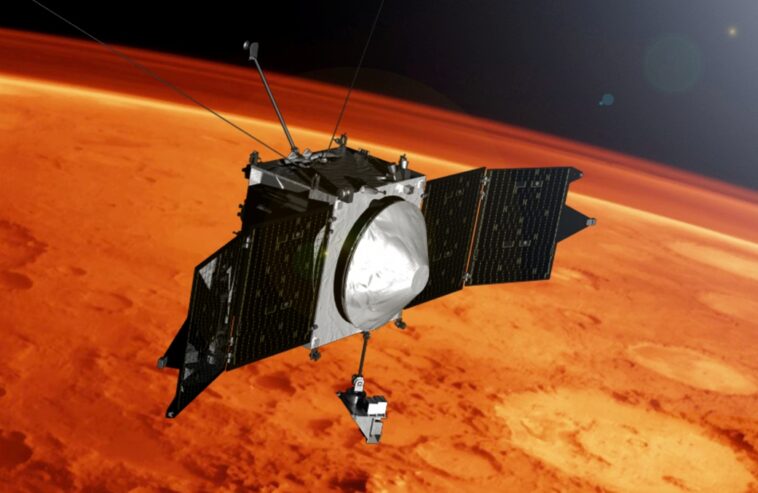
NASA has lost contact with MAVEN (Mars Atmosphere and Volatile Evolution), a long-running atmospheric research spacecraft that’s been orbiting Mars for more than a decade, after it stopped talking to ground stations recently.
The timing is what makes it unsettling: MAVEN rounded the planet, exactly like it has thousands of times, and it looked fine as it did. “Telemetry showed all subsystems working normally before it orbited behind [Mars],” NASA said.
Then it came back into view — and nothing.
“The spacecraft and operations teams are investigating the anomaly to address the situation. More information will be shared once it becomes available,” NASA added.
The Mission That Solved Mars’s Past
MAVEN launched in 2013 and reached Mars the following year. Its main job has been studying the planet’s upper atmosphere, and how it gets battered by the solar wind — work that helped build the case that the sun gradually stripped Mars of most of its atmosphere, turning it from a warmer, wetter place into the cold, dry world it is now.
It’s also been a workhorse in the background, helping support NASA’s surface missions by relaying communications for Curiosity and Perseverance — a high-speed service that is crucial for sending large volumes of science data and high-resolution images back to Earth.
Its high-capacity relay service—part of the redundancy provided by NASA’s orbiters—is essential, as a prolonged outage could significantly limit the total amount of high-resolution imagery and complex scientific data that the surface missions can send home.
NASA still has other Mars orbiters operating to continue providing critical relay communication services — the Mars Reconnaissance Orbiter (MRO), which arrived in 2006, and Mars Odyssey, operating since 2001, while engineers work to bring MAVEN back online. But for the moment, one of the agency’s key long-running Mars spacecraft remains silent.
Sources: NASA, The Guardian, University of Colorado Boulder (LASP)