
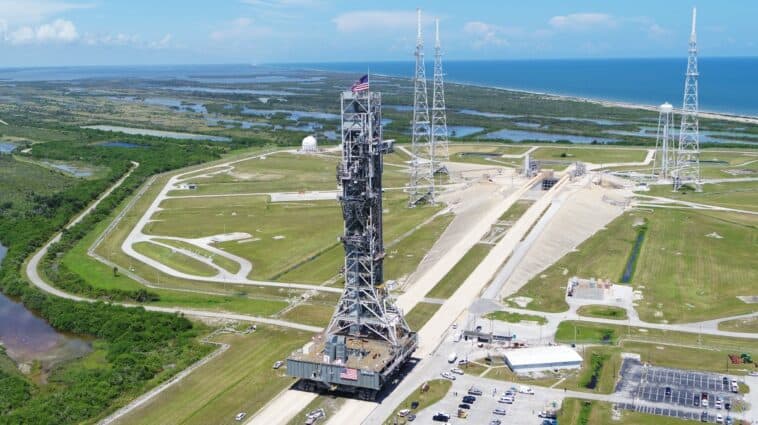
In the early hours of Friday, March 20, Artemis II began its return to the launchpad—following a rollback for helium system fixes and other checks with the spotlight once again on NASA’s towering Space Launch System (SLS) rocket and the astronauts preparing for humanity’s next journey around the Moon.
But before any of that can happen, one of the most remarkable machines in the space program has to do the heavy lifting—literally! That machine is NASA’s crawler-transporter 2, an engineering beast that never leaves the ground, yet remains one of the most important vehicles in spaceflight.
Originally built in the 1960s, these giant transporters first carried Saturn V rockets during Apollo and later hauled space shuttles to the pad. Now, after modernization for Artemis, the crawler is once again helping launch NASA into a new era of lunar exploration.
A Megastructure on the Move
The Crawler-transporter 2 is tasked with carrying the SLS rocket, NASA’s Orion crew spacecraft, and mobile launcher from the Vehicle Assembly Building to Launch Pad 39B at Kennedy Space Center. The trip covers about 4.2 miles and can take anywhere between 8 and 12 hours. It is slow, deliberate, and almost surreal to watch one of the most powerful rockets ever built inching its way to the pad atop a machine moving little faster than a walking pace.
This slow speed is part of what makes the crawler so fascinating. It is by no means a transport vehicle built for efficiency in the normal sense. Control is what it was mainly designed for. Loaded with a rocket, the crawler moves at roughly 1 mile per hour. Unloaded, it can reach about 2 miles per hour. Speed is irrelevant when your job is to move millions of pounds of flight hardware safely and smoothly, without dangerous vibration or tilt.
Diesel, Dreams, and Disproportionate Power
The numbers behind this machine are incredible. NASA says Crawler-Transporter 2 is about 131 feet long and 114 feet wide, and it weighs roughly 6.65 million pounds on its own. After upgrades for the Artemis era, it can carry up to 18 million pounds. This means that the crawler is not just large; it is operating in a category that barely feels real, more industrial megastructure than vehicle.
Its powertrain is just as wild. The crawler uses 16 traction motors rated at 375 horsepower each. It also relies on massive diesel engines and generators to produce the electricity needed to move and operate the system.
NASA’s fact sheet notes that it carries 5,000 gallons of diesel fuel and burns about one gallon every 32 feet. That works out to roughly 165 gallons per mile, making it one of the least fuel-efficient machines imaginable—but also one of the few vehicles in the world with a job this extreme.
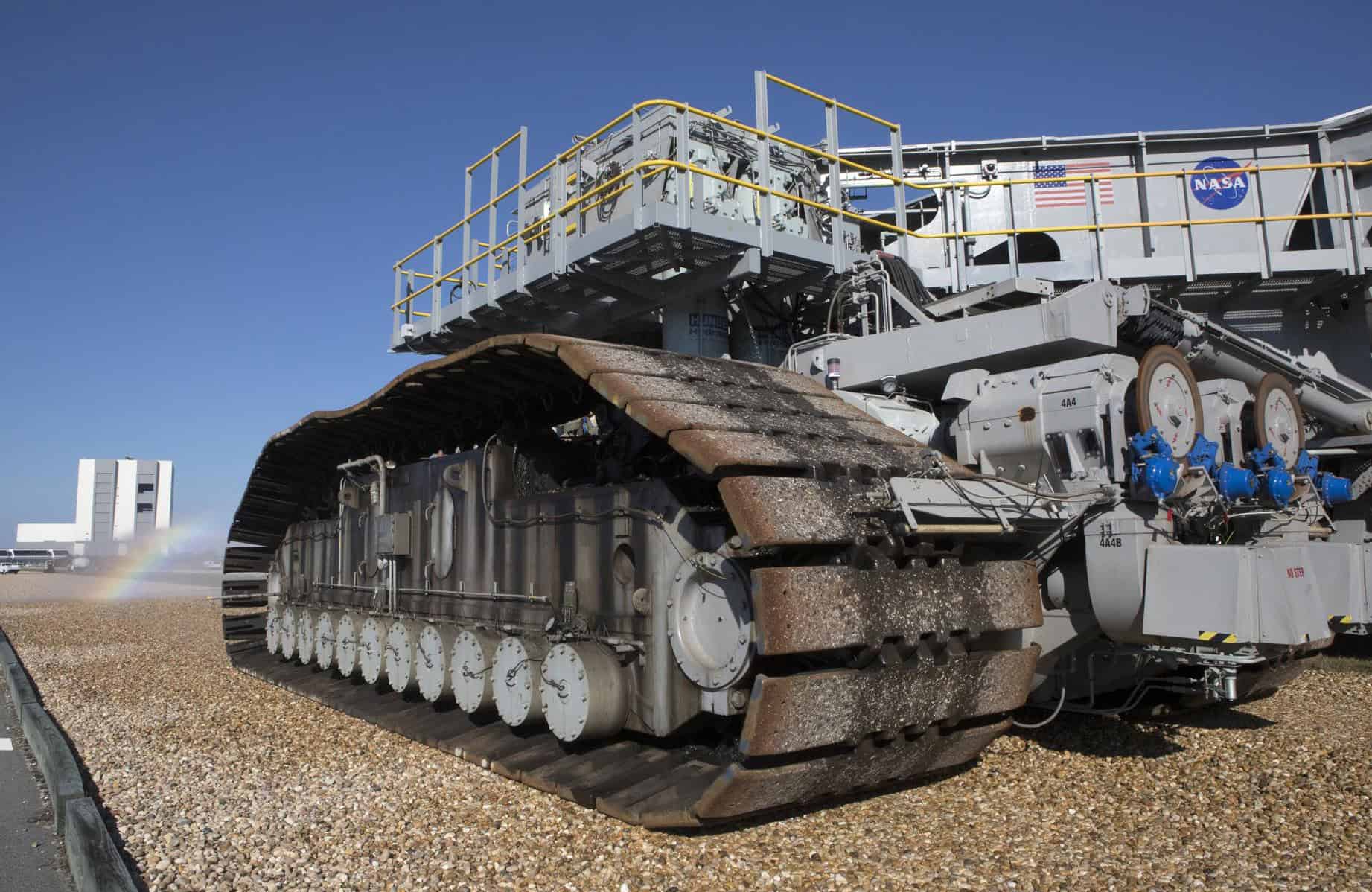
What makes the crawler especially impressive is that it is not simply brute force on tracks. It is also a precision instrument. As it climbs the incline leading to the launchpad, the crawler uses a hydraulic jack-and-leveling system to keep the rocket stable and nearly level. This is a critical capability when transporting a structure as tall and delicate as a Moon rocket. The machine is hauling an enormous weight, but it has to do it with extraordinary care.
Then there is the road itself. The crawler does not drive on asphalt or concrete in the traditional sense. Instead, it travels on the famous crawlerway, a specially engineered route built from layers of Alabama river rock.
NASA says the crawlerway uses stones about 3 to 4 inches in diameter and contains around 70,000 tons of rock. The unusual surface helps distribute the extreme load and reduce wear and vibration during rollout. In other words, even the “road” beneath this machine had to be custom-built for a vehicle unlike anything else on Earth. Figure that!
Few machines anywhere have served across so many generations of spaceflight, and fewer still remain so essential. That’s perhaps what makes the crawler such a perfect symbol of NASA. It is not flashy. It does not fly. It does not get the dramatic launch-day glory. But it is an engineering marvel in its own right.
Sources: NASA Fact Sheet, Space, NASA (Crawlerway), Florida Today, NASA (Artemis II Rollout)