
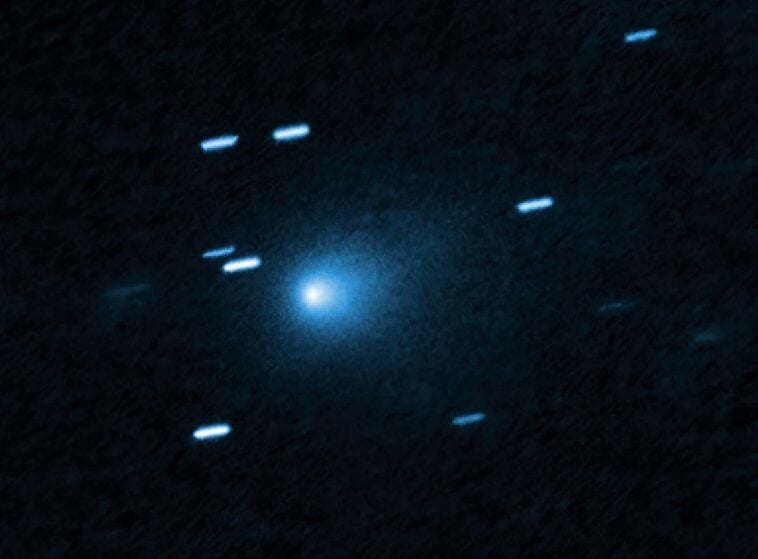
Water discoveries in space happen all the time. But this one’s actually a big deal, and not just because some scientists got excited (though they absolutely did).
NASA’s Neil Gehrels Swift Observatory just spotted something remarkable: water vapor streaming off an interstellar comet called 3I/ATLAS. And before anyone yawns, here’s why this matters to literally everyone, even those who couldn’t care less about space rocks.
The cosmic tourist that’s rewriting the rulebook
First, some context. Comet 3I/ATLAS isn’t from around here – and we mean that literally. This ancient space wanderer came from another star system entirely, making it only the third interstellar comet we’ve ever detected. It dropped by for a cosmic flyby in July 2025, and once it leaves our Solar System, it’s gone forever. No return visits.
Here’s the kicker: this thing is at least 7 billion years old. That makes it roughly twice as old as Earth itself, and the oldest comet humanity has ever laid eyes on. It’s essentially a pristine time capsule from a distant planetary system, which is why astronomers have been scrambling to study it before it vanishes into the cosmic void.
Water where it shouldn’t be
A team at Auburn University in Alabama pointed NASA’s Swift space telescope at 3I/ATLAS and detected hydroxyl (OH) gas—the chemical signature of water. The telescope caught a faint ultraviolet glow that ground-based observatories completely missed, because Earth’s atmosphere blocks that light from ever reaching the surface.
But here’s where it gets weird (and exciting): Swift detected this water activity when the comet was nearly three times farther from the Sun than Earth is. At that distance, most comets from our own Solar System are essentially dormant ice balls. Water ice shouldn’t be turning into gas that far out.
Yet 3I/ATLAS is losing about 40 kilograms of water per second. That’s not quiet. That’s loud.
Why you should actually care
Dennis Bodewits, a physics professor at Auburn, put it perfectly: “When we detect water – or even its faint ultraviolet echo, OH – from an interstellar comet, we’re reading a note from another planetary system. It tells us that the building blocks of life’s chemistry travel freely between stars.”
Translation? The basic building blocks for life as we know it aren’t some cosmic fluke that only happened here. They’re out there, in other star systems, forming around other suns. That dramatically increases the odds that life could exist elsewhere in the galaxy.
This discovery also gives scientists a way to study the chemistry of planetary systems beyond our own using the same methods they use for comets in our Solar System. It’s like finally getting a decoder ring for alien solar systems.
Each interstellar visitor rewrites the script
“Every interstellar comet so far has been a surprise,” says Zexi Xing, the study’s lead author and postdoctoral researcher. “Oumuamua was dry, Borisov was rich in carbon monoxide, and now ATLAS is giving up water at a distance where we didn’t expect it. Each one is rewriting what we thought we knew about how planets and comets form around stars.”
The prevailing theory for why 3I/ATLAS is so active this far from the Sun is that sunlight might be heating tiny icy grains that broke off from the comet’s nucleus, causing them to vaporize and feed that surrounding cloud of gas. It’s different from what we see with local comets, which tells us that planet-forming regions vary wildly across the galaxy.
A cosmic window that’s closing (and reopening)
The ancient comet has faded from view for now, but astronomers will get another shot at studying it after mid-November 2025, when it emerges from behind the Sun and becomes observable again. NASA managed to use Swift’s modest 30-centimeter telescope (most amateur astronomers have bigger ones in their backyards) positioned above Earth’s atmosphere to catch those crucial ultraviolet wavelengths within weeks of discovery.
The bottom line? This 7-billion-year-old cosmic messenger is teaching us that the recipe for life’s chemistry isn’t exclusive to our corner of the universe. And in an era where we’re actively searching for habitable worlds and signs of life beyond Earth, that’s information worth paying attention to.
Source: BBC Sky at Night Magazine