
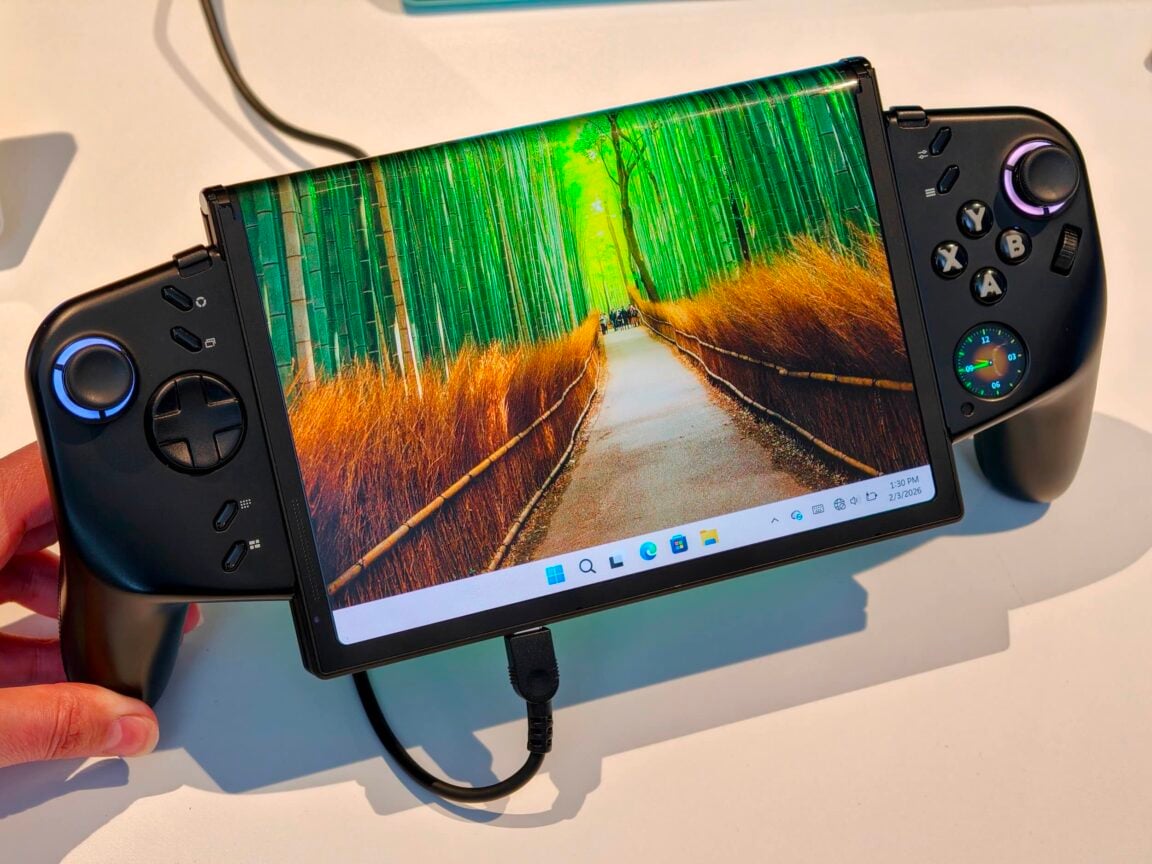
Lenovo’s predilection for thinking up cool new ways to pack more display area into their devices is well known, and to no one’s surprise, that’s not changing at Mobile World Congress in Barcelona this week. We’re getting a look at three Lenovo concepts at this year’s show, including a new take on the Legion Go gaming handheld and two laptop concepts. Almost all the greatest hits are here — multiple displays, folding displays, 3D displays — and knowing Lenovo’s recent track record, we wouldn’t be surprised if we saw all three concepts on the market sooner rather than later.
Lenovo Legion Go Fold
Fresh off of announcing a much-anticipated Steam version of the Legion Go 2 at CES in January, Lenovo is giving us a look at another take on their gaming handheld. A foldable screen is at the core of this concept — a 7.7-inch POLED display that can be folded out into an 11.6-inch display. That’s sandwiched between two detachable controllers, which can be attached to the screen in any orientation — when folded and when unfolded, and either in landscape or portrait orientation.
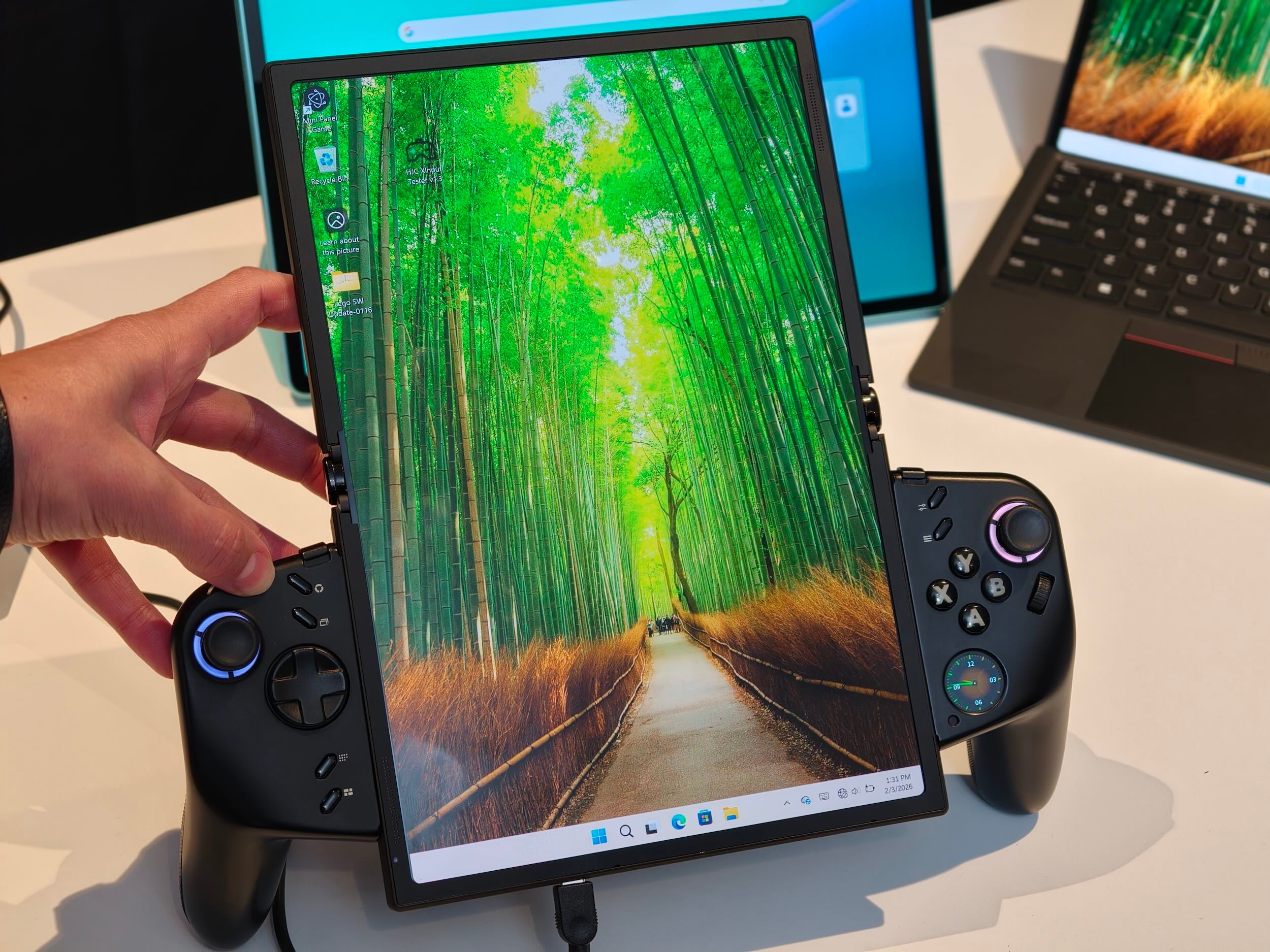
In short: mobile widescreen gaming. Holding the extended screen horizontally with the controllers seems like it’ll be some amount of awkward, so we’re looking forward to getting some hands-on experience eventually to see how that feels in action. Lenovo suggests that the extended portrait mode is likely to be used by streamers, with one half of the screen for the game and one half for chat or stream management.
While the gaming implications are taking center stage, this might be the first Legion Go that means business, too. The concept device came with a wireless keyboard and touchpad, which when combined with the extended display made for a very lightweight laptop. Folks who want to do a little gaming but need to do a little work when they’re on the road will only need this one device. Of course, the keyboard can also just be used as a stand, in which case one of the detachable controllers can be used as a handheld mouse for gaming.
Lenovo says the concept uses an Intel Core Ultra 7 258V processor, and they didn’t mention a GPU — that could mean that should this concept hit the market, there may be some sacrifices in performance for the sake of versatility, maybe to avoid driving the asking price up too high. Whatever the case may be, it’s pretty impressive how many uses Lenovo stuffed into the Legion Go Fold concept, and we’re looking forward to hearing more about it in the months to come.
Lenovo ThinkBook Modular AI PC Concept
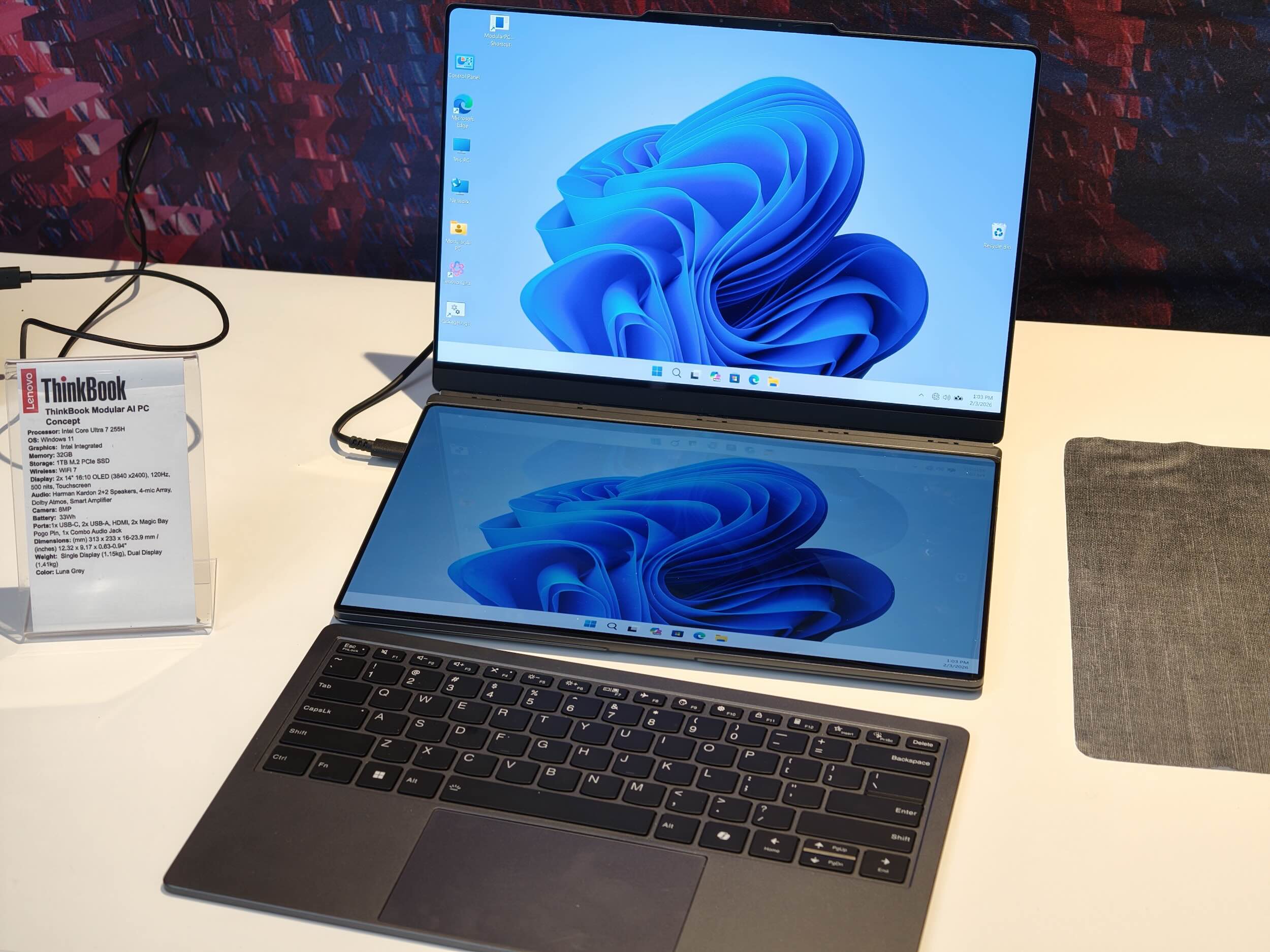
On to strictly business — the Lenovo ThinkBook Modular AI PC concept comprises two displays, a keyboard, and swappable ports. It may eventually be a part of the always experimental ThinkBook Plus line, but for now, it’s just an idea Lenovo is showing off at MWC 2026.
Lenovo’s 14-inch concept laptop comes with a second detached 14-inch display that can be used in about as many ways as you can imagine. For starters, the keyboard is part of the modular system, and can be removed from the case to make space to slot in the second display — great for artists who want to edit an image on the bottom screen while keeping their eyes on a reference image on the top screen. The second display can also be mounted to the back of the primary display, allowing someone to share their screen with someone sitting across from them. In that configuration, the laptop can be closed, with the second display then acting as a tablet.
Or, the second display can sit on its own kickstand and be used as a second screen for individual use. You can even detach the keyboard, put the second display in its place, then put the open laptop case on its side like a book to enable a multi-screen portrait orientation setup while using the keyboard wirelessly. Like with the Legion Go Fold, the concept is simple, but the use cases it enables are countless.
There are even modular USB Type-A, USB Type-C, and HDMI ports that can be swapped in and out of use, depending on what you need. As usual with Lenovo, all the separate modules connect to each other using pogo pins, which also pass power to the individual modules, so you still only need just one charging cable to power the whole kit.
If this indeed ends up being the next ThinkBook Plus, there’s a good chance we’ll hear more later this year at IFA 2026 in Berlin, or at next year’s CES in Las Vegas.
Lenovo Yoga Book Pro 3D Concept
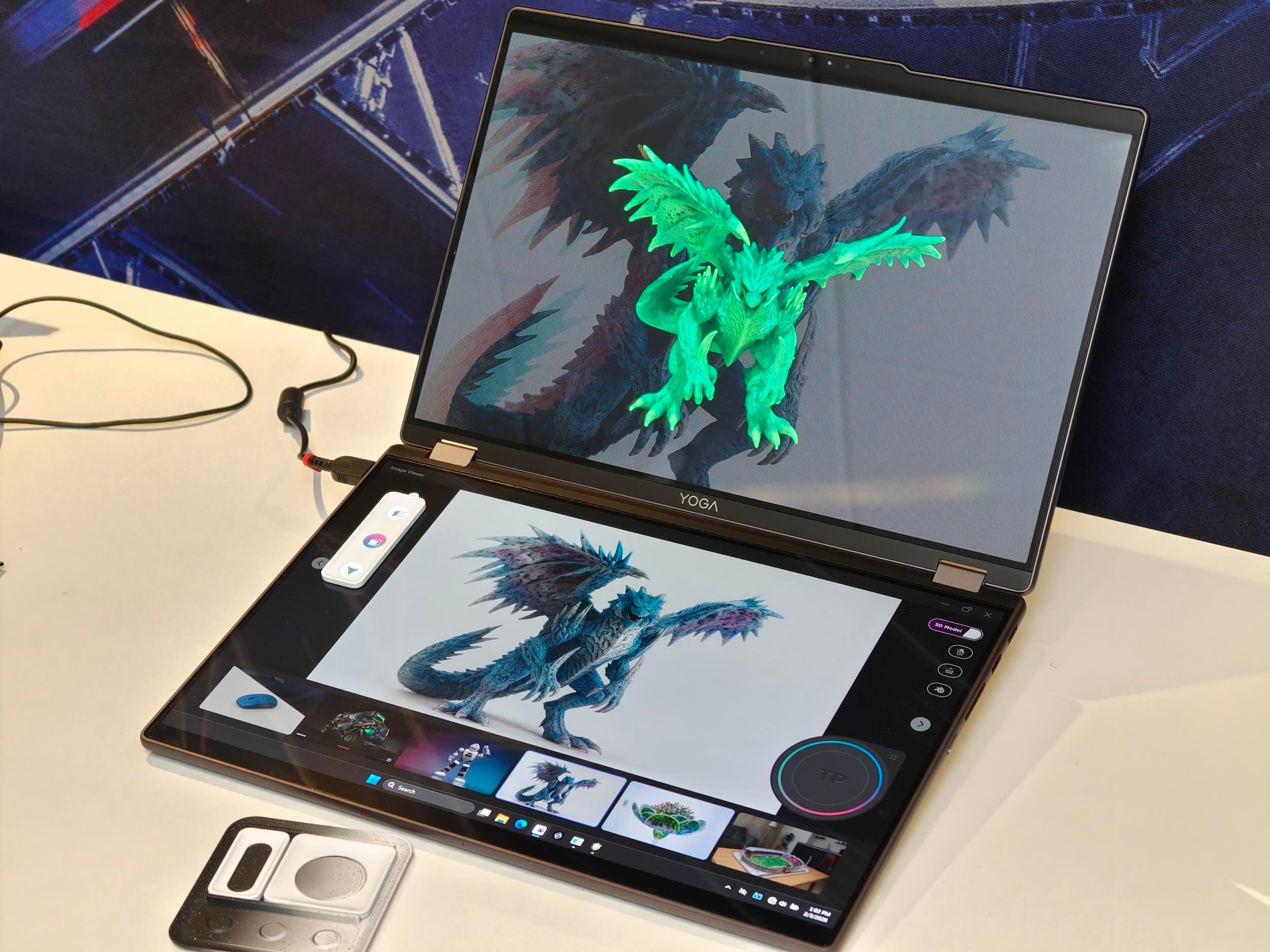
The Lenovo Yoga Book Pro 3D concept also has two displays, but dispenses with the keyboard altogether — this one is just for the digital art and media crowd. Specifically, it’s for folks in that crowd who need to create 3D assets that work with glasses-free 3D games and devices. Admittedly a niche crowd! But if you’re in that crowd, this concept looks like a must-have.
The upper display is itself a glasses-free 3D display. Not only can it be used to display 3D assets, users can prompt AI to create 3D environments for those assets to interact with, testing work to see what else needs to be changed. And when it’s time to make edits, the lower display shines — not only is it a touchscreen that allows assets to be turned and rotated easily, Lenovo included a set of physical snap-on pads that can be used to quickly adjust lighting, viewing angle, and tone.
Working on 3D assets will require some serious hardware, which is why we’re seeing an Intel Core Ultra 7 processor and an NVIDIA GeForce RTX 5070 GPU inside.
New Yoga, ThinkBook, ThinkPad, Legion, and IdeaPad devices coming soon
Lenovo plans to sell some things this year, too. They also took MWC to give some regular hardware refreshes to devices in almost all of their PC lineups.
But, they did sneak in at least one all-new device — the ThinkTab X11. This is a rugged tablet meant for work environments that usually beat up on fragile electronics, like factories and construction sites. In addition to physical toughness (meets military-grade standards for durability and is IP68 for total protection from water and dust), there’s also a wet touch feature that allows the touchscreen to be used effectively even when wet.
These tablets will probably serve important roles at those job sites, so they’ll always need to be usable. To that end, Lenovo has made the screen extra bright and made the battery removable. The ThinkTab X11 can also be used without a battery if it needs to be mounted and directly connected to a power source. All in all, it’s a device that can be used the whole day, or even continuously if there’s always someone on shift at the job site.
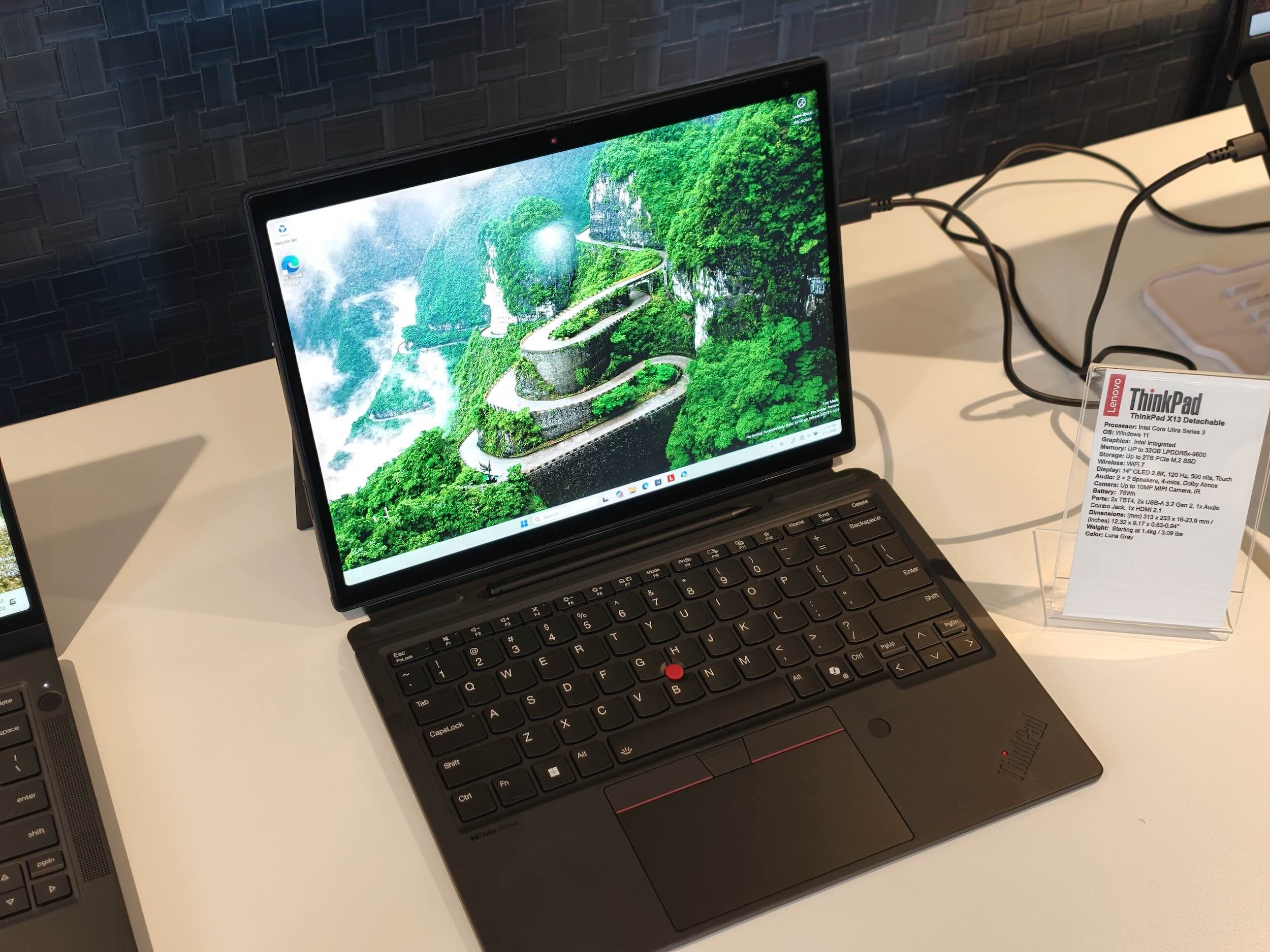
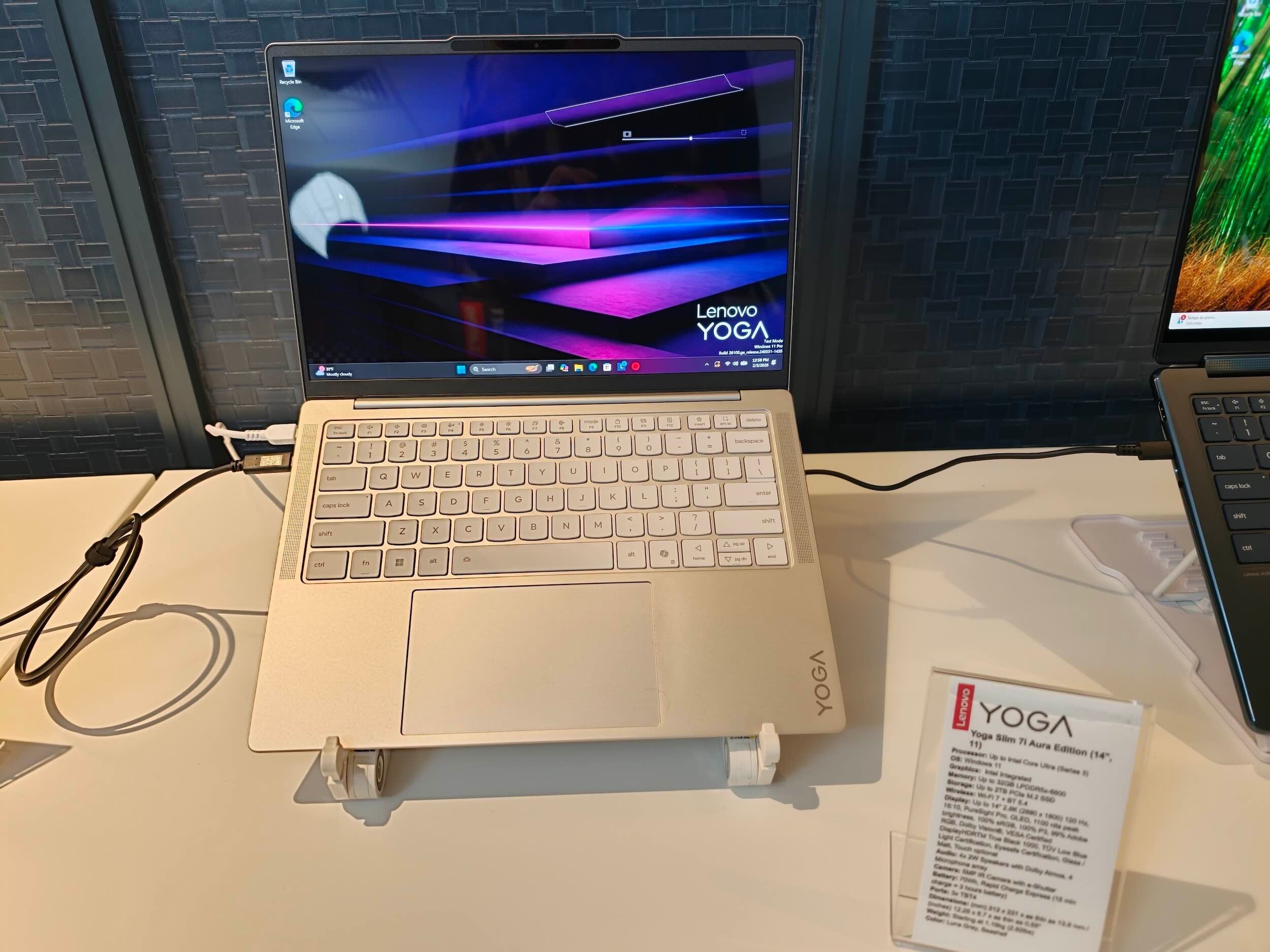
For hardware refreshes, we’re getting next-gen ThinkPad T14, T16, X13, and X11 releases, along with the ThinkBook 14 2-in-1 Gen 6. The new Yoga 9i 2-in-1 is getting an Aura edition, which includes additional tech support, smart user modes (e.g. gaming, work, home), and a Smart Share feature that makes wireless file transfers a little easier.
The IdeaPad Slim 5i Ultra gets a refresh, improving Lenovo’s entry-level ultra-thin, portable laptop, while in the gaming division, the Legion 7a — a 15-inch gaming laptop running on AMD hardware — gets a power boost.
You’ll see all those goodies hit the market between May and October of this year, with the majority launching in the summer.