
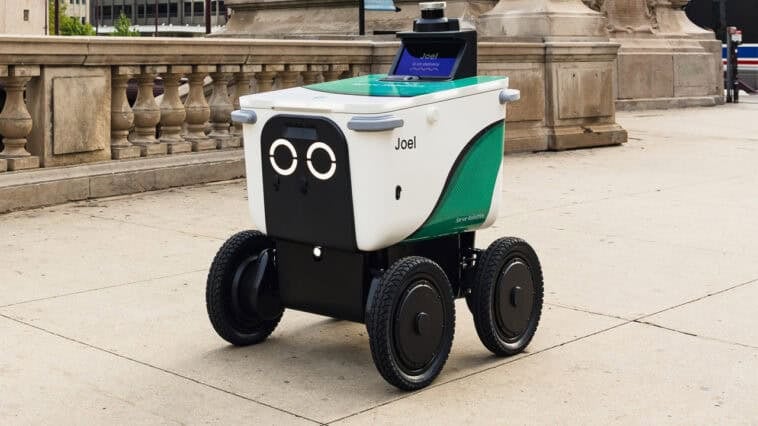
Food delivery robots are supposed to make life easier, but could they be collecting more personal information than people realize? Two lawsuits are raising serious privacy concerns over Coco and Serve Robotics, alleging that their delivery machines scan the faces, hands, and bodies of customers and unsuspecting pedestrians without their consent. Both companies have pushed back against the claims, but the allegations raise an important question about what these machines really see as they roll through city streets.
Lawsuits allege delivery robots collect facial and hand data
Two lawsuits filed in Cook County, Illinois, are raising questions about the privacy practices of food delivery robot companies Coco Robotics and Serve Robotics. The complaints allege that the companies’ machines collect biometric information by scanning people’s faces, hands, and bodies without their consent.
According to the lawsuits, the alleged scanning may affect not only customers receiving deliveries but also pedestrians who happen to walk past the robots on public sidewalks. The claims have sparked concerns about how much personal information these machines gather while moving through busy urban areas.
Serve Robotics says its robots do not identify people
Serve Robotics has defended its use of cameras and sensors, explaining that the technology helps its robots navigate Chicago’s sidewalks safely. The company told WLS that it does not use the collected data to identify individuals.
In a statement, a Serve Robotics spokesperson said the company was aware of the complaint and intended to defend itself against the allegations.
“Serve Robotics is aware of the complaint and will defend against it. Our robots use cameras and sensors to navigate the sidewalks of Chicago safely,” the company said. “Serve does not use that data to identify individuals and our systems are not designed to identify individuals or create biometric profiles.”
Serve Robotics maintains that its navigation systems are designed to help robots move safely through public spaces rather than identify people or build biometric profiles.
Coco Robotics calls the lawsuit meritless
Coco Robotics has also rejected the allegations, insisting that it has not collected biometric data in Chicago. Carl Hansen, the company’s head of Government Relations, said the lawsuit misrepresents how its technology works.
“This lawsuit fundamentally misunderstands our technology; we have not collected biometric data in Chicago, and we are confident that this frivolous lawsuit will go away,” said Hansen.
Hansen also emphasized the company’s commitment to protecting personal information and complying with applicable privacy regulations.
“Privacy and compliance with privacy laws are a top priority at Coco, and we believe these claims are meritless,” he added.
Hansen further disputed claims involving the company’s technology, specifically addressing the use of light detection and ranging (LiDAR), a system that uses laser pulses to measure distances and map surrounding environments.
“We have never used LiDAR in Chicago, and all data we collect complies with Illinois law,” explained Hansen.
Coco Robotics also defended its data-sharing practices, arguing that the information it provides to outside organizations is anonymous and intended to improve sidewalk safety.
“The data we share is anonymous navigational data used to make streets safer,” Hansen shared. “For example, we provide real-time sidewalk hazard information to BlindSquare, a navigation app built for people who are blind or have low vision. We never share video from the beginning or end of a trip.”
BlindSquare helps people who are blind or have low vision navigate their surroundings, making sidewalk hazard information potentially useful for safer travel.
Source:
ABC7 Los Angeles