
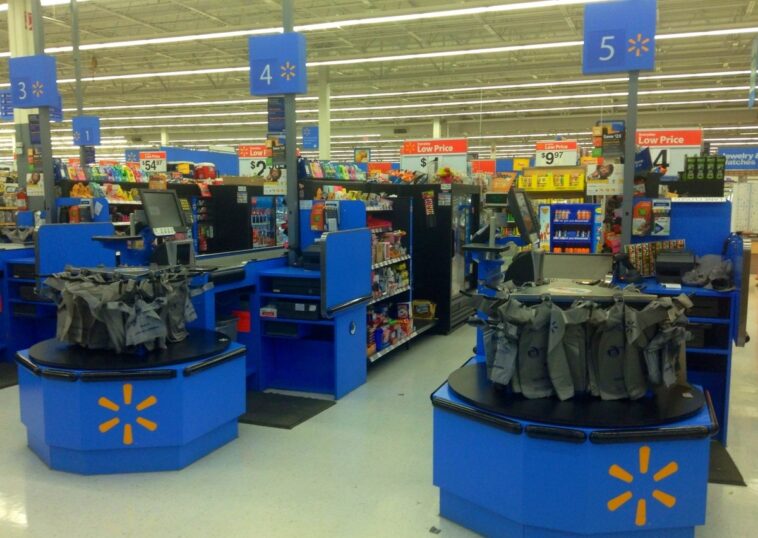
Beyond the broader 2026 store changes recently making headlines, the quiet reversal of the self-checkout model, once pitched as the absolute future of retail, deserves a closer look at the data driving the decision.
While the shift is often framed as a move to improve customer service, specific law enforcement data suggests the machines had become a security crisis that was no longer sustainable.
The “smoking gun” for this reversal is found at a Supercenter in Shrewsbury, Missouri, where self-checkout kiosks were taken out entirely. The move followed a sharp rise in theft-related incidents that had effectively overwhelmed local resources.
According to Shrewsbury police data, officers responded to 509 calls at the store during the first five months of 2024, when self-checkout was still in use. The machines were removed in April 2024. Over the same period in 2025, with traditional cashiers fully in place, that number fell to 183. Arrests at the location dropped by more than 50 percent. Police Chief Lisa Vargas said the difference was immediate and noticeable, with Walmart employees reporting fewer incidents requiring intervention
The Failure of the “High-Trust” Model
The decision to pull the machines was not tied to equipment failures. Instead, the data pointed to theft and fraud tied to self-checkout use, including missed scans and payment manipulation. In other locations, self-checkout stations have also been linked to card-skimming schemes like those recently reported in Gettysburg, Pennsylvania.
This failure of automation is a lesson the retail industry actually learned over 150 years ago. In 1879, saloon owner James Ritty invented the first mechanical cash register specifically to stop “shrink.” He called it the “Incorruptible Cashier.” The register was designed to create friction—a physical record and a human interaction that made theft difficult.
By removing the human cashier, modern self-checkouts removed that essential friction. As author James Clear notes in Atomic Habits, the most effective way to deter a bad habit is to make it difficult. By returning to staffed lanes, Walmart is re-injecting that difficulty back into the shopping experience.
A Quiet, Data-Driven Reversal
Walmart has not announced a nationwide rollback of self-checkout, and the company continues to use the machines in many stores while testing mobile-based Scan & Go technology at Sam’s Club locations.
Retail analysts say the shift reflects a broader pressure across the industry. During the pandemic, many chains expanded self-checkout to reduce labor costs and limit in-person contact. As theft increased and margins tightened, retailers have had to face the reality that the systems may not be worth the trade-off.
For now, the return of the staffed lane marks a notable reversal for a model once pitched as a “utopia.” While Walmart continues to roll out digital labels and AI assistants elsewhere in the store, when it comes to the final exit, the human cashier is making a data-driven comeback.
Sources: El Adelantado, Webster-Kirkwood Times