
Elon Musk has a new idea for the moon that involves a factory, artificial intelligence satellites, and a colossal catapult.
Following SpaceX’s acquisition of xAI on February 2, 2026, Elon Musk shared a company memo outlining his view that, within a few years, space would become the cheapest place to generate massive AI computing power thanks to unlimited solar energy and vacuum cooling.
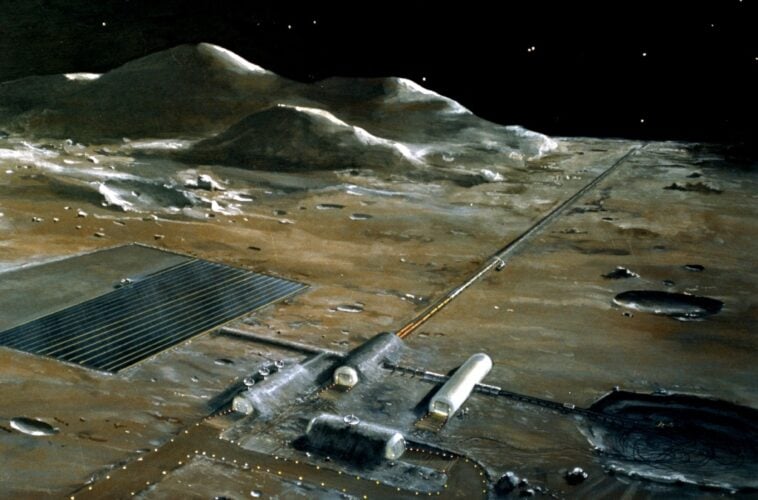
In the same written update and later during an all-hands meeting, he floated a longer-term vision: manufacturing satellites on the moon and using an electromagnetic mass driver—essentially a giant railgun—to launch them into deep space.
How the manufacturing chain would work
The logic, in Musk’s telling, starts with cargo capacity. SpaceX’s Starship rocket is designed to haul large payloads beyond Earth’s orbit. With in-space propellant transfer and repeated lunar landings, Musk argues, Starship could move the heavy equipment needed to establish a permanent manufacturing presence on the moon.
Once there, he suggests, factories could use local resources to build AI satellites. An electromagnetic launcher on the lunar surface would then accelerate those satellites off the moon without relying on traditional chemical rockets.
Such a system could eventually deploy hundreds of terawatts per year of AI satellites into deep space—a scale he links to advancing humanity up the so-called Kardashev scale, a measure of a civilization’s energy use.
A concept with decades of engineering history
Although the concept sounds futuristic, it isn’t exactly new.
In 1974, physicist Gerard O’Neill proposed using electromagnetic “mass drivers” on the moon. His idea was to mine lunar material and fling it into space, where it could be used to build solar power satellites or space habitats. Working at MIT with colleague Henry Kolm and student volunteers, O’Neill even helped develop early prototypes. Later iterations, supported by the Space Studies Institute, suggested that a mass driver about 520 feet long could loft material off the lunar surface.
The appeal was straightforward: launching from the moon requires far less energy than escaping Earth’s gravity. Add solar power and locally sourced materials, and the need to ship fuel from Earth drops sharply.
More recently, Robert Peterkin of General Atomics Electromagnetic Systems revived the idea in a 2023 report to the Air Force Office of Scientific Research. He argued that modern electromagnetic launchers, powered by abundant lunar solar energy, could support a resource-based lunar economy and pointed to existing electromagnetic aircraft launch systems on U.S. Navy carriers as proof that the technology works at scale, even if adapting it for the moon would require significant development.
The moon is known to contain silicon, aluminum, iron, and titanium, along with water ice in permanently shadowed craters. Advocates of lunar industry see those materials as the backbone of a self-sustaining space infrastructure: mine, refine, build, launch—all without lifting everything from Earth’s deep gravity well.
What Musk adds to the decades-old mass driver conversation is a modern catalyst: AI demand. As data centers on Earth strain under power and cooling requirements, some companies are exploring orbital or space-based computing. Musk’s version pushes that further, suggesting the moon itself could become part of the supply chain.
For now, the proposal remains conceptual. Starship has yet to complete a crewed lunar mission. No lunar factories exist. And a working, kilometer-scale electromagnetic launcher on the moon is still theoretical.
But the idea of a lunar catapult has been circulating for more than half a century. Musk’s comments don’t invent it. They bring it back into view—this time tied to AI rather than ore and space colonies.
The question isn’t whether the physics works. Engineers have long said it can. The question is whether anyone is willing to fund, build, and maintain a railgun on the moon.