
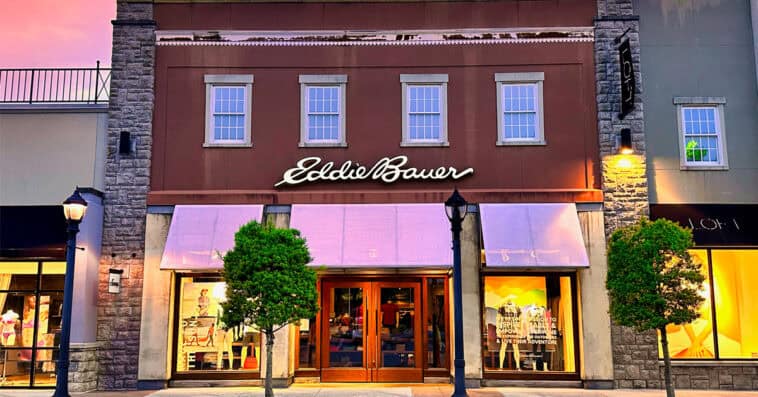
For over a hundred years, Eddie Bauer has been the go-to name for outdoor gear, but that long run in local malls is coming to a sudden end. With a bankruptcy filing on the horizon, the company is reportedly preparing to shut down all of its North American stores. While rival brands are winning over shoppers with high-tech gear and modern styles, Eddie Bauer has struggled to keep up, leaving fans wondering how a retail giant lost its way. Read on to uncover the key factors behind Eddie Bauer’s decline and what this landmark move signals for the retail industry.
Eddie Bauer steps away from physical retail, files for bankruptcy soon
Eddie Bauer is joining the growing list of retailers stepping away from physical stores. Citing sources, WWD reported that the outdoor apparel chain is preparing a Chapter 11 bankruptcy filing that would close roughly 200 of its North American locations.
The brand’s store operations are run by Catalyst Brands under a licensing agreement with Authentic Brands Group, the company that owns Eddie Bauer. So, this move is not expected to affect Catalyst Brands as a whole. Formed last year by Simon Property Group, Brookfield Corp., Authentic Brands Group, and Shein, Catalyst Brands oversees several well-known labels, including Lucky Brand, Aéropostale, Nautica, Brooks Brothers, JCPenney, and Eddie Bauer.
Starting Monday, February 2, Eddie Bauer will transition its e-commerce, wholesale, design, and product development operations to Outdoor 5, a global brand development and licensing platform. That partnership, announced on January 8, is a key step before the anticipated bankruptcy filing, which is expected either after the transition is complete or later this month.
Eddie Bauer to live on despite exit from physical stores
Does the imminent bankruptcy filing mean the end of Eddie Bauer? Not necessarily. While the brand is vanishing from North American street corners, the business is undergoing a restructuring rather than a total shutdown.
The anticipated Chapter 11 filing is strictly focused on the retail store entity. The brand’s core lifeblood—including manufacturing, e-commerce, and wholesale partnerships in the U.S. and Canada—will remain completely operational. These segments are currently being moved from Catalyst Brands to a new licensee, ensuring that the brand continues to exist in a digital-first capacity.
It’s worth noting that the filing is localized to North America. The 20 or so Eddie Bauer locations in Japan are not involved in this bankruptcy and will continue business as usual.
The storied history of Eddie Bauer
Eddie Bauer is widely regarded as a heritage brand in the outdoor apparel industry, with roots stretching back over a century. Founded in 1920 by Pacific Northwest sportsman Eddie Bauer, the company began by selling tennis wear in Seattle. Bauer is also credited with inventing the first quilted down jacket, earning a patent for his innovative design in 1940.
As reported by The Street, Eddie Bauer changed hands multiple times over the decades. After the founder sold the company in 1968, it passed through the ownership of General Mills and Spiegel. While under Spiegel Inc., Eddie Bauer filed for Chapter 11 bankruptcy in March 2003, as the parent company’s financial troubles forced the closure of numerous stores. Following a restructuring, Eddie Bauer re-emerged in June 2005 as a standalone entity, Eddie Bauer Holdings, Inc.
By June 2009, Eddie Bauer Holdings faced financial strain of its own. Burdened by heavy debt, declining sales, and recession-era pressures, the company filed for Chapter 11 bankruptcy once again. At that time, it operated hundreds of retail locations but struggled to stay financially afloat. During the bankruptcy process, Eddie Bauer secured financing to maintain operations while searching for a buyer. In July 2009, private equity firm Golden Gate Capital acquired the brand at a bankruptcy auction for approximately $286 million.
Since then, the Eddie Bauer name has expanded beyond apparel, licensing products that include furniture, bicycles, and even vehicles such as Ford’s Bronco, Explorer, and other SUVs. When Catalyst Brands was later established, it brought together more than $9 billion in sales, operated 1,800 stores, and held $1 billion in liquidity — with Eddie Bauer becoming part of its growing portfolio.
Why Eddie Bauer struggled to stay relevant
According to industry experts, Eddie Bauer’s decline isn’t just a financial story; it’s a failure of identity. Neil Saunders, Managing Director of GlobalData, argues that the brand has become “troubled” because it lacks a clear reason to exist. In his view, walking into an Eddie Bauer store today feels more like browsing a cluttered warehouse than visiting a premium outdoor specialist.
Saunders notes that while competitors like Fjällräven and Arc’teryx create “fantastic stores” full of storytelling and inspiration, Eddie Bauer’s locations are “crammed full of product” and difficult to shop. This lack of differentiation makes it hard to justify the brand in a competitive outdoor market.
In addition, Craig Sundstrom of the RetailWire BrainTrust points out a recurring retail lesson: brands often become “expendable” when they are absorbed into large conglomerates. He compares the situation to Lord & Taylor being sidelined after its acquisition, suggesting that Eddie Bauer lost its individual voice when it became just another piece of a giant corporate puzzle.
Sources: WWD, TheStreet, RetailWire