
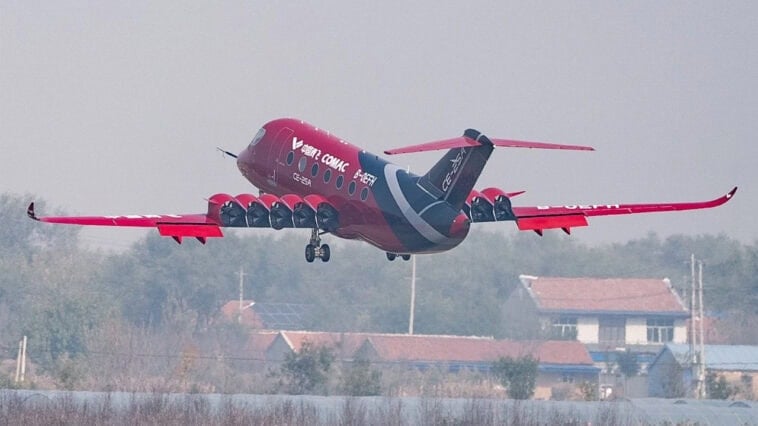
What if the next passenger plane you board doesn’t need a pilot to take off, navigate the skies, or land safely? China is bringing that possibility closer to reality with the CE-25A, an all-electric aircraft that can fly either with a human crew or entirely on its own. Designed to carry up to 19 passengers, the unusual aircraft has already completed multiple uncrewed test flights before reaching another important milestone with a crewed flight. But how close is China to making pilotless passenger flights a reality? Read on to find out what this aircraft can do and what its latest tests reveal.
A milestone flight with crew on board
The CE-25A, China’s first domestically developed 10-metric-ton-class electric commercial aircraft, completed its first piloted test flight in Binzhou, Shandong province, on Saturday. The flight marks a major step forward in bringing all-electric aircraft into regular short-haul commercial service.
Developed by the Commercial Aircraft Corp of China (COMAC), the plane took to the skies with two pilots and a flight test engineer on board. The entire test run lasted 57 minutes and 46 seconds, including 16 minutes and 38 seconds in the air, during which the aircraft covered a distance of 60.4 kilometers. Following the landing, COMAC noted in a statement that the aircraft performed normally and all test results met expectations.
Built for regional travel and autonomous flight
Before putting a human crew in the cockpit, engineers put the CE-25A through extensive pilotless trials. Saturday’s flight followed the plane’s debut unmanned autonomous test flight on Feb. 2, building on a series of 19 autonomous flight tests conducted throughout its development.
Designed specifically to ferry up to 19 passengers on short commercial routes between cities, the CE-25A offers a mix of regional range and clean propulsion:
- Propulsion: Instead of traditional jet engines, the plane relies on a distributed electric ducted-fan propulsion system mounted directly onto its wings.
- Size and Weight: It has a maximum takeoff weight of 10 metric tons.
- Speed and Altitude: The aircraft reaches a cruising speed of 300 kilometers per hour at a cruising altitude of 2,400 meters.
- Range: It can travel up to 400 kilometers on a single charge.
Powerhouse partnerships and the road to commercial service
To bring the electric commuter plane to life, COMAC joined forces with several major domestic partners, including Chinese battery giant Contemporary Amperex Technology Co. Ltd. (CATL) and Shanghai Jiao Tong University.
With testing progressing steadily, the aircraft is also moving forward on the regulatory front. According to COMAC, the Civil Aviation Administration of China has officially accepted the type certificate application for the CE-25A. The plane is being built to meet China’s strict CCAR-25 airworthiness standards for transport-category aircraft — the same safety regulations applied to large commercial airliners. While full certification must still be completed before paying passengers can board, the application’s acceptance clears an essential hurdle toward commercial service.
Source:
China Daily