
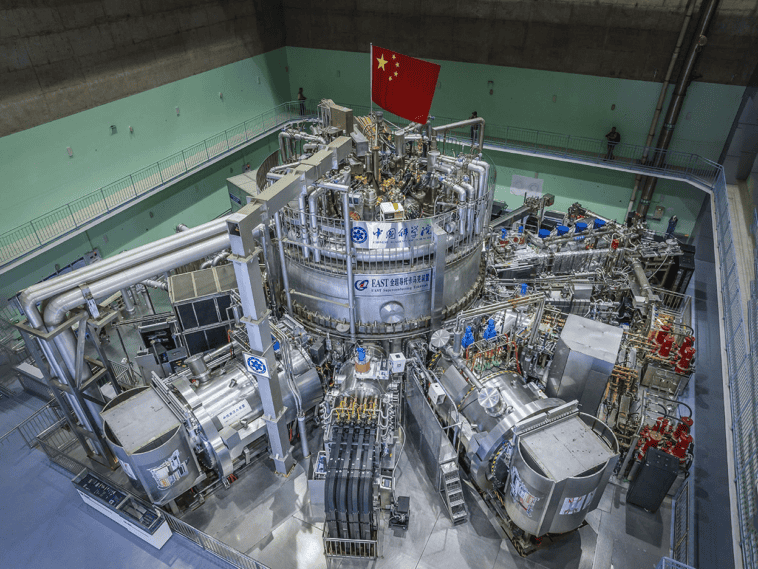
China just built a magnet so enormous that calling it “heavy” feels like underselling the situation. The superconducting magnet weighs 582 metric tons, stretches 21 meters long, and is designed to help create a controlled nuclear fusion reaction with plasma heated to around 100 million degrees Celsius.
For context, that’s roughly six times hotter than the core of the actual Sun.
Welcome to the wonderfully unhinged world of fusion energy.
The ‘Artificial Sun’ isn’t literally a tiny Sun
The “Artificial Sun” is a nickname for a nuclear fusion reactor that attempts to recreate the basic process powering the real thing. Inside the Sun, hydrogen nuclei smash together under enormous pressure and temperature, fusing into heavier elements and releasing energy.
Fusion researchers are trying to recreate that process on Earth. The problem is that the plasma needs to get extremely, absurdly, comically hot. And one obviously can’t put 100-million-degree plasma inside a metal container and hope for the best. That is where the giant magnet comes in.
The 582-ton magnet is basically a magnetic force field
The newly completed component is a toroidal-field superconducting magnet, designed for China’s next-generation Burning Plasma Experimental Superconducting Tokamak (BEST) project. BEST is a type of fusion reactor called a tokamak, which has a doughnut-shaped vacuum chamber. The magnet creates an incredibly powerful magnetic field that suspends the superheated plasma inside that chamber, keeping it from touching the reactor walls.
Think of it as an extremely complicated cosmic game of keep-away. The plasma is insanely hot but the reactor walls are not. The magnet’s job is to make sure they never become acquainted.
The magnet had to be that big
Scientists need to maintain plasma at temperatures exceeding 100 million degree Celsius while keeping it stable enough for fusion reactions to occur. The new magnet is reportedly 1.3 times larger by volume than the equivalent magnet designed for the international ITER fusion project in France. It can also store roughly three times as much magnetic energy.
And that’s not just a bigger number on an engineering spreadsheet. More magnetic energy means researchers can generate stronger fields to help confine the plasma.
The magnet is also superconducting, meaning it can carry enormous electrical currents with almost no electrical resistance when cooled to extremely low temperatures. And when we say extremely low, we mean around -269 degree Celsius.
So this machine is essentially trying to maintain something hotter than the Sun’s core while simultaneously operating part of its machinery at temperatures approaching absolute zero.
The toroidal-field magnet isn’t the only magnet
Chinese researchers have also tested a high-temperature superconducting central solenoid. The central solenoid is sometimes described as the heart of the reactor because it helps generate the electrical current needed to start and maintain the plasma.
Keep in mind that if the massive toroidal magnet is the force field keeping the plasma contained, the central solenoid is closer to the ignition system, helping get the whole thing going.
Both components have to perform under some seriously hostile conditions, including extreme temperatures, huge electrical currents, intense radiation, and enormous mechanical forces.
China says it built the technology itself
The six-year development program reportedly produced 47 patents and 25 industry standards, while Chinese researchers say the magnet and central solenoid were developed using domestic materials and manufacturing capabilities.
The new magnet is intended for BEST, not China’s existing Experimental Advanced Superconducting Tokamak, better known as EAST. EAST has already been used to test fusion technology and has produced some eye-catching records. Earlier this year, the reactor sustained plasma at around 100 million degree Celsius for 1,066 seconds. That’s more than 17 minutes of maintaining plasma at a temperature that makes the surface of the Sun look positively chilly by comparison.
The goal now is to take those experiments another step toward an actual fusion power system.
The expectation is that construction of BEST will be completed by 2027, with its first fusion power generation targeted around 2030. The longer-term ambition is a China Fusion Engineering Demonstration Reactor that could eventually demonstrate fusion-generated electricity at power-plant scale.
Sources: Times of India, Business Today