
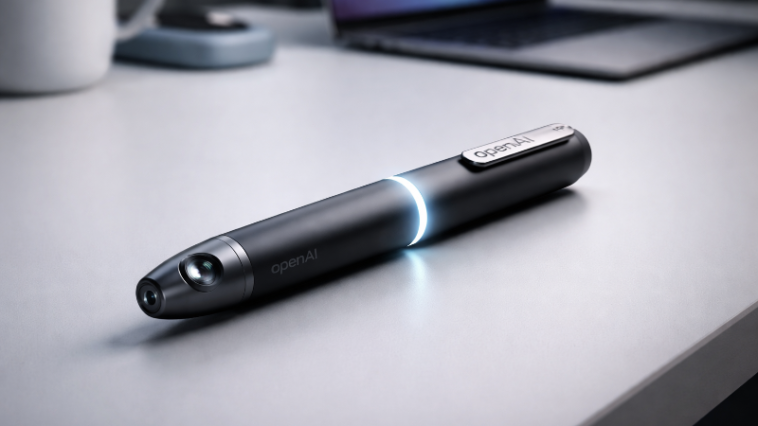
OpenAI is reportedly working on a small consumer device that doesn’t look like a phone—or much of anything else that people carry today.
The device is pen-shaped and goes by the internal name “Gumdrop,” according to Taiwan’s Economic Daily (building on earlier supply-chain leaks). People familiar with the project say it’s roughly the size of an old iPod Shuffle and doesn’t have a screen.
The Purported Architecture of the “Gumdrop”
As the project transitions toward large-scale production, OpenAI is prioritizing a supply chain independent of mainland China. Manufacturing plans have thus shifted to reflect these geopolitical sensitivities. OpenAI initially explored production through Luxshare in China, but later contacted Foxconn about building the device in either Vietnam or the United States.
Details about the hardware are limited, but the device is described as using cameras and microphones to take in its surroundings. It can capture handwritten notes and convert them into text, with those notes sent directly into ChatGPT. Some processing happens on the device itself, while more demanding tasks rely on cloud computing.
Although the pen isn’t classified as a wearable, it can be carried in a pocket or worn on a lanyard. It’s also designed to communicate with other devices, similar to how phones exchange data today.
The project is part of a concerted effort inside OpenAI to build consumer hardware alongside software that has, until now, been largely confined to third-party devices and web browsers. The San Francisco-based firm acquired Jony Ive’s hardware startup io Products for $6.5 billion in May 2025, bringing the former Apple design chief’s team in-house.
Ive and his design company, LoveFrom, which remains independent, now handle design responsibilities across OpenAI’s hardware initiatives, work that feels more like a tool and less like a digital distraction, and potentially challenge smartphone dominance, including the iPhone’s role as the go-to personal device.
The pen-like device is the first of those efforts to surface publicly, with a release timeframe discussed internally around 2026 or 2027.
Because the project is still in its relatively early stages, many of the details surrounding its market debut are still in flux. OpenAI still hasn’t shared public details about pricing, availability, or how the device will be sold.
Sources: WCCFtech, Economic Daily News