
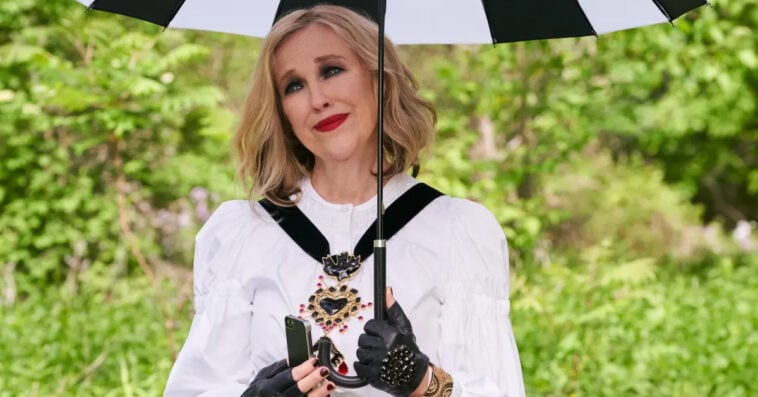
The comedy world is mourning the loss of a true legend, as Catherine O’Hara, the star who brought us everything from the frantic mom in Home Alone to the unforgettable Moira Rose on Schitt’s Creek, has passed away at 71. For over fifty years, she had a rare gift for making us laugh until it hurt, creating characters that felt like family to fans all over the world. As we celebrate her incredible journey from sketch comedy to global superstardom, we’re looking back at the surprising ways she shaped the movies and shows we love—and the one-of-a-kind legacy she leaves behind that can never be replaced.
What we know about Catherine O’Hara’s passing
Catherine O’Hara died on Friday, January 30, 2026. While her death was first reported by TMZ, it was her manager who officially shared the news with People. Her representative later confirmed that she passed away following a brief illness, though no official cause has been released.
According to reports from local authorities, emergency services were summoned to O’Hara’s Brentwood, Los Angeles, residence early Friday morning after she experienced sudden respiratory distress. Despite the quick response from medical professionals, she was pronounced dead at a local hospital shortly after arrival.
In the wake of this sudden loss, O’Hara’s family has requested privacy as they navigate their grief. She is survived by her longtime husband, Bo Welch, and their two sons, Matthew and Luke. While the family has opted for a private celebration of life rather than a traditional public wake, they have expressed their deep gratitude for the outpouring of love from the public.
The formative years of a comedy legend
Born in Toronto in 1954, Catherine O’Hara grew up in a bustling household as the sixth of seven children. Her early life was grounded in the hardworking spirit of her parents—a father who served the Canadian Pacific Railway and a mother who navigated the local real estate market. Ironically, her legendary acting career began with a silent, holy role: playing the Virgin Mary in a childhood Nativity play. However, it wasn’t until after high school that her path toward comedy truly began, starting not on the stage, but as a waitress at Toronto’s famed Second City Theater.
By 1974, O’Hara had traded her tray for a spot in the acting troupe, where she met fellow comedian Eugene Levy. This meeting sparked a lifelong friendship and a creative partnership that would eventually change the face of comedy. Despite her natural talent, O’Hara admitted to The New Yorker in 2019 that the stage was initially a source of fear for her. To cope with the pressure of live performance, she developed a unique safety net. As she put it, her go-to strategy during improvisations was to “play insane” whenever she felt stuck. This allowed her the freedom to say anything without the burden of logic or explanation.
In 1976, the troupe transitioned to the small screen with the launch of Second City Television (SCTV). As the show moved to NBC in the 1980s, O’Hara became a standout star, captivating audiences with sharp celebrity parodies of icons like Meryl Streep and Brooke Shields. Yet, it was her inventive, original characters that truly cemented her status as a fan favorite. Her work as a writer on the show earned her five Emmy nominations, culminating in one memorable win, cementing her status as a comedic force to be reckoned with.
How artistic integrity defined her career shift
When SCTV wrapped in 1984, O’Hara didn’t view the ending as a loss; instead, she saw it as a necessary evolution. By the time the show concluded, she confessed to People in 1986 that the work had become “less than fulfilling.” Having lost her initial spark for the program, she felt a pull toward personal growth, later remarking that she was eager to deepen her acting craft, build a life outside of the studio, and—perhaps most importantly—find a project that made her feel “scared again.”
This transition period led to a common misconception in Hollywood that O’Hara was intentionally stepping away from the limelight. After famously withdrawing from a stint at Saturday Night Live and declining several high-profile roles, rumors began to circulate that she was simply unwilling to work. However, she was quick to debunk that narrative. She explained that her selectivity wasn’t about a lack of ambition, but rather a commitment to quality.
“It’s not true,” she insisted to People when asked if she took a break from acting. “I read scripts and get a gut feeling about whether I want to be a part of them. Do I want my parents to see this? I’d just rather stay home than do something I know is bad and have to defend it later.”
The rise of a movie icon
O’Hara’s leap into cinema began in 1980 with Double Negative, a project that felt like a family affair alongside her SCTV colleagues Eugene Levy and John Candy. Her talent for balancing humor with edge soon caught the attention of legendary directors, leading to roles in Martin Scorsese’s 1985 dark comedy After Hours and the 1986 drama Heartburn. However, it was her 1988 performance in Beetlejuice as the eccentric, avant-garde stepmother Delia Deetz that truly made her a household name—a role she would triumphantly return to decades later in the 2024 sequel, Beetlejuice Beetlejuice.
In 1990, O’Hara took on what would become one of the most recognizable roles in film history: Kate McCallister, the frantic but devoted mother in Home Alone. Reflecting on the film’s enduring legacy in 2024, she told People that she considered it “a perfect movie.” Her decision to join the cast was a testament to her high standards; she noted that she refused to play a great character in a mediocre production. For O’Hara, the quality of the entire project was paramount, a philosophy she carried into the 1992 sequel, Home Alone 2: Lost in New York.
How a modern masterpiece sparked a global comeback
In 2015, O’Hara experienced a massive global career resurgence when she reunited with her longtime creative partner, Eugene Levy, for the hit series Schitt’s Creek. Created by Eugene’s son, Dan Levy, the show allowed the two legends to once again play a married couple.
While the series began as a quiet gem on Canada’s CBC and the U.S. Pop network, it exploded into a worldwide phenomenon once it hit Netflix. Central to this success was O’Hara’s portrayal of the eccentric Moira Rose, whose most famous accessory was a seemingly endless collection of elaborate wigs.
“I suggested, or actually begged for it,” O’Hara told WWD in 2021. “When we were all developing our characters, I said, ‘I’d like to wear a wig depending on my mood.’ It kind of scared everyone at the beginning, like ‘Wait a minute, how much work are you asking the hair department to do and how much planning is there?’ And I said, ‘No, it’s according to how she feels that day.’”
O’Hara’s transformative performance culminated in a historic sweep at the 2020 Emmys, where she took home the award for Outstanding Lead Actress in a Comedy Series. Along with her Emmy, her portrayal of the unforgettable Rose matriarch earned her both a Golden Globe and a SAG Award, solidifying her status as a once-in-a-generation comedic powerhouse.
Catherine O’Hara’s favorite role
Despite decades of unforgettable performances on stage and screen, Catherine O’Hara often reflected that her most cherished role wasn’t in a movie, TV show, or on stage. In a 2024 interview with TMZ, when asked which role she would most like to be remembered for, she didn’t name any of her legendary characters — instead, she answered simply, “Mother of my children.”