
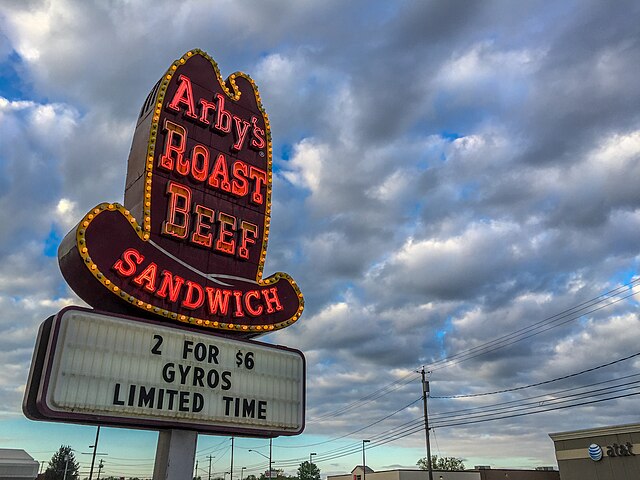
Arby’s has spent most of 2025 shrinking its footprint without saying a word about it — shedding at least 25–30 locations year-to-date on top of the 48 it cut in 2024. One by one, stores have gone dark across the country — a contraction that mirrors the wider slowdown hitting nearly every major fast-food chain.
The latest count: 14 closures across eight states, all confirmed through local reporting rather than an official announcement. These closures come on the heels of a symbolic loss last summer when Arby’s shut its 55-year-old roast beef restaurant on Sunset Boulevard — the flagship that couldn’t survive the new economics.
When the Sunset store closed in June 2024, general manager Gary Husch explained exactly why:
“The customer count has gone down over the last few years. A lot of the offices around this area are empty now, and we’re just not getting the same foot traffic we did before,” he told The LA Times.
“Grocery prices have risen tremendously due to inflation, and the $20-an-hour minimum wage was the nail in the coffin.”
That “nail in the coffin” line stuck for a reason — it summed up what a lot of restaurants were already struggling with: high labor costs, expensive ingredients, and far fewer budget-conscious customers walking through the door.
Rather than a big wave in one region, Arby’s shut stores in scattered pockets, including Tennessee, California, Florida, Delaware, Maryland, New Jersey, Washington, and South Carolina. A handful in each place, the kind that disappear, so most people find out only when they show up to a locked door.
Tennessee and Florida each lost four stores—the biggest hits in the 2025 wave. California and Washington each lost a store while others slipped away in single-store markets, surfacing only in scattered local news reports.
A Problem Bigger Than Arby’s
Arby’s isn’t alone. Rising menu prices have pushed away the industry’s core customer — low-income households. McDonald’s CEO Chris Kempczinski reportedly told investors that low-income traffic dropped by double digits, while higher-income visits rose almost as much.
Inflation and new state-level wage laws have made it even harder for chains with older buildings, smaller footprints, and thin margins. Arby’s has already been pruning locations for years. QSR Magazine says the chain dropped 48 restaurants from 2023 to 2024, and 2025 hasn’t slowed that trend.
Even after the closures, Arby’s is still a large sandwich chain with approximately 3,291 locations as of November 24. But it’s also a brand recalibrating in real time, trying to stay profitable in a consumer landscape that’s changed faster than most chains expected.
The numbers tell the story: traffic sliding, comp sales barely positive only because those who still show up are spending more per visit, and a growing gulf between menu prices and what budget diners can actually afford.
Whether Arby’s stabilizes from here or trims even more in 2026 is the open question, but the shutterings this year show just how far the industry has moved from the days when a cheap meal was actually cheap.
Sources: McDonald’s, LA Times, QSR, The Sun