
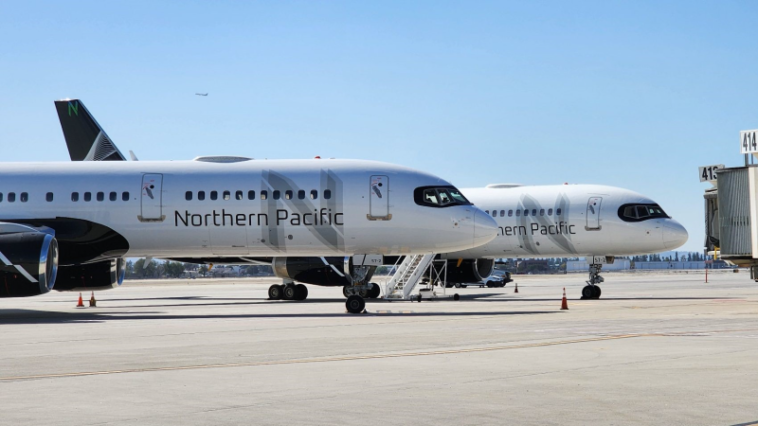
New Pacific Airlines, the Alaska-based startup that once promised to reshape transpacific travel via Anchorage, has officially shut down operations, and this time, it’s not another pivot; it’s the end.
In a recent email sent to staff, CEO Thomas Hsieh told employees, “it is with a heavy heart that I’m announcing that we will be ceasing operations today,” adding that “unfortunately, we are unable to continue to fund the losses in our business.”
He also acknowledged the team’s efforts, saying he was extremely proud of what they had accomplished together as New Pacific/Ravn Alaska, and thanked them for their “hard work, commitment, and being part of the team.”
From ambitious launch to operational reality
For anyone who followed the airline’s story from the beginning, the news isn’t exactly shocking. The only surprise is how long it managed to hang on.
Originally known as Northern Pacific Airways, the airline set out with a very specific playbook: take a fleet of used Boeing 757-200s and turn Anchorage (ANC) into a kind of mini-Reykjavík, a one-stop hub connecting cities in North America with destinations in Asia.
On paper, the model echoed what Icelandair has done for decades: operate mid- to long-haul routes with narrowbodies, run them through a geographically convenient hub, and sell stopovers and one-stop connections instead of ultra-long-haul nonstop flights.
In practice, New Pacific never got that far. Closing of Russian airspace to U.S. carriers after the invasion of Ukraine made many of the planned routings longer, more expensive, or simply unworkable. The basic economics of the plan were already tight, and with the constraints mentioned earlier, the transpacific idea effectively died before it lived.
Survival mode
Rather than folding on the spot, though, New Pacific tried to reinvent itself on the fly. In summer 2023, the airline pivoted to something completely different: a couple of U.S. domestic routes out of Ontario, California (ONT), flying a few times per week to Nashville (BNA) and Reno (RNO). The routes had nothing to do with the original Asia–North America vision, but they at least put the 757s to use.
However, the flights didn’t last long. Eventually, the carrier walked away from scheduled service altogether and moved into charter work instead. Given the 757’s flexibility and the right niche, this could have been a decent business, but by then, the airline was already dragging a lot of sunk costs and debt behind it.
After nearly a year of relative silence and no major public developments, New Pacific popped back into industry headlines only a few weeks ago thanks to a splashy partnership announcement with Maldives-based Beond Airlines.
Beond said it planned to expand globally and launch an all-business-class airline in the United States in partnership with New Pacific. Now, with just weeks into the collaboration and New Pacific gone, it raises obvious questions about how realistic that joint plan ever was.
Whether the U.S. all-business-class idea gets reconfigured with another partner or quietly disappears remains to be seen. For New Pacific, the answer is clear: there won’t be a second act.
The aftermath
The shutdown has left a small fleet of Boeing 757-200s that will almost certainly find new homes in charter or cargo work. It also leaves a group of employees now out of work, some of whom previously lived through turbulence at Ravn Alaska—a related regional carrier that ceased operations in early August 2025—before this latest venture.
The closure also serves as a cautionary tale about how hard it is to build a long-haul carrier around a clever route map without rock-solid fundamentals behind it.
The idea of using Anchorage as a modern connection point between North America and Asia has tempted more than one management team over the years. New Pacific tried to make that idea feel fresh again, layered on branding and ambition, and still couldn’t outrun basic constraints: airspace, fuel, demand, and timing.
In the end, the airline’s final message to staff said it all: it simply “could not continue to fund the losses.”
Source: One Mile at a Time