
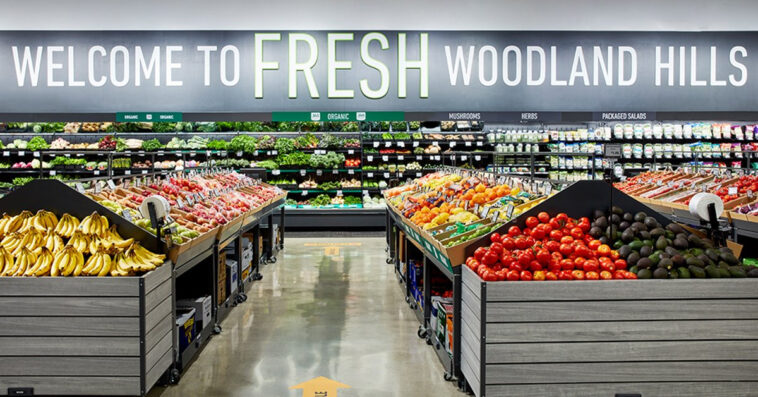
Amazon is closing the doors on all its Amazon Fresh and Go stores, leaving shoppers and industry watchers wondering: Is this the end of its grocery experiments, or the start of a bold new strategy?
Why Amazon is exiting its physical grocery stores
On January 27, Amazon announced that it is ceasing the operations of all 57 Amazon Fresh stores, along with the remaining 15 Amazon Go locations. The move marks the end of the company’s five-year effort to carve out a presence in the conventional supermarket space, which began with the opening of the first Amazon Fresh store in Woodland Hills, California, in 2020.
Despite expanding Amazon Fresh to dozens of locations since then, Amazon struggled to draw shoppers and compete with established grocers. In early 2023, the company paused further growth of the chain to explore ways to better differentiate its stores and improve financial performance. Executives admitted that the company may have moved too quickly in its push to capture market share from more seasoned competitors.
“There are some clear fundamentals that every grocer needs to get right. And we need to improve on that,” Claire Peters, then-vice president of retail for Amazon, remarked during a tour of the Woodland Hills store in 2023.
Amazon attempted to revitalize the Fresh stores by expanding product selections, refreshing store décor, emphasizing low prices, and highlighting technology-driven features like Dash Carts. Still, Tuesday’s announcement confirmed that the company was unable to turn Amazon Fresh into a sustainable, large-scale supermarket chain. “We haven’t yet created a truly distinctive customer experience with the right economic model needed for large-scale expansion,” Amazon stated.
Meanwhile, Amazon Go convenience stores, launched in 2018, aimed to redefine the convenience store experience with its “Just Walk Out” technology, allowing customers to pick up items and leave without stopping at a checkout. While the concept never achieved the traction needed for broader expansion, the technology itself has thrived: Amazon has licensed Just Walk Out to over 360 third-party locations, including sports arenas, where speedy service is critical.
Amazon shifts focus to Whole Foods and online grocery delivery
As it winds down its physical Fresh and Go stores, Amazon is redirecting its focus toward growth areas with proven potential, including online grocery delivery and Whole Foods, where established business models and prior successes give the company a solid advantage.
Both segments have demonstrated scalability. Since Amazon’s 2017 acquisition, Whole Foods sales have grown by more than 40%, and with 550 locations currently, the company sees an opportunity to add over 100 new stores in the coming years, including small-format Whole Foods Market Daily Shops. Whole Foods is also experimenting with store-within-a-store integrations with Amazon, further blending the online and in-store experience.
Some of the closing Fresh and Go locations will be repurposed into Whole Foods stores, while the Daily Shop concept continues to expand, with plans to open five additional locations by the end of 2026.
Meanwhile, customers can still access Amazon Fresh online, with the company emphasizing its same-day perishable grocery delivery service, which is set to expand to more communities throughout 2026. Already available in over 5,000 communities, Amazon highlighted that its grocery business has generated more than $150 billion in gross sales, underscoring the scale and growth potential of its delivery-focused strategy.
Will Amazon-branded physical stores return?
“While Fresh and Go will no longer form part of Amazon’s grocery ambitions, this should not be taken as a signal that Amazon has given up on the category. Nor does it mean that Amazon has failed in grocery,” GlobalData Managing Director Neil Saunders wrote in emailed comments. “In our view, in one way or another, Amazon’s physical grocery mantra is: we’ll be back.”
Sources: Retail Dive, Forbes