
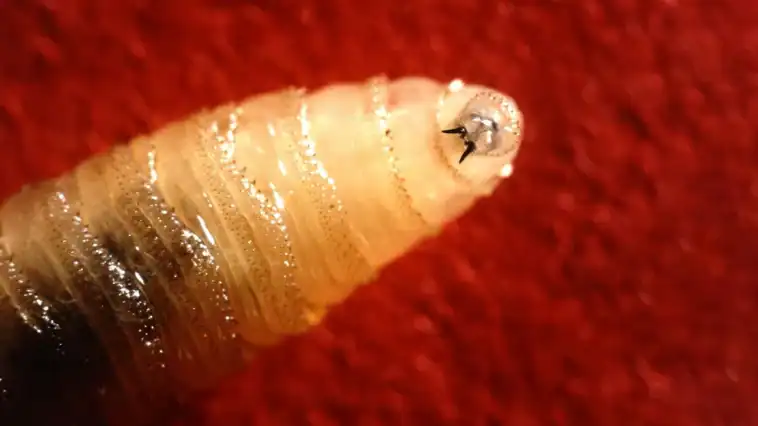
The U.S. already got rid of this nightmare once. Now, the New World screwworm is moving north again and it has a particularly horrifying way of feeding. New World screwworm is a parasitic fly whose larvae feed on living flesh.
And after disappearing from the United States for decades, the pest has now reached Texas and New Mexico, raising concerns for livestock, wildlife, pets and, in rare cases, people. Here is all we know about the situation.
There is now a dashboard for the parasite
Researchers at the University of California San Diego and the County of San Diego Health and Human Services Agency have built a new tracking dashboard that estimates screwworm risk across U.S. counties. Think of it as a weather map, except instead of telling you whether to grab an umbrella, it is trying to show public health officials where a flesh-eating parasite might be heading.
The tool combines confirmed screwworm detections with environmental conditions that could favor the fly and its larvae. It also pulls in news reports, which is one of its more unusual features. For now, the dashboard is restricted to public health officials and project partners. The researchers hope to eventually release a version for the public.
Screwworm is so nasty
Female screwworm flies lay their eggs in open wounds or natural openings in animals. Once the eggs hatch, the larvae burrow into the surrounding tissue and start eating living tissue. As the larvae continue feeding, wounds can become larger and deeper, leaving animals vulnerable to serious secondary infections. Untreated infestations can cause severe injury and death.
Humans can get infected too, although such cases are uncommon.
And despite the alarming name, this is not something that spreads from person to person like COVID-19. The larvae have to enter through a wound or mucous membrane, where they need to be removed quickly to prevent further tissue damage.
The parasite can also travel well, according to the researchers. Adult flies can fly miles while searching for hosts, while infected livestock, pets, birds and wildlife can potentially help move the parasite into new areas.
America has beaten this thing before
The U.S. had dealt with screwworm for the first time. Back in the 1950s, infestations were causing enormous losses for livestock producers. In the Southwest alone, the pest was estimated to cause $50 million to $100 million in damage every year.
Then came one of the most impressive pest-control operations in history. Officials used something called the sterile insect technique. Basically, huge numbers of male flies were sterilized using radiation and released into the wild. When those sterile males mated with wild females, the females produced no viable offspring. Repeat that on a massive scale and the population starts collapsing.
The campaign eventually eliminated New World screwworm from the United States and pushed its range south to Panama.
The comeback fight is already underway
The U.S. Department of Agriculture is leading the current eradication effort, combining sterile insect releases with pesticides and quarantines intended to limit animal movement. Officials are also seeking Environmental Protection Agency approval for a genetically modified, all-male strain that’s being tested in the field.
Meanwhile, UC San Diego researchers are working on genetic technologies that could eventually give officials more ways to control or eradicate the parasite.
The new dashboard is part of a larger UC San Diego initiative called Resilient Shield, a CDC-funded center focused on helping public health agencies build tools for emerging threats.
The idea is for public health agencies to be able to bring researchers an actual problem so they can build the technology around it instead of researchers sitting around guessing what the agencies might need. That has already included work on influenza tracking. The same infrastructure can pull together information about human disease, livestock, weather, environmental conditions, health records and other signals.
Sources: Science Daily, Devdiscourse