
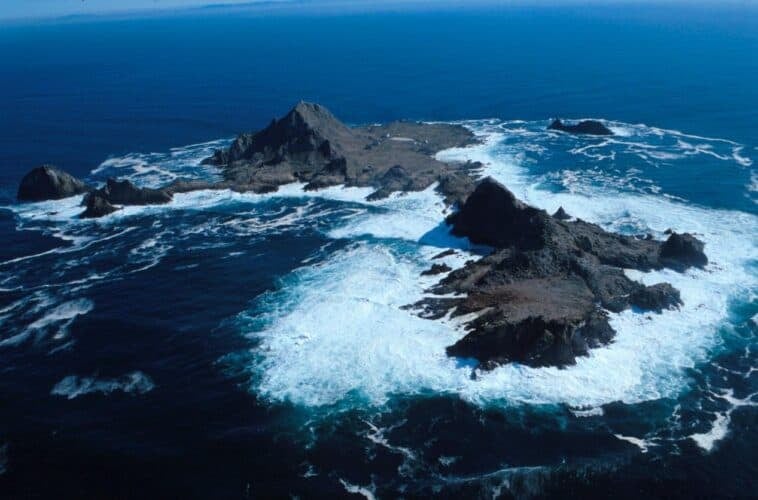
Approximately 47,800 containers of radioactive waste are sitting on the ocean floor off San Francisco. No salvage operation has ever been mounted to retrieve them, though limited surveys and sampling have occurred.
Ships dumped the barrels between 1946 and 1970, carrying them 25 to 60 miles offshore and tipping them over the side. Most were 55-gallon steel drums weighted with concrete, built for a one-way trip. Declassified records and government reviews said as much. The drums only had to hold together long enough to sink. After that, the ocean was supposed to take care of it.
The waste was officially labeled low-level by the Atomic Energy Commission (AEC) at the time, a leftover category that covered everything that wasn’t high-level or transuranic, including broken glassware, ash, dead lab animals, and equipment that had spent too long near a reactor.
Even with leaving tritium out of the tally, the material still carried roughly 540 terabecquerels of radioactivity (about one-thousandth the atmospheric release estimated from the Fukushima Daiichi accident). Worse still, a detailed isotope breakdown was never recorded.
Through the ’40s and ’50s, crews navigated by dead reckoning. Nothing required them to write down where a drum actually landed while the Navy handled most of the disposal for the AEC and kept almost no paperwork on its Pacific runs.
The drums ended up scattered across roughly 1,400 square kilometers of seafloor, anywhere from 100 to more than 2,000 meters down. Much of that ground now sits inside the Greater Farallones National Marine Sanctuary (formerly Gulf of the Farallones), established in 1981, eleven years after the last barrel went in.
Revisiting the wreckage
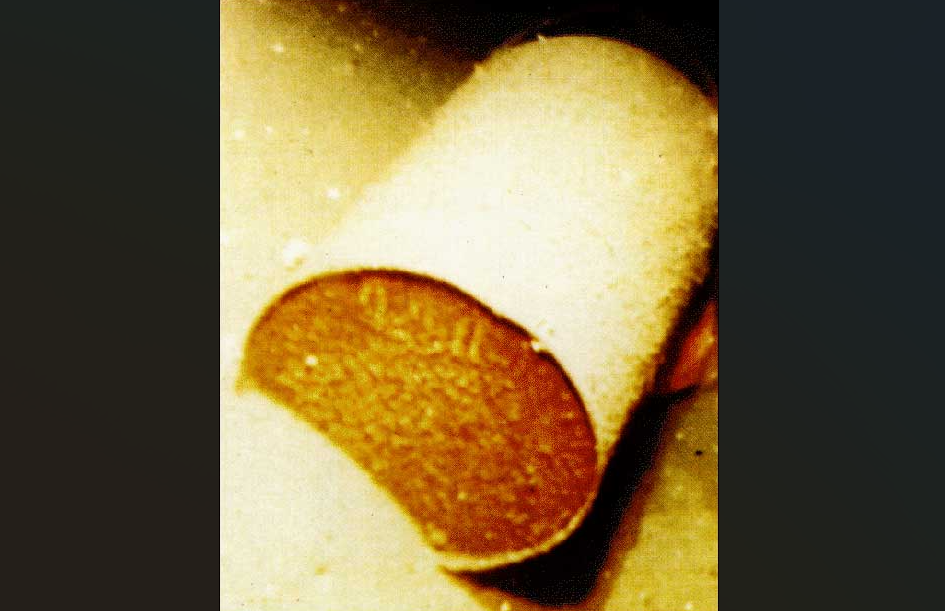
Sonar picked up barrel-shaped objects in 1990, and when the Navy submersible Sea Cliff went down in 1994 to verify them, crews found a mixed graveyard. While some drums sat there intact and untouched, others had rotted into a smear of rust and concrete on the mud.
Yet, officials have stayed calm about it for decades.
A comprehensive 1981 General Accounting Office review surveyed more than thirty scientists and concluded that public anxiety was much more than the evidence justified, estimating that 90 percent of the radioactivity had already decayed.
A 1996 study came along and challenged this view. Researchers writing in the peer-reviewed journal Health Physics found anomalous isotope ratios in fish and mussels collected near the Farallon dump sites that didn’t match ordinary weapons fallout. The projected health risk from eating the fish still came out small, and a follow-up paper in the same journal pushed back, disputing whether the drums were responsible for the contamination at all.
In fact, the most durable hazard on the seafloor may not be radioactive at all. Alongside the nuclear waste, industrial quantities of cyanide, mercury, and beryllium were tossed into the same water.
Even before the 1996 fish study, an independent panel in 1980, convened by the Oceanic Society, had already set out to prove that the barrels were a radiological hazard but came up short and ended up telling regulators to worry about the toxic chemicals instead.
But no cleanup ever followed. Then a worldwide ban on dumping radioactive waste at sea took effect in 1994. It didn’t require anyone to retrieve what was already down there since attempting to hoist rotted barrels risks spilling both chemicals and isotopes into the water column.
The current approach, therefore, is simple. Leave the drums alone and keep watching.
Sources: USGS Open File Report, GAO Report, Karl et al. 1994, PubMed, National Marine Sanctuaries, IAEA, USGS Fact Sheet, The Daily Spin