
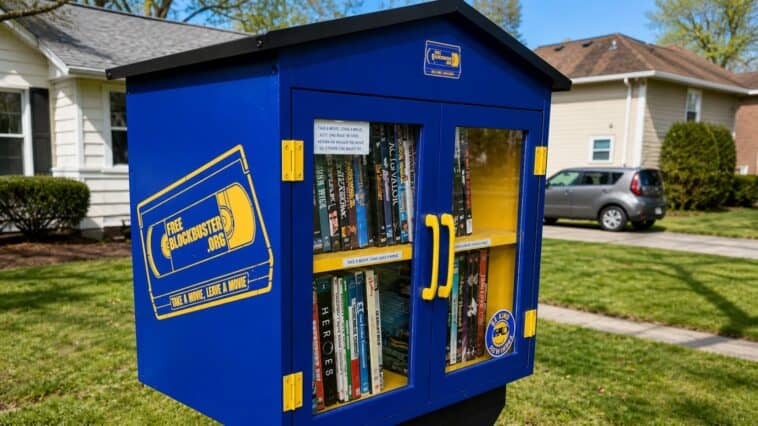
We’ve officially hit the point where digital convenience has morphed into digital exhaustion. Monthly streaming bills keep piling up, licensing disputes swallow our favorite shows overnight, and navigating five different apps just to find something decent to watch feels more like homework than relaxation.
Enter a surprisingly resilient solution, a rogue revolution that is bringing physical movie borrowing back to over 200 neighborhoods around the world.
Reclaiming the lost joy of physical media
If you walked past a repainted, bright-blue-and-yellow newspaper dispenser sitting on a sidewalk in London, Mexico, or Minnesota today, you’d be looking at a “Free Blockbuster.”
The movement kicked off back on February 27, 2019, thanks to former Blockbuster employee and VHS enthusiast Brian Morrison. Brian took an abandoned Los Angeles Times newsrack, gave it a splash of classic Blockbuster blue-and-yellow paint, stuffed it with physical media, and left it out for the neighborhood.
Among the very first borrowers was screenwriter Andrew Kevin Walker, the mind behind iconic films like Seven and Sleepy Hollow.
The boxes are thoughtfully placed in high-foot-traffic areas like shopping strips, transit stops, or right near a volunteer’s home. As one founder explained, the goal is to combat the “myth of scarcity” by distributing free entertainment as widely as possible.
What it offers
These boxy neighborhood hubs rely on the ultimate low-tech honor code: pick out a movie, drop off one of your own, and enjoy. You don’t even have to create logins and passwords. The best part? There are zero algorithms trying to analyze your behavioral data to push an annoying sponsored blockbuster.
Instead of endless scrolling, you get the tactile thrill of actually flipping through plastic cases. Local boxes end up stacked with an unpredictable mix of DVDs, Blu-rays, retro VHS tapes, and occasionally even old hardware like VCRs and DVD players donated by neighbors.
A quiet rebellion against digital ownership
What makes this movement so fascinating isn’t just nostalgia. It’s basically a direct response to the “you will own nothing and be happy” reality of the modern internet.
When you buy or bookmark a film on a digital platform, you don’t actually own a copy. You are simply renting permission to stream it until a licensing contract quietly expires behind the scenes.
Physical media, on the other hand, belongs to you forever. Once a movie is printed on a disc or a tape, no media conglomerate can reach into your living room and delete it.
That desire for permanence is why these miniature micro-libraries have expanded from a single box in Los Angeles to an international web across six countries, popping up everywhere from Alaska to the UK.
200+ locations and counting
What started with a single newsrack in Los Angeles has officially exploded into an international analog phenomenon. Organizers and local reports confirm that over 200 Free Blockbuster boxes now exist worldwide across six countries, including the U.S., Canada, the U.K., Mexico, and Australia.
You can find some of these little and exciting blue-and-yellow boxes in places like:
- The Twin Cities
- North Carolina’s Triangle region
- Louisville
- Anchorage
- Valley Stream, NY
Because the network is decentralized and not every single box gets registered on the official interactive map, the real total is likely even higher.
Sidestepping the corporate giant
You’d think a giant corporation like Dish Network, which still owns the official Blockbuster trademark, would immediately unleash an army of lawyers to shut down hundreds of unofficial boxes using their iconic color scheme.
Surprisingly, that hasn’t happened. While DISH did not shut down the project, it demanded Free Blockbuster stop using its logo. The demand forced the organization to request a license, and consequently, the organization redesigned its logo around a rewound VHS tape to avoid infringement.
With only one single “official” Blockbuster store left standing in Bend, Oregon, the corporate rights holders seem completely content letting this grassroots movement keep the brand’s spirit alive on major street corners.
How to Join the neighborhood resistance
The best part about this whole phenomenon is that anyone can participate without needing a suit-and-tie stamp of approval.If you want to turn your local curb into an analog movie hub, all it takes is tracking down an old newsrack, slapping on some blue and yellow paint, and loading it up with whatever forgotten physical media is sitting in your attic.
You can register your newly minted box on the official community map, and just like that, you’ve carved out a tiny, algorithm-free sanctuary for movie night right in your neighborhood.
Sources: Gadget Review, The Free Blockbuster Project, Boise State Public Radio