
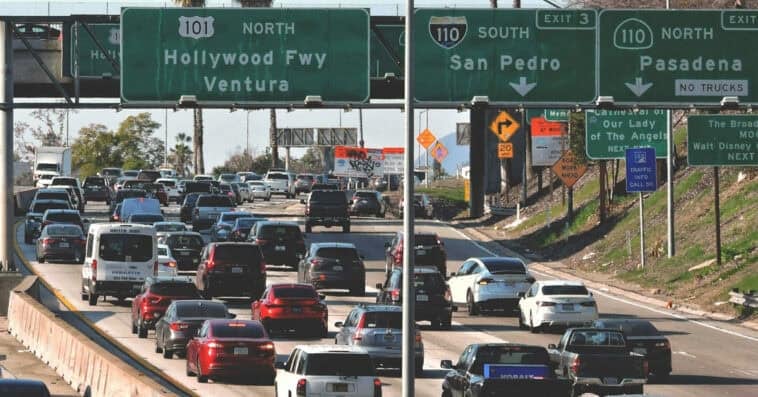
What if simply leaving your car parked could put hundreds of dollars back in your pocket? That’s exactly what Los Angeles is offering through a program that pays eligible commuters up to $600 for changing how they travel. Designed to encourage residents to rely less on personal vehicles, the initiative could reward thousands for making a simple shift in their daily routines. Here’s how the program works, who qualifies, and what participants need to do to claim the cash.
A bold experiment in traffic-choked LA
For decades, personal cars have reigned supreme in Southern California. But as gridlock worsens, transit officials are testing a radical question: What if the key to clearing the freeways isn’t building more lanes, but directly bankrolling a change in habits?
Enter Phase 2 of LA Metro’s One Car Challenge, an ambitious pilot program offering up to $600 to Los Angeles County residents who willingly bench at least one household vehicle for five full weeks. Instead of reaching for their car keys, participants are encouraged to navigate the city by bus, light rail, bicycle, on foot, or via rideshares.
The initiative marks a massive scale-up from a modest 2023 trial in Santa Monica, which involved roughly 300 multi-car households. This time around, Metro is casting a much wider net — targeting approximately 2,000 households countywide and opening eligibility to single-car households for the very first time.
How the One Car Challenge works
To cash in, drivers can’t simply take the agency on its word. Participants must be at least 21 years old and agree to let technology keep them honest. Travel routines and vehicle mileage are continuously monitored using the GoCarma smartphone app, which automatically records trips to verify that the target vehicle remains parked. Those who complete the five-week hiatus stand to walk away with the full $600 payout.
The $2 million expansion is backed by a Regional Early Action Planning (REAP) grant provided by the Southern California Association of Governments. For Metro, the financial investment is a small price to pay if it yields actionable data on how to permanently curb solo driving, reduce carbon emissions, and ease the region’s legendary traffic bottlenecks.
Early results showed promising changes
Preliminary results suggest that money really does move the needle. Data gathered from the initial Santa Monica trial proved that financial rewards can disrupt deeply ingrained driving routines.
“The pilot showed a significant behavioral shift away from solo car trips, with the most notable increases seen in walking and micromobility,” Metro said in a statement to Spectrum News 1. “Data tracked during the initial phase revealed that participants were 2.6 times more likely to avoid driving an extra vehicle, resulting in a documented 16.16% increase in walking, biking, and public transit utilization.”
With the 2028 Los Angeles Summer Olympics looming on the horizon — and millions of international visitors expected to strain local infrastructure — transit leaders are using this expanded study to determine if cash incentives could serve as a permanent weapon against gridlock and help shape future regional policy.
Public reaction is mixed
Despite the promising statistics, the program has sparked a lively debate online, highlighting a stark divide between those eager for extra cash and commuters frustrated by local transit limitations.
For residents who already live close to their workplaces, the challenge feels like free money for virtually zero effort. However, critics argue that no cash incentive can compensate for the massive time drain of switching to buses or trains, noting that a quick 15-minute drive can easily turn into a 45-minute bus ride — or take up to two hours to travel 10 miles. Still, regular riders were quick to push back against the online cynicism, claiming that many of the harshest critics rarely use the Metro system and overestimate its drawbacks.
How to sign up
Residents interested in joining the One Car Challenge can register at metro.net/onecar.
Source:
New York Post