
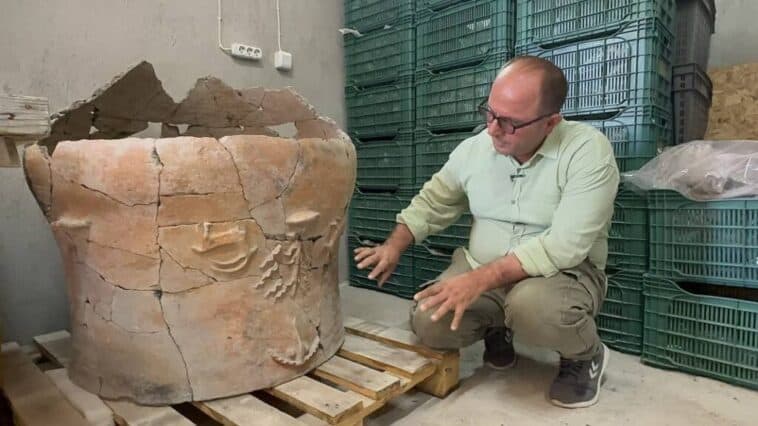
Archaeologists digging at Gökhöyük, an ancient prehistoric settlement in central Turkey, have stumbled upon a 5,000-year-old clay jar that is leaving experts completely puzzled.
Discovered right at the center of the prehistoric settlement near Seydişehir in Konya province, this giant jar doesn’t look like your typical Bronze Age kitchenware. This artifact’s unusual decorations and placement are making researchers look closely at its backstory.
A massive vessel with unique artwork
This ancient jar, which scientists believe gives us a glimpse into the world of communities living in Central Anatolia during the transition from the Early Bronze Age I to the Early Bronze Age II, stands about 1.2 meters tall (around 4 feet) with a mouth nearly a meter wide. It is big enough to store between 800 and 1,000 kilograms (up to a metric ton) of grain or liquid.
Despite its huge weight, it features five handles positioned around its body. The handles suggest the artifact was built to be moved when necessary.
What makes it stand out is its artwork. The body of the jar is designed with a human face featuring raised eyebrows, eyes, and a prominent nose. Right underneath the face sits a tree of life, flanked on both sides by wild goats climbing up toward its branches.
Ceremonial mystery and representation
According to excavation director Associate Professor Ramazan Gündüz of Selçuk University, this artwork likely carries deeper symbolic meaning. Gündüz believes the jar was designed as a symbol of fertility, abundance, and the continuation of life. He noted that the human figure at the top might have been viewed as a protective or creative force overseeing nature’s cycles.
The researchers do not believe the jar was used for everyday household storage. Instead, they think its huge size, designs and five handles mean it was probably used for communal feasts, seasonal rituals, or even ceremonial offerings.
A vessel deliberately buried upside down
Adding to the mystery is how the vessel was found. When the team first came across a portion of it in 2024, they noticed the jar was sitting completely upside down. Storage jars of this size were always placed right-side up to hold goods.
The upside-down position strongly indicates the jar was not simply dropped, lost, or discarded in a structural collapse. Finding it inverted strongly suggests it was intentionally buried this way to ritually decommission the vessel or mark the deliberate abandonment of the building. The ancient residents intentionally buried it face-down for a precise purpose 5,000 years ago.
A remarkably preserved piece of history
Despite sitting buried beneath centuries of accumulated sediment and dirt, the clay vessel managed to survive almost entirely intact, giving archaeologists a rare, clear look at its exterior surface.
While the jar shows signs of serious structural damage, all its designs and symbols are still clearly visible. This gives credence to the researchers’ belief that the jar was intentionally discarded.
The excavation team is conducting ongoing laboratory analysis, microscopic cleaning, and detailed comparative studies on the artifact. By examining chemical residue inside the vessel, scientists hope to figure out what the jar originally held, how it was crafted, and why it was placed face-down in the earth millennia ago.