
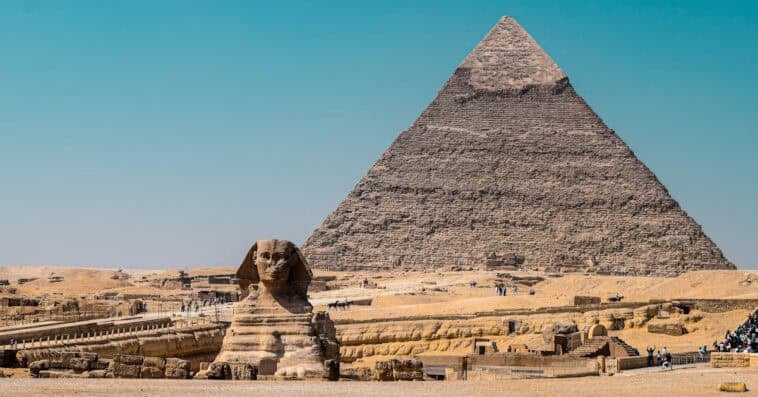
In the quiet landscape of Laconia in southern Greece lies a structure that is quietly stirring controversy among historians and archaeology enthusiasts alike — a mysterious pyramid in Vigklafia that some believe may predate many of Egypt’s most famous ancient monuments. Often overshadowed by its more celebrated counterparts in the ancient world, this enigmatic site raises difficult questions about who built it, when it was constructed, and whether its origins have been misunderstood for centuries. Nearby, an unusual Sphinx-like carving only deepens the intrigue, hinting at a complex past that has yet to be fully uncovered.
The forgotten Pyramid of Vigklafia
While Egypt is famous for its towering monuments, Greece hides a much rarer mystery: a handful of ancient pyramids that have sparked intense debate among historians. While the Pyramid of Hellinikon and the Pyramid of Ligourio in Argolis are the most recognized, many of these Greek structures remain a puzzle. Some experts believe they date back to the Classical era, while others argue they could be thousands of years older than we think.
One of the most elusive examples is the Pyramid of Vigklafia in Laconia. To the naked eye, it’s a pyramid-shaped building that has survived centuries of wear and tear. Local legends say the site was once much larger, but over the years, residents repurposed its heavy stones to build nearby storage sheds and sheep pens. Even though it has been partially dismantled, the core of this mysterious landmark still stands today.
The biggest challenge for historians is that the Laconia pyramid has never been officially excavated. Because no formal scientific study has been done, its true purpose is anyone’s guess. Was it a military watchtower meant to guard the coast? A grand tomb for a forgotten leader? Or perhaps just a secure warehouse for valuable supplies? Until archaeologists dig deeper, this ancient site remains one of the Mediterranean’s best-kept secrets, leaving us with more questions than answers.
The ‘Sphinx’ of Laconia: a natural formation or ancient masterpiece?
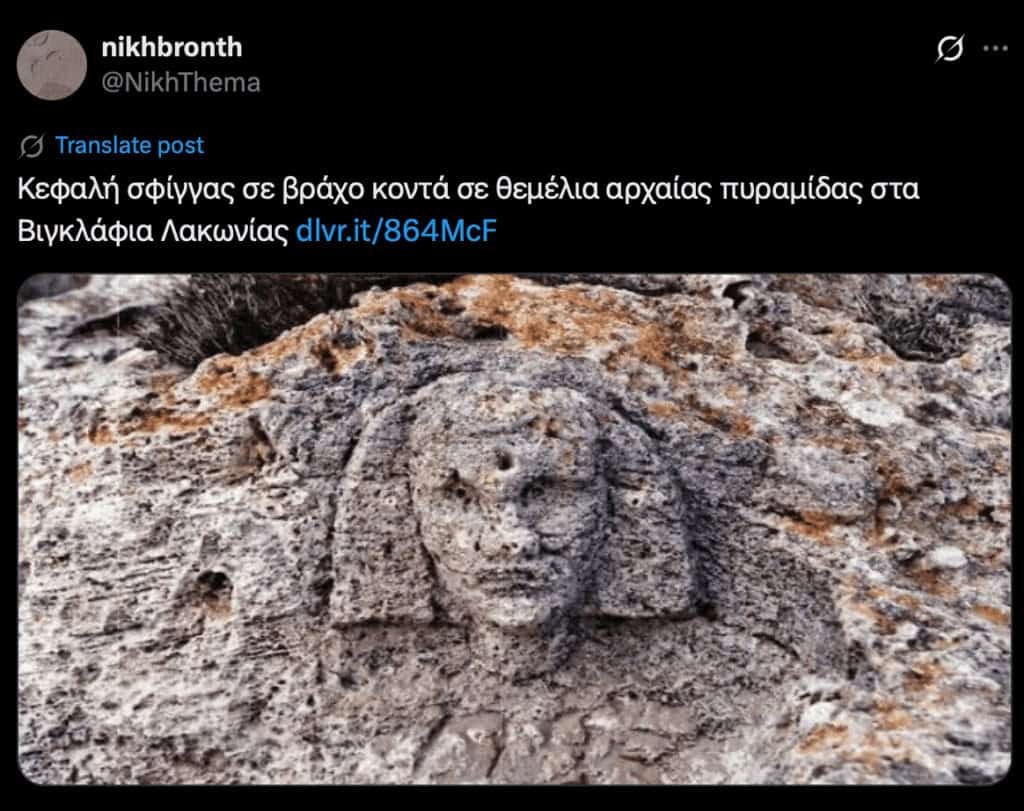
Alongside the mysterious Pyramid of Vigklafia lies another puzzle: a weathered rock formation known as the “Sphinx” of Laconia. This ancient shape appears to rise directly out of the natural bedrock. While centuries of wind and rain have smoothed its edges, many onlookers believe they can still trace the outline of a legendary guardian — the same mythical creature often seen in classic Greek art.
What makes this find so unusual is that Greek sphinxes are almost always small. Typically, they appear as elegant paintings on pottery, intricate carvings on temple walls, or modest handheld statues. Finding a massive figure carved directly into a landscape is practically unheard of in the ancient Greek world, leaving experts to wonder if this “Sphinx” is a rare masterpiece of early engineering or simply a trick of nature.
The race to study the Vigklafia pyramid and Laconia’s ‘Sphinx’
The planned construction of a nearby power plant has recently thrust these ancient enigmas back into the spotlight. While the project doesn’t directly threaten the ruins, the arrival of modern industry has sparked a heated debate among locals who want to protect the area’s historical charm.
What makes the Vigklafia pyramid so significant is its sheer scale. It is actually one of the largest pyramidal structures in Greece, dwarfing the famous Pyramid of Hellinikon and ranking second only to the massive Amphion site in Boeotia.
Beyond its size, the pyramid’s design is what truly baffles researchers. Measuring approximately 57 by 52 feet, it is surrounded on three sides by a deep trench. Some believe a retractable bridge once served as the only entrance, suggesting this wasn’t just a monument, but a high-security fortress. While scattered pottery suggests people were active here around 2,500 years ago, many suspect a full scientific dig would prove the foundation was laid much earlier.
Time hasn’t been kind to the site; many of its massive blocks were recycled into local barns, and erosion has chipped away at the southern cliffside. These layers of damage make a formal investigation essential to piece together the original blueprint. Until then, the site remains an open-air mystery, inviting travelers to wander the ruins and speculate on what—or who—this massive stronghold was built to protect.
Source: Greek Reporter