
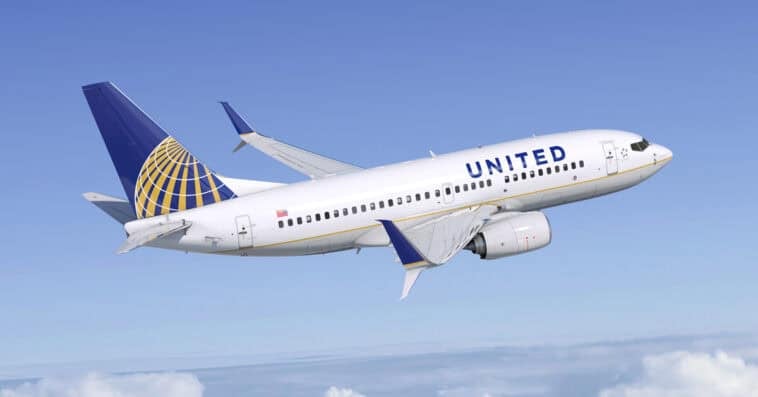
What should have been a smooth landing quickly turned into a tense and puzzling moment in the skies above San Diego, as a United Airlines pilot reported striking a “small, red, shiny” object during the aircraft’s final descent. The brief encounter happened at around 3,000 feet — a critical phase of flight where even the smallest disruption can carry serious risks. While the plane landed without incident, the question remains: was it really a drone, and how did it get so dangerously close to a commercial jet?
The midair encounter
A routine morning flight from San Francisco turned into a federal investigation on Wednesday after a United Airlines crew reported a midair collision with a suspected drone during their descent into San Diego.
United Flight 1980, a Boeing 737 that departed the Bay Area at 6:53 a.m., was less than 10 minutes from touchdown when the cockpit crew alerted the tower to a potential strike. The incident occurred at approximately 8:28 a.m. while the aircraft was cruising at 3,000 feet—an altitude far exceeding legal limits for most civilian unmanned aircraft.
According to air traffic control recordings, the pilot reported the impact occurred on the “base leg” of the approach, a critical phase where the plane flies perpendicular to the runway before its final turn.
The ‘shiny red’ mystery
When ground control pressed for a description of the object, asking for “approximate size or how many engines or style,” the pilot was unable to provide technical specifics but offered a distinct visual.
“It was so small I couldn’t tell,” the pilot responded. “It was red … it was shiny.”
The report was not entirely unexpected by the crew. Minutes before the suspected impact, the pilot had radioed SoCal Approach to ask if any drones were authorized in the vicinity. After the controller responded, “Not that I’m aware,” the pilot warned: “I believe I just saw like a red small object … about 1,000 feet below us to our right.”
Official statements
While the Federal Aviation Administration (FAA) and United Airlines have confirmed the sighting, the actual physics of the collision remain under review.
The FAA clarified the timeline, noting that “while approaching San Diego International Airport at about 4,000 feet altitude, the crew of United Airlines Flight 1980 told air traffic control they believed they saw a drone 1,000 feet below them.”
But was there really a collision? United Airlines stated that while the crew reported a “potential drone prior to arriving in San Diego,” they have not yet officially confirmed a physical strike.
The aftermath
Following the reported midair encounter, United Flight 1980 completed its landing at San Diego International (SAN) at approximately 8:45 a.m. Despite the pilot’s report of a strike, the Boeing 737 taxied to the gate without assistance, allowing all 48 passengers and six crew members to deplane as scheduled.
Maintenance findings
The aircraft was immediately grounded for a specialized safety review. However, the search for impact evidence yielded no results:
Zero damage: Maintenance technicians performed a comprehensive inspection of the fuselage, engines, and wings, finding no physical evidence of a collision.
Return to service: The aircraft was cleared for flight shortly after, departing San Diego at 10:16 a.m. and completing a successful cross-country leg to Houston that same afternoon.
Investigation and airspace monitoring
While the pilot was certain of the encounter, the object appeared to be a solitary intruder. The FAA confirmed that although “air traffic control alerted other pilots,” the agency “did not receive any additional drone-sighting reports” from other aircraft in the busy San Diego corridor.
The Federal Aviation Administration is currently leading an investigation to determine if a drone was indeed operating illegally at 3,000 feet. As of now, the “red, shiny” object remains unidentified, and no operator has come forward.
Airspace regulations and drone restrictions
The sky above major airports is a highly controlled environment, governed by strict federal safety mandates designed to separate manned aircraft from unmanned systems. In 2026, the FAA has significantly intensified enforcement, shifting from a “compliance first” approach to immediate legal action for high-risk violations.
Under standard FAA regulations, drone operations are subject to a rigid ceiling:
The 400-foot rule: Pilots are strictly prohibited from flying drones above 400 feet (AGL) unless they hold specific, prior authorization from the FAA.
Airport exclusion zones: Operating near flight paths or within several miles of major hubs like San Diego International is generally forbidden. In these sensitive zones, altitude limits are typically capped at zero, meaning all drone activity is barred without a federal waiver.
Operating a drone at 3,000 feet — as reported in the United Flight 1980 incident — represents a severe breach of federal law.
In 2026, the stakes for illegal flights have never been higher. Violators can face civil penalties reaching $75,000 per incident, the immediate seizure of their equipment under the SAFER SKIES Act, and potential federal criminal prosecution for endangering a commercial airliner.
As air traffic grows more complex, the FAA continues to warn that “the legality of drone flight rarely stops at the pilot’s controller.” Any operator found bypassing software “geofencing” or ignoring altitude caps risks life-altering fines and jail time.
Sources: The Los Angeles Times, FOX Business, FOX 5 News