
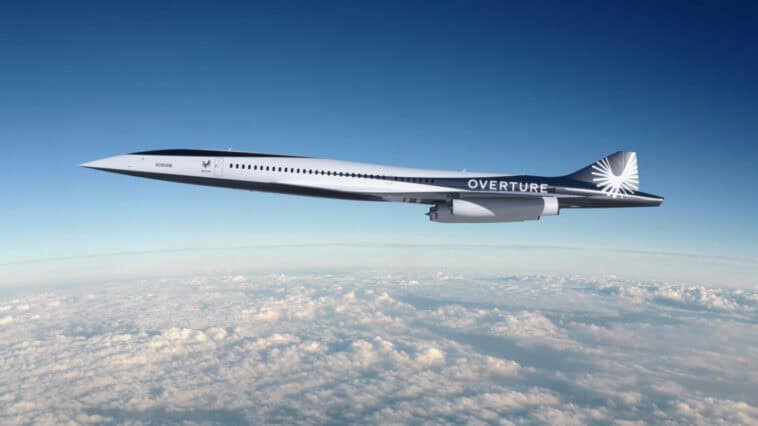
Boom Supersonic could begin production of its Overture passenger jet within the next two years, founder and chief executive Blake Scholl announced on Fox Business’s Varney & Co. recently.
The Colorado-based company, which has been developing the aircraft for about a decade, is expected to seat 60 to 80 passengers. The top cruise speed will be roughly 1,122 mph, according to the company. Four engines, which Boom is developing with partners (and calls Symphony turbofans), will power it.
The new jet also draws visual inspiration from its famous predecessor, the Concorde. The market it’s chasing, though, is different as the company is pitching it as a commercial airliner.
To prove the concept, a smaller demonstrator, the XB-1, has done much of the engineering work and has been flying for a couple of years now.
Chasing a quieter Mach 1
Concorde always had one regulatory limit it couldn’t shake. The aircraft was barred from supersonic flight over land because its boom was loud enough that complaints from the ground forced its routes onto oceans.
Boom Supersonic designed the XB-1 to attack this issue. In February of last year, the demonstrator pulled off what’s called a Mach cutoff. It went past the sound barrier high enough that the boom stayed at altitude with NASA releasing imaging of shockwaves wrapping around the aircraft as it crossed Mach 1.
Last year, U.S. lawmakers moved to relax the overland supersonic ban for civil aircraft. A House-passed bill would allow such flights so long as no sonic boom reaches the ground, while also requiring the FAA to set related noise standards.
A six-decade supersonic journey
The road to reviving commercial supersonic flight has been long. Britain and France launched the original Concorde program in 1962, but the Soviet Tu-144 beat it into the air with its first flight at the end of 1968.
Concorde finally entered commercial service in 1976, while the Tu-144 was withdrawn from passenger flights just two years later (in 1978) after only 55 passenger flights.
Concorde continued flying commercially until October 2003, when British Airways and Air France retired the aircraft together, citing high operating costs and falling demand.
NASA, meanwhile, spent much of the 1990s studying a proposed High Speed Civil Transport (HSCT) under its High-Speed Research program, but the effort was canceled before any aircraft was built.
The present generation of supersonic startups began appearing in the 2000s and 2010s, with Boom currently the most prominent.
Sources: Boom Supersonic, Supercar Blondie, Fox Business