
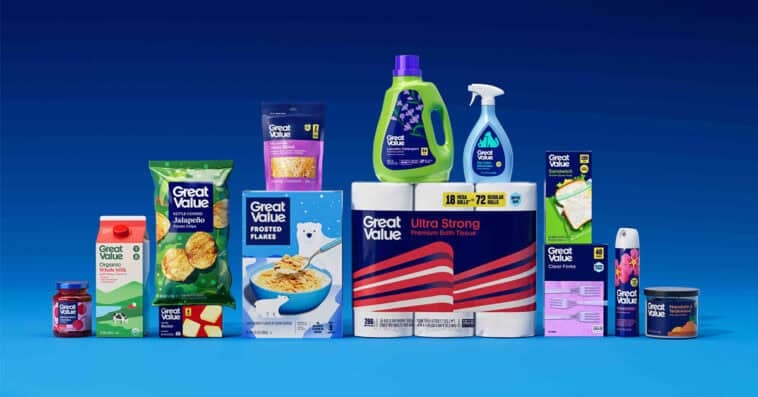
For years, Walmart’s Great Value products have quietly filled carts while wearing packaging many shoppers barely noticed — or worse, associated with being “cheap.” Now, the retail giant is finally admitting what customers have long suspected: the look didn’t match the value inside. After a decade without a major update, Walmart is rolling out a sweeping redesign aimed at transforming perception, elevating its private label, and proving that budget-friendly doesn’t have to feel low-end. But what exactly pushed this long-overdue makeover, and will a new look be enough to change how millions of shoppers see the brand?
Walmart’s bold plan to glam up Great Value
Walmart is officially shedding the “budget” aesthetic. In a massive strategic shift, the nation’s largest retailer has unveiled a comprehensive redesign of its Great Value line, marking the brand’s first major visual evolution in over ten years. This isn’t just a minor tweak; it is a monumental 18-month rollout encompassing nearly 10,000 products across 100 different categories.
The overhaul aims to fix a long-standing disconnect: customers loved the products, but they didn’t love looking at the boxes. David Hartman, Walmart’s VP of Creative Design, explained to Fast Company that the goal was to close the sentiment gap by creating “cleaner and more elevated” packaging.
Data-driven redesign
This aesthetic pivot wasn’t a guessing game. The new look is the byproduct of years of rigorous consumer research, including trials in a simulated “mock store” at Walmart’s headquarters in Bentonville, Arkansas. By walking through these physical shelf sets, designers could see exactly how the new visuals performed in a real-world environment.
Walmart also tapped into a constant stream of data from online reviews and call centers to guide its hand. “The feedback is always on,” said Tiffany Morris, Walmart’s Senior VP of Private Brands. “We’re able to aggregate it in a manner that helps us drive action.
The quality gap
While Great Value consistently earned high marks for price and effectiveness, its visual identity was lagging. The company realized that the outside of the box finally needed to reflect the quality of what was inside.
“We wanted to bring the external expression of the brand up to par to what the customer experiences when they buy the brand,” Hartman said.
Redefining value
Perhaps the most significant takeaway from this rebrand is Walmart’s newfound confidence in its market position. Morris pointed out that because Walmart has spent decades cementing its reputation as the low-price leader, the packaging no longer needs to scream “bargain” to get the message across.
“We don’t need to make things look cheap to be inexpensive,” Morris said. The new philosophy is simple: true value isn’t just about the lowest price tag; it’s about the feeling that a product is worth your hard-earned money. By balancing high-end design with the same affordable prices, Walmart is betting that Great Value can finally look as good as it performs.
The notable upgrade to Great Value’s visual appearance
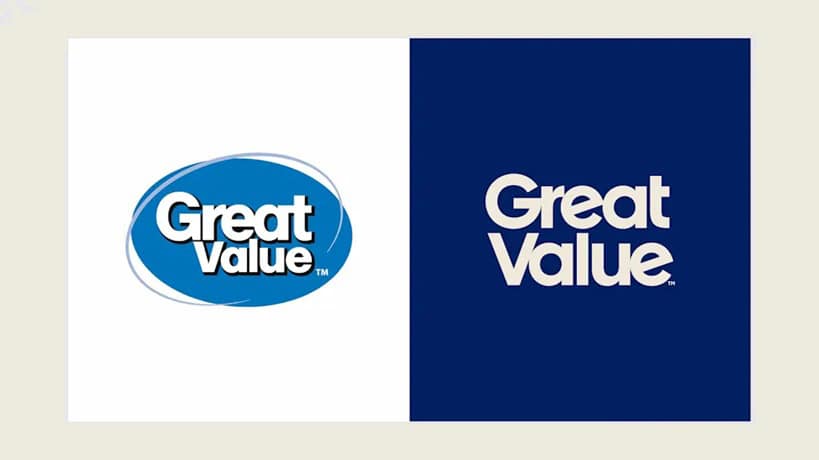
For years, Great Value’s aesthetic was a visual shorthand for “budget.” The stark white backgrounds, heavy block lettering, and utilitarian blue logo were intentional design choices meant to signal a no-frills, wallet-friendly experience. However, Walmart is now trading that generic look for a sophisticated identity developed by its internal creative team in partnership with the design agency JKR.
At the heart of this transformation is a completely reimagined logo. Set in a custom, bespoke typeface, the new mark is larger and more commanding, rendered in a deeper, more premium shade of blue that retains Walmart’s brand DNA while adding a newfound sense of authority.
The redesign features meticulous typographic refinements aimed at influencing the shopper’s subconscious. Hartman highlighted nuances like the specific alignment of the two “E’s” in the logo, which creates a subtle, interlocking shape—a design “Easter egg” that mimics the hint of a smile.
Beyond the art, the team prioritized functional clarity. In a move to streamline the shopping experience, nutrition facts have been standardized:
- Consistent placement: Key data is now anchored in the upper-right corner of all food packaging.
- High-visibility cues: A new color-coded tab system — featuring bright yellow for essential facts — helps shoppers scan for information at a glance.
- Aisle-to-app consistency: The design is optimized to be as legible on a smartphone screen as it is on a physical store shelf.
What sparked Great Value’s major makeover
The push for a new look was born from a surprising realization in customer focus groups. While shoppers loved the savings, they weren’t necessarily eager to display the products on their kitchen counters when guests arrived. There was a lingering “stigma of the generic” that Walmart felt it was time to erase.
“They want to be proud to buy Great Value,” said Scott Morris, Walmart U.S. SVP of private brands, food, consumables, and manufacturing. “They want to be proud to have it in their home, to share it with their friends and family.”
Walmart is also taking a page from the playbook of trendy, direct-to-consumer startups like Brightland, Fishwife, Fly by Jing, and Ghia. These indie brands first gained traction online through bold, artistic packaging before migrating to curated boutiques and eventually landing in major retailers. Inspired by this trend, Walmart pushed the redesign of Great Value to offer that same “shelf appeal”, attracting more affluent consumers in the process.
Early signs suggest the strategy is working. According to a 2025 survey by A&M Consumer and Retail Group, higher-income shoppers are increasingly opting for private-label items, drawn in part by packaging that looks just as polished and modern as their branded counterparts.
Source: Fast Company