
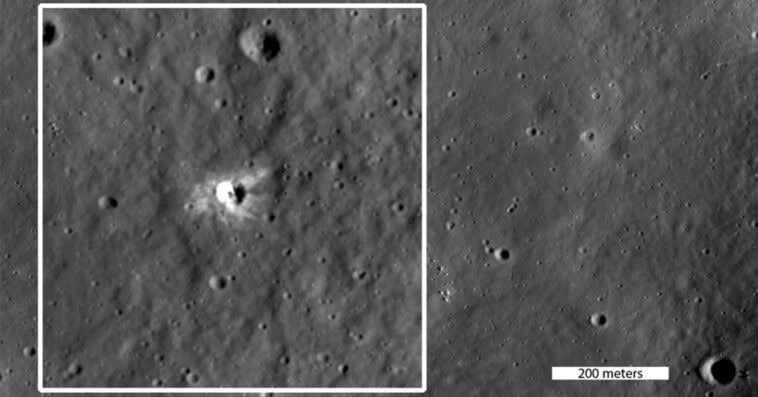
For decades, the Moon has been seen as a silent, unchanging neighbor — but a surprising discovery is challenging that idea in a big way. Scientists have identified a new 22-meter-wide crater that formed without anyone witnessing the impact, revealing itself only years later through careful image comparisons. Even more striking, the collision left behind bright streaks of debris that make the scar stand out against the Moon’s otherwise familiar surface. So, what exactly hit the Moon, and how often are these unseen impacts happening right under our noses?
Before-and-after images reveal a recent impact on the Moon
While the Moon might look like a peaceful, unchanging orb in our night sky, its surface is actually a 4.5-billion-year-old battlefield. The dark patches we call the “Man in the Moon” are actually massive scars from a chaotic era of space collisions that quieted down billions of years ago. But the bombardment hasn’t stopped; it’s just gotten smaller and stealthier.
Because space is vast and these strikes happen in a flash, catching an asteroid hitting the Moon in real-time is nearly impossible. Instead, NASA scientists play a high-stakes game of “spot the difference.” By meticulously comparing “before” and “after” snapshots from the Lunar Reconnaissance Orbiter, researchers identified a brand-new crater that didn’t exist a few years ago. By narrowing down images taken between 2009 and 2012, they confirmed that a new neighbor moved in while no one was looking.
This fresh crater is roughly 22 meters wide — about the size of a large suburban house. While it isn’t a giant by lunar standards, it is incredibly flashy. The impact was powerful enough to spray underground soil across the surface in a brilliant, sunburst-like pattern. Because this newly unearthed material hasn’t been darkened by space radiation yet, it glows with a stark, bright intensity, standing out like a fresh scuff on a well-worn floor.
Why fresh lunar craters don’t stay bright forever
The Moon’s brilliant new features have an expiration date. While a fresh impact might glow with a bright, star-like intensity today, that luster is destined to fade. This is due to a process called space weathering — a slow-motion wearing down of the lunar surface caused by a relentless barrage of solar wind, cosmic radiation, and tiny dust particles called micrometeorites.
Over thousands of years, these invisible forces chemically change the lunar soil, turning the bright, freshly unearthed material a dull, dark gray. Eventually, the spectacular sunburst rays will dim until they blend perfectly into the ancient landscape around them.
This cosmic aging process is how scientists tell a crater’s age. It’s why the Moon’s oldest scars look muted and dusty, while younger craters like the famous Tycho (formed about 108 million years ago) still boast the spectacular white streaks that we can see from Earth with a simple pair of binoculars.
Why finding new Moon craters matters
Tracking these lunar impacts is about much more than just cataloging new holes in the ground; it’s a vital part of our roadmap for exploring the stars. Every time a new crater appears, it provides a data point that helps scientists calculate the impact rate —essentially a cosmic weather report that tells us how often the Moon (and Earth) gets hit by stray rocks.
For NASA’s upcoming missions, it’s a matter of safety. Knowing the frequency of these collisions helps engineers design better shielding for spacecraft and safer habitats for future astronauts living on the lunar surface. After all, if you’re planning to build a Moon base, you’ll want to know the odds of a house-sized asteroid dropping by unannounced.
Beyond safety, watching how quickly a brand-new crater fades, researchers can fine-tune their “lunar clocks.” This allows them to look at any surface across the Moon — or even other planets — and estimate its age with incredible precision based on how weathered its features appear.
Source: Science Daily