
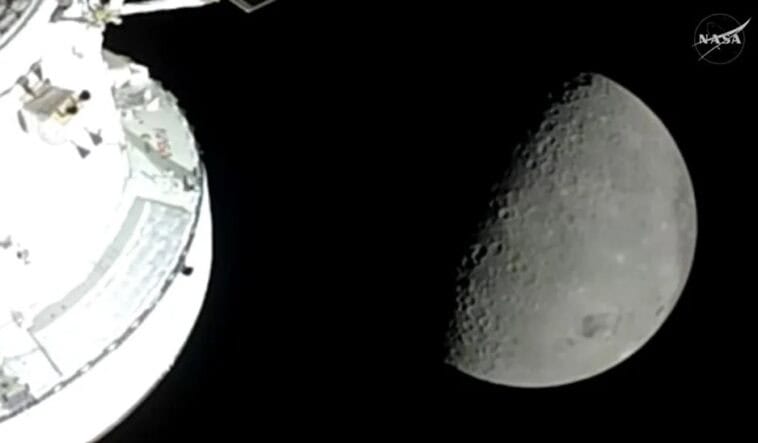
Space, the final frontier. The crew of Artemis II has just gone where no one has gone before.
Today, NASA’s Artemis II mission has officially pushed humanity farther from Earth than ever before, marking a historic milestone in deep space exploration and giving its four-person crew a view of the Moon that no human has ever seen with their own eyes.
At 12:56 p.m. CDT on Monday, April 6, 2026, six days into the mission, Artemis II surpassed the Apollo 13 record for the farthest distance humans have ever traveled from Earth. The crew, NASA astronauts Reid Wiseman, Victor Glover, and Christina Koch, along with Canadian Space Agency astronaut Jeremy Hansen, passed 248,655 miles from Earth aboard NASA’s Orion spacecraft. At the mission’s farthest point, Orion is expected to reach about 252,760 miles from Earth before beginning the long journey home.
That alone would make Artemis II a landmark mission. But this flight is doing more than breaking records. It is also giving astronauts a direct look at parts of the Moon never before seen by human eyes. According to NASA, the Artemis II crew will be the first humans to see the far side of the Moon in person and the first to travel behind it. During their closest approach, Orion will come within about 4,070 miles of the lunar surface, offering the astronauts a rare and dramatic perspective on terrain hidden from Earth by the Moon’s tidal lock.
That is what makes Artemis II feel so extraordinary. For decades, spacecraft have mapped the lunar far side in great detail, but no human being has ever looked out a spacecraft window and seen that hidden landscape directly. During the flyby, NASA says both the astronauts and a fleet of cameras will capture imagery of lunar features humans have never directly seen, while the crew also uses handheld digital cameras for high-resolution photography. NASA noted that the astronauts’ own eyes remain one of the mission’s most powerful scientific tools, helping observe illumination, texture, and geological detail in ways cameras alone cannot fully replicate.
This journey kicked off on April 1, when NASA’s massive Space Launch System (SLS) roared off the pad at Kennedy Space Center. Since then, it’s been a high-stakes sprint to the Moon. While this mission is technically a “test flight,” the stakes couldn’t be higher: these four astronauts are stress-testing the tech that will eventually put boots back on the lunar surface and build humanity’s first permanent Moon Base.
NASA officials are framing the achievement as more than a symbolic distance marker. In a statement included in the agency’s release, Dr. Lori Glaze, acting associate administrator for NASA’s Exploration Systems Development Mission Directorate, said the Artemis II astronauts are “charting new frontiers for all humanity” and helping carry forward NASA’s goal of returning to the Moon “this time to stay.”
There is also something wonderfully human about the moment. After surpassing the record, Jeremy Hansen delivered emotional remarks from Orion, honoring the astronauts who came before while challenging the next generation to make sure this new milestone does not stand for long. The crew also suggested names for two lunar craters during the mission: one in honor of their spacecraft, Integrity, and another in tribute to Wiseman’s late wife, Carroll. Those proposals will be formally submitted to the International Astronomical Union after the mission.
And Artemis II is not done making history yet. As Orion passes behind the Moon, NASA expects a roughly 40-minute communications blackout as lunar mass blocks signals between the spacecraft and Earth through the Deep Space Network. The crew is also expected to witness a solar eclipse as the Moon passes in front of the Sun another reminder that this mission is not just a test flight, but a front-row seat to some of the most remarkable sights humans can experience in space.
Artemis II is now more than halfway through its mission and is scheduled to splash down off the coast of San Diego at approximately 8:07 p.m. EDT on Friday, April 10. Recovery teams will retrieve the crew and bring them aboard the USS John P. Murtha before they return to shore.
For now, though, the lasting image is this: four astronauts, farther from Earth than any humans in history, flying behind the Moon and looking at a world few have imagined from this angle and none have ever truly seen.