
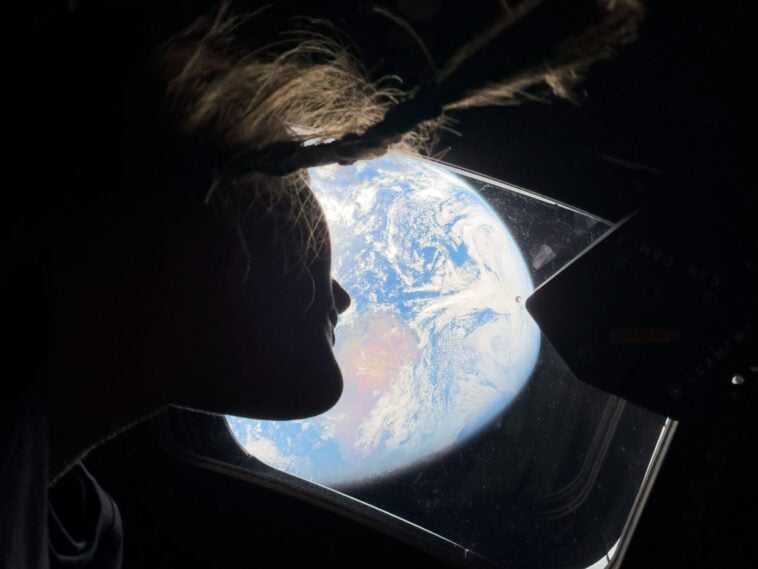
NASA’s Artemis II mission has officially left Earth orbit and is now on its way around the Moon — but not before mission control had to deal with one of the least glamorous problems in spaceflight.
Yes, before the astronauts could boldly go, NASA first had to make sure they could, well, boldly go!
After launching from Kennedy Space Center on April 1, the four-person Artemis II crew, Reid Wiseman, Victor Glover, Christina Koch, and Canadian astronaut Jeremy Hansen, spent their first day in space checking out Orion’s systems, settling into life in microgravity, and dealing with an issue involving the spacecraft’s toilet. Thankfully, the issue was fixed before Orion’s crucial translunar injection burn, restoring the crew’s “loo with a view” before they left Earth orbit behind.
And with that, humans are now heading beyond Earth orbit for the first time since Apollo 17 in 1972. That alone makes Artemis II historic.
But this mission is not just a victory lap or a nostalgia trip for the Apollo era. Artemis II is NASA’s first crewed test flight of the Space Launch System rocket and Orion spacecraft, making it a high-stakes engineering shakedown in deep space. In plain English, this is the mission where NASA proves its next-generation Moon ship can carry astronauts out there, keep them alive, and bring them safely home.
The burn that sent Artemis II to the Moon
The biggest turning point of the mission came with what NASA calls the translunar injection burn. During this maneuver, Orion fired its main engine for nearly six minutes — a carefully timed burst of acceleration that allowed the spacecraft to break free from Earth orbit and begin its outbound journey toward the Moon.
Up until that moment, Artemis II was still essentially circling Earth while engineers and astronauts checked that Orion was performing as expected. The burn changed everything. It transformed the mission from an Earth-orbit checkout into a true deep-space voyage, placing the crew on the precise trajectory needed to swing around the Moon and then head back home.
It is the kind of maneuver that sounds routine on paper but carries enormous importance. The timing, duration, and performance all have to be exact. Too little thrust, and Orion would not have the speed needed to reach the Moon. Too much, or in the wrong direction, and the spacecraft could miss its intended path. In many ways, this was the moment Artemis II truly began.
That means every part of the mission matters — from navigation and communications to power systems, manual piloting, crew performance, and yes, bathroom functionality. Space exploration may inspire poetry, but it still depends heavily on valves, seals, software, and toilets that actually work.
Artemis II is also a science mission. During the lunar flyby, the crew will photograph the Moon in high resolution and make direct observations of the surface, including parts of the far side humans have not seen up close in more than 50 years. NASA says the angle of sunlight should cast long shadows across the terrain, helping reveal crater rims, ridges, slopes, and other features in especially dramatic detail.
Beyond the views, the mission will also gather data on how astronauts and spacecraft systems perform in deep space, information that will feed directly into future Artemis missions. Those later missions are expected to take humans back to the lunar surface and help NASA prepare for the even bigger challenge of sending astronauts to Mars.
So while Artemis II may not include a Moon landing, it is still one of the most important crewed flights NASA has launched in decades. It is the bridge between the Apollo past and whatever comes next.
And maybe that is the perfect summary of Artemis II so far: a grand, inspiring leap into deep space… made possible only after somebody fixed the space toilet.
Humanity is back on the road to the Moon. Thankfully, Orion’s bathroom is too.